

 By Prof. Ujjwal Anu Chowdhury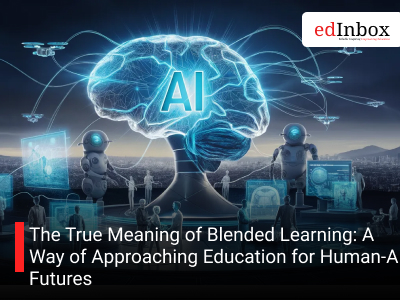
It’s time to retire that worn-out debate on higher education: classroom learning versus online learning. The debate has been a race between two camps, as if education needs to declare a winner. In truth, such framing itself is outdated. Sometimes, it may be in a late-night online module, sometimes in a heated classroom discussion, and often in an offline real-world project testing the theory.
Appropriately mixed, these ingredients make for a truly flexible, engaging, deeply human learning ecology. This would replace the passivity of lectures and the isolation of online courses with an integrated experience based on trust, collaboration, and respect for the personality of the learner. In the noisy world, in which information overflows everywhere, this is not a luxury-it’s survival for the mind.
The Learner Becomes the Driver
With blended learning, the power dynamic gets turned on its head. It’s flipped: learn the basics online and use in-person time to create, debate, code, simulate, build, and solve.
The Mentor Evolves — Not Fades
While critics fear that technology is substituting for teachers, the reality is it liberates them. Today, teachers design learning journeys, interpret data for intervention, and facilitate deep human learning experiences impossible to be supplanted by any AI. In return, their time is dedicated to what truly matters: sparking curiosity, instilling values, guiding teams, and mentoring individuals.
The Three-Part Harmony
Blended learning works because elements of the online, on-ground, and offline reinforce one another:
Online builds knowledge – the “what” On-ground builds understanding-the “so what”. Offline build application and reflection — the “now what”. This balance also protects mental wellbeing, which is acutely needed in today’s post-pandemic screen-saturated world. The Next Leap: Human + AI Blended learning is the bridge to this new frontier of the human-AI partnership in education. AI will provide personalized learning pathways, AR/VR will facilitate safe and immersive practice, while wisdom, empathy, ethics, and creativity remain the distinctly human strengths which the mentors focus on. The Editorial View The universities that will thrive will not be the ones which digitalize but the ones which humanize intelligently. Blended learning, powered by technology but anchored in human connection, is the model that shapes wiser, capable, more empathetic citizens. The question for the institutions is no longer “Should we blend?” It’s: Will we have the courage to redesign, rebalance, and rehumanize learning for the world that is rapidly approaching?
|
Discipline |
Core Blended Strategy |
Key Advantage |
Illustrative Application |
|---|---|---|---|
|
Emerging Tech |
Flipped Classroom + Virtual Labs |
Safe, scalable skill practice |
Learn AI theory via MOOCs; apply it in collaborative on-campus hackathons. |
|
Management |
Asynchronous Modules + Simulations |
Real-world decision-m aking |
Study business frameworks online; compete in live virtual business games. |
|
Wellness |
Online Theory + Mentored Practicum |
Balancing knowledge and empathy |
Learn behavior change psychology online; practice coaching skills in live, evaluated sessions. |
|
Design |
Digital Toolkits + Studio Critiques |
Global collaboration & tactile creation |
Learn software via online tutorials; engage in intensive, in-person prototyping and critiques. |
|
Sustainability |
Virtual Field Trips + Community Projects |
Bridging global data with local action |
Analyze global climate data online; design and implement a local water conservation project. |
|
Media & Comms |
Online Content Analysis + Production Workshops |
Integrating theory and craft |
Analyze narrative structures in online case studies; produce a multimedia news package in a studio. |


 Edinbox Team


Add comment