

 Miss Kanishka
Ever thought if any living organism can remember the start of its life? It’s a question that a child might ask, and an adult might answer. It’s also the question that started a scientific investigation in Kobe, Japan, where a 10-year-old boy, Jo Nagai, spent years trying to separate a fact from an illusion. When rearing butterflies, he noticed they didn’t always leave him when he released them, and occasionally returned. It happened often enough for him to wonder whether they could still remember the lives they’d lived as caterpillars.
It’s a question that scientists have asked before. The transformation from caterpillar to butterfly is so extreme that it’s hard to believe that anything could persist through it. One obvious challenge is that a butterfly hardly looks like the creature it used to be. To understand this, we can take an exam of a baby that starts to kick in the belly, has enough consciousness to suck the thumb, but can’t remember anyone or anything once born, because they lose that memory. This is exactly what scientists believed was different about the butterflies.
During the transformation (or metamorphosis, as biologists call it), the pupa’s tissues and organs are broken down and replaced with new ones. And so a new body comes into being, with wings, a different body plan, and a different way of life. Scientists have been intensely curious about this process, and not only because of its beauty.
Do butterflies remember their lives?
The question seems to have been asked long before Jo Nagai became curious. In 2008, Douglas Blackiston, Elena Silva Casey and Martha Weiss published an article about how a moth could remember a particular smell after it had become an adult.
Blackiston’s team conditioned caterpillars to associate a certain smell with an unpleasant experience. After the insects had metamorphosed into moths, they were tested to see if they still associated that smell with the unpleasant experience. The answer, it seemed, was yes. They remembered.
The study provided evidence that an ‘associative memory’ could persist after metamorphosis. But it also brought to surface an interesting question that how can such a memory persist through such a fundamental change? As far as biology is concerned, this is a fascinating mystery.
This research interested the little Japanese boy Jo Nagai. He eventually tracked down Martha Weiss, the entomologist (specialist in insect biology) who had conducted part of this research. Weiss, unsurprisingly, was keen to hear from him. And so an interesting scientific collaboration began between a university entomologist and a 10-year-old. Jo’s experiments were conducted on the Asian swallowtail (Papilio xuthus).
When the insects were still in their caterpillar form, Jo conditioned them to avoid lavender, which was associated with an unpleasant experience. Then, once they had metamorphosed into butterflies, he observed their reaction to lavender.
Most of them avoided the scent. According to reports in the media, around 70% of the butterflies tested actually avoided that smell, suggesting that they had indeed been conditioned as caterpillars. This somewhat proved that butterflies remember their lives when they were caterpillars.
The scientific answer isn’t that simple
Jo’s butterfly memory experiment results merely suggest that a learned behavioural response can persist after metamorphosis, rather than proving that a butterfly has a human-like memory of being a caterpillar. Scientists are still working on understanding just how memories and learning work in insects, and the mechanisms of memory storage and retrieval during metamorphosis.
The moth study provided evidence that these memories could be retained, if the right conditions were present. It also showed that timing was important. The caterpillars that were conditioned at a late stage retained this memory in adulthood, while those that were conditioned earlier didn’t show the same adult response.
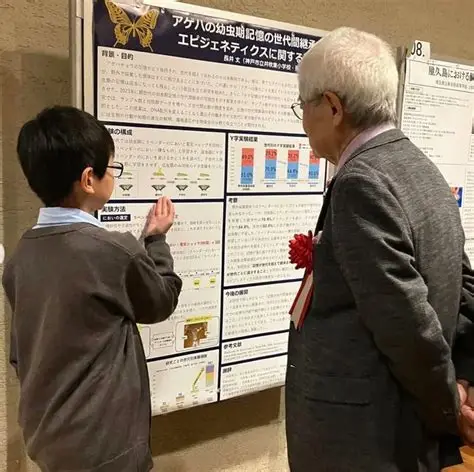
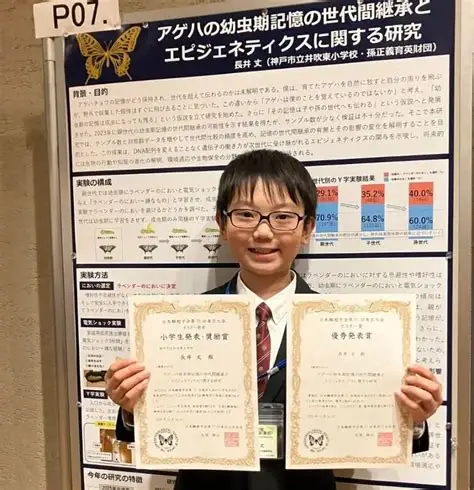
Jo Nagai’s advance research
He didn’t stop at the butterflies he’d tested. He bred some of them, and then tested their offspring and their grandchildren. According to the 2026 poster he gave at the Ecological Society of Japan, they showed the same behaviour. The poster was titled Epigenetic Transmission of Learned Larval Memory across Generations in Papilio xuthus.
This, if proved, would take the question of ‘do butterflies remember being caterpillars?’ and take it several steps further. If confirmed, Jo’s research would suggest that experiences in one generation could affect subsequent generations.
Jo’s research is remarkable but not confirmed
Jo’s research has certainly captured imaginations, but we should be careful not to mistake an interesting observation for proof of a scientific theory. In order to prove that butterflies really do “remember” being caterpillars, we need to test his findings, and confirm that any mechanism really does exist. Even the idea of an “epigenetic memory” isn’t proof of a biological mechanism. It’s a hypothesis, which requires testing.
Why butterfly metamorphosis is such a fascinating question
Butterfly metamorphosis is one of the most amazing transformations in nature because it’s a creature that emerges from the chrysalis, and looks almost unrecognisable compared to the insect that went into it. Complete metamorphosis is common among insects: the life cycle takes the form of egg, larva, pupa and then adult.
This has always been a problem for scientists interested in memory and learning: if an insect’s body changes so fundamentally during its life cycle, what happens to the memories it has acquired during its development? According to research, the answer is that they can, in some cases, persist. The 2008 moth study provided evidence that an ‘associative memory’ could persist through metamorphosis.
Jo Nagai’s work takes that question and puts it into a new context. A child rearing butterflies in his home city of Kobe became fascinated by a behaviour he observed, and decided to investigate.
Jo Nagai’s butterfly memory experiment
There’s a lot about Jo Nagai’s story that warrants our attention. For now, the most interesting aspect of Jo’s story is that we shouldn’t mistake a question for an answer. Science doesn’t begin with a theory, but with questions like this. Jo didn’t start with a theory about how memory works in butterflies.
He started with a question. He became curious about a phenomenon, and then pursued it with some tenacity, eventually finding a scientist willing to collaborate with a 10-year-old! Jo found his answer to some extent and has perhaps made his way into a scientific career.
This real story of a 10 year old Japanese boy proves that age is just a number and achieving anything is possible with dedication, efforts, and commitment.


 Edinbox Team


Add comment