

 Edinbox Team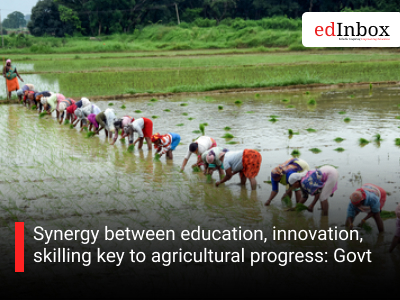
The government stated on Tuesday that the secret to advancing India’s agriculture will be to increase the synergy between education, innovation, and skilling.
About half of India’s population makes their living from agriculture, which also contributes about 18% of the country’s GDP.
Building human capability is consequently essential to increasing production, cutting expenses, and achieving national objectives. This would be achieved through higher education, research, and hands-on training, the government said, while referring to them as “key pillars of the sector”.
These pillars form “the institutional and scientific base essential for sustaining the targeted 5 percent agricultural growth rate and realizing the national vision of ‘Viksit Krishi aur Samruddh Kisan’ — the core philosophy of ‘Viksit Bharat’.”
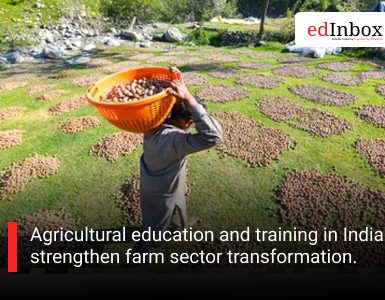
Agricultural education and training system in India reflects today an integrated approach linking education, research, technology, and field-level skill development,” the government said in an official statement.
The government has also emphasized capacity building as a way of enabling farmers to adapt to technological innovations, climatic, and market transformations, realizing that modern farming demands it.
Skill Training of Rural Youth, Sub-Mission on Agricultural Mechanization, Pradhan Mantri Kaushal Vikas Yojana, and initiatives through Krishi Vigyan Kendras and the Agricultural Technology Management Agency are some of the programs building capacities of farmers in practical knowledge and vocational skills related to sustainable agriculture. Quality education with a consistent emphasis, reforms in accreditation, and farmer-centric training-all are working in harmony to bridge the gap from scientific research to practical application, said the government. Integration of the Internet of Things, Artificial Intelligence, and precision farming tools is one of the major shifts towards modern and data-based agriculture.
The ATMA, STRY, and SMAM programs help farmers and rural youth develop critical technical and entrepreneurial skills, enabling village communities to become self-sufficient, by creating jobs. “When considered collectively, these programs are increasing productivity, earnings, and resource sustainability. Strengthening this synergy between education, innovation, and skilling will be critical to the nation’s agricultural progress as India works toward self-sufficiency in food production and a strong rural economy, the ministry said.


 Nibedita Speaks


Add comment