

 Nibeditaa Speaks
A career in agriculture no longer necessarily means working on a farm or pursuing traditional agricultural research. Today, a graduate interested in technology, business, finance or management can find opportunities in agricultural startups, food supply chains, digital marketplaces and precision-farming services.
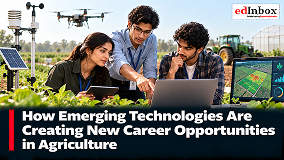
India’s agricultural economy is undergoing a gradual technological transition. Artificial intelligence, drones, satellite imagery, robotics, digital payments and data-driven platforms are creating new ways to produce, process, transport and market agricultural goods.
This transition is also changing the skills required by the sector. Agricultural knowledge remains important, but businesses increasingly need professionals who can combine technical understanding with entrepreneurship, financial planning and market strategy.
For students exploring career options, the intersection of agriculture and emerging technology offers opportunities across several disciplines.
1. AgriTech entrepreneurship
AgriTech startups use technology to address problems faced by farmers and agricultural businesses.
Their services may include digital advisory platforms, farm-management software, equipment rental, crop monitoring, market information and access to buyers.
Entrepreneurs in this sector need to identify genuine problems before developing technological solutions. A platform may have advanced features, but it will struggle to succeed if farmers cannot afford it, understand it or see a practical benefit.
Students with backgrounds in management, engineering, agriculture and economics can explore startup opportunities in this field.
2. Artificial intelligence and agricultural data analysis
AI is being explored for crop-disease identification, weather-based advisory services, yield estimation and agricultural market analysis.
Data analysts and AI professionals can work with agricultural companies, research organisations, technology startups and food businesses.
Their responsibilities may include collecting and interpreting agricultural data, developing predictive models and helping organisations make informed decisions.
A background in computer science, statistics, data science or agricultural sciences can be useful, depending on the role.
3. Drone technology and precision agriculture
Drones are increasingly being explored for crop monitoring, field mapping and precision application of agricultural inputs.
This has created opportunities for drone operators, technical specialists, service providers and businesses offering drone-based agricultural solutions.
However, commercial drone operations require compliance with applicable aviation regulations and operating requirements. Students interested in this area should understand the relevant certification, safety and regulatory framework.
There is also a management dimension: agricultural drone services need customer acquisition, equipment maintenance, trained personnel and financially sustainable operating models.
4. Smart irrigation and IoT-based farming
Water management is a critical concern in agriculture. IoT-enabled sensors and automated irrigation systems can help monitor soil moisture and environmental conditions.
Professionals working in this area may be involved in designing, installing, maintaining or marketing smart irrigation solutions.
Electrical engineering, electronics, computer science and agricultural engineering graduates can explore technical roles, while management graduates can work in business development, project management and operations.
5. Agricultural supply-chain and logistics management
The journey from farm to consumer involves procurement, grading, storage, transportation, processing and distribution.
Poor coordination at any stage can affect product quality and increase costs. Digital inventory systems, logistics platforms and data analytics can help businesses improve supply-chain visibility and planning.
Career opportunities include procurement management, warehouse operations, cold-chain logistics, food distribution, commodity management and supply-chain consulting.
Management graduates with an understanding of agricultural markets and operations can find opportunities in this segment.
6. Food processing and value addition
Agricultural produce does not have to be sold only in its raw form. Processing can turn fruits, vegetables, cereals, milk and other products into goods with different market values and shelf lives.
Food-processing companies require professionals in production planning, quality management, packaging, marketing, finance and distribution.
Students interested in this sector can explore food technology, food science, agricultural business management and operations management programmes.
7. Agricultural finance and digital services
Farmers and rural enterprises require access to credit, insurance, payments and financial advice.
Financial technology platforms are exploring ways to improve access to digital transactions and financial services in rural markets.
Professionals with backgrounds in finance, banking, economics and management can work in agricultural lending, rural financial inclusion, crop insurance and agri-finance businesses.
A sound understanding of agricultural cycles and rural income patterns is particularly valuable in this field.
8. Climate-smart agriculture and sustainability
Climate variability, water stress, soil degradation and extreme weather events are creating new challenges for agricultural production.
Businesses and institutions are exploring climate-resilient farming practices, resource-efficient technologies and sustainable supply chains.
Career opportunities include sustainability consulting, environmental research, climate-risk assessment, agricultural project management and responsible sourcing.
Students interested in this area can combine knowledge of environmental science, agriculture, economics and public policy.
9. Digital agricultural marketing
Digital platforms are changing how agricultural products reach buyers. Online marketplaces, social media, direct-to-consumer platforms and digital payment systems are creating new routes to market.
Agricultural marketing professionals work on branding, market research, customer acquisition, pricing and distribution.
This field can be suitable for students pursuing management, marketing, commerce and communications, particularly those interested in rural and consumer markets.
10. Research, innovation and policy
Emerging agricultural technologies also require researchers, policy analysts and programme managers.
Universities, agricultural research institutions, government departments, development organisations and private companies employ professionals to study agricultural innovation, evaluate programmes and support technology adoption.
Students interested in research can pursue postgraduate studies in agricultural economics, agricultural engineering, data science, public policy or related disciplines.
What should students study to enter the AgriTech sector?
There is no single academic route into agricultural technology. The right programme depends on the career a student wants to pursue.
Agricultural sciences and engineering can provide technical foundations. Computer science and data science are relevant to AI, analytics and digital platforms. Management education can prepare students for entrepreneurship, marketing, finance and supply-chain operations.
Interdisciplinary learning is particularly valuable. An agricultural technology company needs engineers to develop products, agricultural experts to understand field conditions and managers to build sustainable businesses.
Internships with AgriTech startups, food-processing companies, farmer-producer organisations, research institutions and agricultural businesses can help students gain practical exposure.
Technology must work for farmers
The expansion of agricultural technology should not be measured only by the number of startups, apps or devices entering the market.
Its real value lies in whether farmers can use these solutions, whether they are affordable and whether they improve productivity, market access or income.
Students entering this sector must therefore understand the economic and social realities of agriculture alongside technological innovation.
The future of agricultural careers will belong to professionals who can connect the farm with the laboratory, the marketplace and the boardroom. For a generation exploring careers beyond conventional industries, agriculture may offer one of the most diverse intersections of technology, entrepreneurship and social impact.


Add comment