

 Nibeditaa Speaks
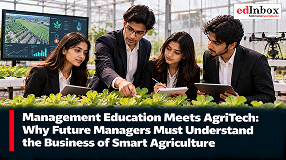
Agriculture is no longer driven solely by the availability of land, labour, rainfall and traditional farming knowledge. Increasingly, decisions about what to grow, when to irrigate, how to manage soil health and where to sell produce are being influenced by data, artificial intelligence and digital technologies.
From drones monitoring crop health to sensors measuring soil moisture and AI-powered platforms analysing weather patterns, technology is changing how agricultural businesses operate. Yet, adopting technology is only one part of the transformation. The larger challenge is managing resources, connecting farmers with markets, reducing financial risks and building sustainable agricultural enterprises.
This is where management education can play a significant role.
As India’s agricultural sector encounters challenges involving climate variability, fragmented supply chains, post-harvest losses and changing consumer expectations, the need for professionals who understand both business management and agricultural technology is becoming increasingly important.
Why agriculture needs management professionals
Agriculture is an economic activity involving multiple stakeholders, including farmers, input suppliers, processors, financial institutions, distributors, retailers and consumers.
A successful agricultural enterprise must coordinate these participants while managing production costs, quality, logistics and market demand.
Management graduates can contribute through agricultural marketing, operations management, financial planning, supply-chain development and business strategy.
For instance, a food-processing company must understand seasonal crop availability, storage requirements, transportation costs and consumer demand before deciding where to establish a processing unit. Similarly, an agri-business startup must develop a viable business model that addresses farmers’ needs while remaining financially sustainable.
These challenges require more than technical knowledge of farming. They require an understanding of markets, finance and organisational management.
How emerging technologies are transforming agricultural businesses
1. Artificial intelligence and predictive analytics
Artificial intelligence can help analyse agricultural data, identify potential crop diseases, estimate production trends and support decisions on irrigation and fertiliser use.
Predictive analytics can also help businesses anticipate demand, plan procurement and manage inventory. For agricultural managers, understanding how to interpret such information is becoming an important professional skill.
However, AI-generated recommendations must be evaluated against local soil conditions, crop varieties and actual field observations. Technology cannot replace sound agricultural judgement.
2. Internet of Things and smart farming
Internet of Things (IoT) devices use connected sensors to collect information about soil moisture, temperature, humidity and other environmental conditions.
This information can help farmers and agricultural businesses monitor fields and make more informed decisions about water use and crop management.
For management professionals, IoT creates opportunities to improve operational efficiency, measure resource consumption and develop technology-enabled agricultural services.
3. Drones and remote sensing
Agricultural drones can support crop monitoring, field mapping and certain precision-farming operations. Satellite imagery and remote sensing can provide information about vegetation, land conditions and crop development.
Businesses can use these technologies to monitor large agricultural areas and identify potential problems more efficiently.
Managers must also understand the costs, regulatory requirements, technical limitations and training needs associated with deploying such systems.
4. Blockchain and digital traceability
Consumers and businesses increasingly seek information about the origin, quality and movement of agricultural products.
Blockchain-based systems can support record-keeping and traceability across supply chains. When combined with reliable data collection, these systems may help businesses document the movement of produce from farms to processing facilities and markets.
Their effectiveness, however, depends on accurate information being entered at every stage.
The changing role of management education
Traditional management programmes cover subjects such as finance, marketing, human resources, operations and strategy. These remain relevant, but agricultural businesses increasingly require graduates who can apply these concepts to technology-driven and climate-sensitive environments.
Business schools can introduce agricultural supply-chain management, agri-finance, food processing, rural entrepreneurship, sustainability management and digital agriculture into their curricula.
Students should also receive exposure to data analytics, AI applications, IoT systems and technology-based business models.
Field projects are particularly important. Working with farmer-producer organisations, cooperatives, agricultural startups, food-processing companies and rural enterprises can help students understand the practical challenges of agricultural markets.
Opportunities for management graduates
The growing intersection of management and agriculture creates opportunities in several areas, including:
- Agri-business and rural enterprise management
- Agricultural supply-chain and logistics management
- Food processing and retail management
- Agri-finance and rural banking
- Precision agriculture and technology services
- Agricultural marketing and commodity trading
- Sustainability and climate-risk management
- Agri-tech entrepreneurship and consulting
Specialised agricultural management programmes can help students understand the sector’s economics, institutions and operational challenges.
The challenge of making technology accessible
The adoption of emerging technologies in agriculture is not uniform. Small and marginal farmers may face barriers involving affordability, connectivity, digital literacy and access to technical support.
A technology that works well on a large commercial farm may not be financially practical for a smallholder.
This is why future agricultural managers must understand the realities of rural India. They need to develop solutions that are affordable, locally relevant and economically viable rather than simply introducing sophisticated tools.
Preparing managers for the future of agriculture
The future of agriculture will depend not only on better seeds, machinery and digital platforms but also on the ability to manage resources, markets and people effectively.
Management education has an opportunity to prepare professionals who can connect technological innovation with the everyday realities of farming.
The next generation of agricultural leaders will need to understand both the language of business and the science of agriculture. Their success will be measured not by the number of technologies they introduce, but by whether those technologies improve productivity, strengthen farmer incomes and make agricultural businesses more resilient.



Add comment