

 Nibeditaa Speaks
From detecting deepfakes to understanding data privacy, the activity-based module teaches students how AI works, where it fails and how to use it responsibly.
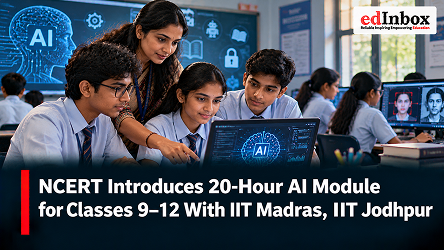
Artificial intelligence is already influencing how students search for information, translate languages and solve problems. Now, the National Council of Educational Research and Training (NCERT) is bringing these everyday experiences into the classroom through a new 20-hour introductory module on computational thinking and artificial intelligence (AI) for Classes 9 to 12.
Released on October 23, the module was developed with faculty members from IIT Madras and IIT Jodhpur. Designed for students without prior AI knowledge, it replaces an approach centred on technical definitions with practical exercises, discussions and real-life examples.
The five-unit module explores how AI operates, learns from data, produces incorrect information and handles personal data, while encouraging students to use digital tools without surrendering their independent judgement.
How AI works in everyday life
The first unit, AI Is Already in Your Life, introduces students to the difference between conventional devices, rule-based automation and learning-based AI. A pressure cooker responds to physical pressure, FASTag follows predefined rules, while a smartphone keyboard predicts words using patterns learned from examples.
Students also examine AI’s limitations through the experience of Inaya, a student from Bhopal, whose translation app struggles with the Hindi idiom “mere bhai ne naak mein dum kar diya hai”. Its literal translation, “my brother has put life into my nose”, illustrates how AI can miss cultural context even when it recognises individual words.
The second unit, How Machines Learn from Examples, introduces machine learning through a classroom experiment. Students train a classifier using pictures of blue pens, red pens and erasers before testing it on unfamiliar objects.
Karthik, a student from Visakhapatnam, discovers that a system trained on images of his own pen may fail to recognise another brand. The exercise demonstrates why the quality and diversity of training data matter and why AI systems must be tested beyond the examples they have already encountered.
Deepfakes, misinformation and AI hallucinations
The third unit, When AI Gets It Wrong, addresses AI-generated misinformation, manipulated images and hallucinations—instances in which AI produces incorrect or fabricated information.
Through an activity called the “Hallucination Hunt”, students question an AI assistant about subjects they understand and learn to verify its answers. The module encourages them to examine sources, assess the nature of claims, compare information and pause before sharing content.
Teaching students to protect their data
The fourth unit, Your Data, Your Rights, Your Responsibility, introduces privacy and consent through familiar digital situations.
Students examine app privacy policies to understand what information is collected, why it is needed, who can access it and how long it is retained. They also consider the risks of uploading school notes containing classmates’ personal details and the consequences of facial-recognition systems incorrectly rejecting users.
The final unit, Working with Modern AI Tools, focuses on using AI as an assistant rather than a substitute for human thinking.
In one example, Rohan, a Class 10 student from Bhubaneswar, uses an AI tool to prepare mathematics questions for a neighbourhood class run by his mother. After receiving unsuitable questions, he refines his prompt to specify Grade 4, two-digit multiplication and familiar settings such as fish markets, school tiffin and birds at Chilika Lake.
The exercise shows how clear instructions and contextual details can improve AI-generated results, while the responsibility for evaluating and adapting them remains with the user.
Activities possible without digital devices
NCERT said the activities can be conducted with or without digital devices. Students will also maintain a “Curious Notebook”, a portfolio containing an AI diary, classifier experiments, verification checklists, privacy analyses and a collection of prompts.
“The module encourages students to become informed, confident, and responsible users of technology, while reinforcing that human judgement, creativity, and ethical responsibility remain central to learning,” NCERT said.
By introducing AI literacy alongside computational thinking, the module seeks to prepare students not merely to use emerging technologies, but also to question their outputs, recognise their limitations and make responsible decisions about their use.






Add comment