

 Miss Kanishka
A tiny cat in Bolivia’s woods has become a big discovery in science. It has been found to be a new species of wild cat, Leopardus tilcayo, the first new living feline species described in over 100 years.
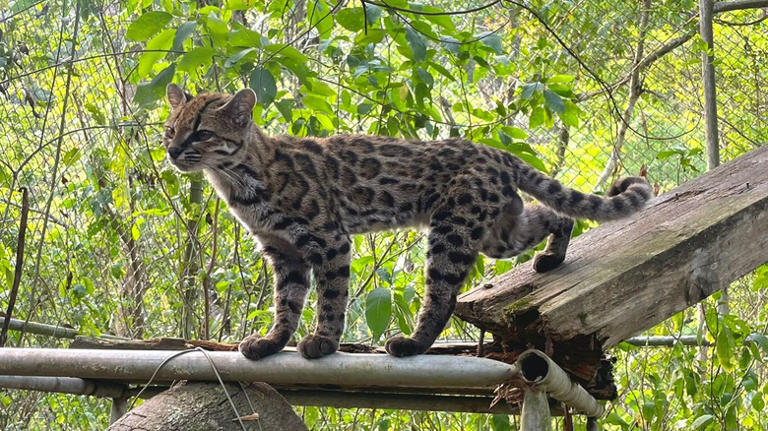
The cat is found in the Yungas cloud forests of eastern Bolivia, in the mountains. It is smaller than a domestic cat, light brown in color and with dark irregular spots. It was not its size or appearance that made it special. What was surprising was its DNA.
How was the new cat discovered?
It all started in 2016, when Bolivian biologist and National Geographic Explorer Paola Nogales-Ascarrunz received a call from a wildlife sanctuary about an “unusual cat”.
The animal had been found as a kitten and brought into the care of a local man, who thought it was a domestic cat. As it continued to grow, it was realized that it was a wild animal, and was brought to the Senda Verde wildlife refuge. It was initially thought to be a member of a known family of tiger cats in South America.
However, Nogales-Ascarrunz spotted something wasn’t fitting. In 2019,while working on a guide to Bolivia’s wild cats in 2019, she noticed that the animal’s size and markings did not quite match existing descriptions. That led researchers to investigate further.
DNA provided something no scientists had expected
The research team looked at the DNA of 38 tiger cats across South America, including from museums. The genetic analysis revealed that what scientists had previously treated as a single tiger-cat species was actually made up of five distinct species.
The researchers decided that it was a new species of animal, and named it Leopardus tilcayo. It is believed that its lineage was split off from other tiger cats about 1.4 million years ago, as suggested by genetic evidence. The research is described in the latest paper published.
What is so significant about this discovery?
New species are discovered on a regular basis but discovering a new species of living cat is very unusual. Scientists have not described a new feline species of cat that hasn’t been around before since 1923, when the pampas cat was described.
The discovery also reveals that there is still more to be learned about species studied for centuries by scientists. They were so similar that classifying them still seemed to be a problem, and DNA revealed differences that were not apparent from the animals.
Little is currently known about how many Tilcayo cats live in the wild or how widely they are distributed. The Yungas region also faces threats from deforestation, fires, agriculture and mining. Identifying the species gives researchers a clearer starting point for studying its population and understanding what conservation measures it may need.
How was the new cat species named?
The scientific name Leopardus tilcayo has an interesting relation to the local communities. The local name, “tilcayo”, was kept as the name for the animal, instead of a new common name being developed. That is significant because the cat was not necessarily unknown to people living in the region. It was the scientific community that had not yet formally recognised it as a separate species.
What does the discovery suggest to a student?
The biggest lesson is perhaps the simplest that scientific discovery often begins with noticing something that does not fit. Nogales-Ascarrunz didn’t begin her trip with any idea she’d discovered a new species. She observed that the animal was not quite as she’d expected and asked a question. The researchers then looked to genetics, field observations and museum specimens to discover the answer.
To passionate people and students, it’s a significant approach to science. It doesn’t always take a complicated experiment to make a new discovery. It could start with curiosity, with careful observation and asking what is different, “Why is that?”
What must students and researchers know?
The Tilcayo cat shows the synergy of modern science in making new connections. In the identification of one small animal, biology, genetics, wildlife conservation, technology and even historical museum collections all contributed, and different experts came together to understand this new species of cat.
Such discoveries tell us that things are still awaiting to be discovered because sometimes all it takes is a careful observation of things already known instead of hunting the lesser known to discover the unknown.



 Nibeditaa Speaks


Add comment