

 Nibeditaa Speaks
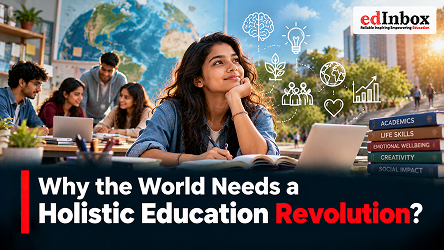
India, China and Bhutan can draw on their civilisational traditions to rethink education—not as a contest for individual success, but as a means of cultivating discernment, social responsibility and ecological stewardship.
Modern education has become remarkably efficient at producing specialists, yet far less successful at teaching them to see the whole. Students learn biology, chemistry, physics, economics and history as separate disciplines, while the connections between human society, the natural world and collective well-being often remain at the margins. The result is a system that can generate technical expertise without necessarily cultivating the wisdom required to use it responsibly.
This fragmentation is not merely an academic concern. It shapes how societies understand economic growth, political power, environmental degradation and international conflict. When progress is measured primarily through competition, consumption and control, the capacity to recognise interdependence risks being lost.
The question, therefore, is no longer whether education needs reform, but whether reform can go beyond updating curricula and introducing new technologies. What the world needs is a deeper reconstruction of its educational philosophy—one that places wholeness, discernment and responsibility at the centre of learning.
India, China and Bhutan offer an important starting point for this conversation.
The limits of a fragmented worldview
Modern education has delivered substantial advances in science, technology and professional knowledge. Yet its dominant structures frequently reward narrow specialisation, individual achievement and measurable performance over the ability to connect ideas across disciplines.
A student may understand the chemistry of a river without examining the political economy of pollution, the ecology of its watershed or the livelihoods dependent on its health. Economic growth may be celebrated without accounting adequately for the depletion of natural resources. History may be taught largely through wars and territorial rivalries, leaving questions of cultural exchange, cooperation and shared survival underexplored.
Such divisions are useful for organising knowledge, but they become counterproductive when students are not taught to reconnect what they learn.
The consequences extend beyond classrooms. Governments confront climate change through the same growth-oriented assumptions that have contributed to environmental pressures. International rivalries are frequently addressed through military preparedness, strategic competition and control over resources. Solutions developed within a narrow framework can create new problems because they fail to account for the wider systems in which those problems exist.
Education cannot resolve every political or economic crisis. It can, however, influence the habits of thought through which future scientists, policymakers, business leaders and citizens approach them.
The task is to cultivate critical thinking without reducing every disagreement to a contest between opposing camps; ambition without limitless consumption; and individual rights alongside an understanding of collective responsibility.
Reclaiming civilisational wisdom without rejecting modernity
The case for holistic education is not an argument against science, technology or modern institutions. Nor should it become a claim that one civilisation possesses all the answers while another has none.
Rather, it calls for a meaningful dialogue between contemporary knowledge and philosophical traditions that understand human life as embedded in wider social and ecological relationships.
Rabindranath Tagore’s educational philosophy offers a powerful point of reference. His emphasis on freedom of thought, creativity, community and communion with nature challenged the limitations of mechanical, examination-driven schooling. His vision invites educators to see learning as an engagement with the world, not simply preparation for employment or competition.
Similarly, the Indian idea of Vasudhaiva Kutumbakam—the world as one family—provides an ethical framework for considering responsibilities beyond the individual or nation. Such principles become relevant to modern education when they influence how students examine environmental problems, economic choices and the consequences of technological development.
India’s National Education Policy 2020 offers an institutional opportunity to advance multidisciplinary learning and more holistic approaches to student development. The challenge is implementation. Integrating subjects on paper will accomplish little if classroom practice continues to reward memorisation, narrow examination performance and competition alone.
Holistic education must be visible in how teachers teach, how students are assessed and how schools connect knowledge with lived experience. It must encourage learners to ask not only whether an intervention works, but also for whom it works, what it costs, which relationships it changes and what consequences it may have for future generations.
Why the Trans-Himalayan partnership matters
India, China and Bhutan could contribute distinct perspectives to this educational reimagining.
India has the scale to experiment with approaches that reach millions of learners. Its philosophical traditions, community practices and emerging multidisciplinary educational frameworks provide resources for examining the relationship between knowledge, duty and collective well-being.
China’s educational tradition, including the Confucian emphasis on moral cultivation, offers another perspective. The principle of Lide Shuren, commonly associated with fostering virtue and educating people, places character development alongside the acquisition of knowledge. The idea of Tian Ren He Yi, or harmony between humanity and nature, also provides a philosophical lens through which to consider ecological responsibility.
Bhutan offers a different point of reference through its emphasis on Gross National Happiness, which places well-being alongside conventional measures of economic development. Its experience raises an important question for education systems everywhere: should the success of learning be measured solely by academic attainment and future earnings, or also by the ability to contribute to community life and live responsibly within ecological limits?
These traditions are neither identical nor immune to contradiction. India, China and Bhutan have different political institutions, educational structures and contemporary challenges. Their histories should not be romanticised, and civilisational continuity alone cannot guarantee enlightened policy.
Yet their differences need not prevent cooperation. A trans-Himalayan initiative could create a forum for comparing educational practices, developing interdisciplinary curricula and studying how cultural knowledge can inform contemporary science, sustainability and public policy.
The objective should not be to export a single model, but to learn across traditions while subjecting ideas to evidence, debate and practical evaluation.
From philosophy to classroom practice
The real test of holistic education lies in its ability to change everyday learning.
Environmental studies, for example, could connect biology, chemistry, geography, economics and civic responsibility through the study of a local river or forest. Students could examine its ecological condition, the communities that depend on it, the economic activities affecting it and the policies governing its use.
History could explore not only conflict but also cooperation, cultural exchange and the evolution of shared institutions. Technology education could address not only innovation but also privacy, inequality, environmental costs and ethical responsibility.
Assessment must evolve alongside teaching. Students should be encouraged to demonstrate their ability to connect evidence, identify assumptions, consider competing perspectives and reflect on the consequences of decisions. Collaboration, empathy and independent judgement deserve meaningful attention, without displacing subject knowledge or academic rigour.
Such changes require trained teachers, suitable learning materials, institutional support and careful evaluation. They cannot be achieved through philosophical declarations alone.
Nor should holistic education become another slogan imposed on already overburdened schools. Its value will depend on whether it helps teachers teach more effectively and students understand their world more deeply.
A shared responsibility for the future
The United States, Russia and other major powers also have a role in creating the conditions for international cooperation. Strategic restraint, sustained scientific exchange and reduced dependence on coercive competition would give educational partnerships greater room to develop. But the responsibility for rethinking education cannot rest on geopolitical powers alone; it belongs to governments, universities, teachers, communities and learners.
The most urgent lesson is that humanity cannot address interconnected problems indefinitely through disconnected thinking.
Climate change, technological disruption and geopolitical instability cross disciplinary and national boundaries. Preparing young people for such a world requires more than technical competence. It requires the capacity to recognise relationships, question immediate incentives and consider the consequences of decisions over generations.
India, China and Bhutan can help advance this conversation by bringing their philosophical traditions into serious engagement with contemporary knowledge. Their contribution will be measured not by claims of civilisational superiority, but by the quality of the educational practices they develop and the evidence of their impact.
The purpose of education must ultimately extend beyond producing successful individuals. It must also prepare people to participate thoughtfully in a shared world.
The transition from fragmentation to wholeness will not happen overnight, and no civilisation can accomplish it alone. But education offers a place to begin: by teaching students to connect what they know, question what they assume and recognise what they owe to others.
The future of education depends not simply on how much humanity learns, but on whether it can turn knowledge into wisdom, progress into stewardship and individual achievement into a responsibility for collective flourishing.




Add comment