
Edinbox
Empowering Nepalese Youth: Prof Ujjwal K Chowdhury Inspires Purpose-Driven Careers in a Changing World

Empowering Nepalese Youth: Prof Ujjwal K Chowdhury Inspires Purpose-Driven Careers in a Changing World

Empowering Nepalese Youth: Prof Ujjwal K Chowdhury Inspires Purpose-Driven Careers in a Changing World

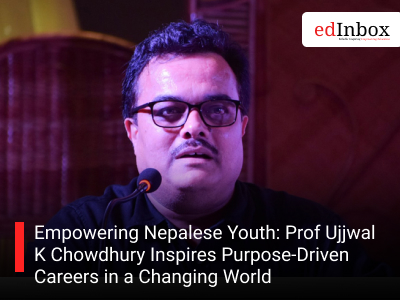
At a session with Nepalese youth on November 28, Prof Ujjwal K Chowdhury, an acclaimed educator and media mentor, spoke about building purposeful and passionate careers for South Asia’s emerging generation. He highlighted South Asia’s unprecedented “demographic dividend,” with thousands of young people entering the workforce daily and the urgent need to bridge persistent skills and purpose gaps. Drawing on stories of trailblazing South Asian changemakers, Prof Chowdhury emphasized finding one’s “why”–the alignment of values, community needs, and personal strengths–as the key to significant impact. He outlined actionable frameworks for self-discovery, prototyping career choices, and sustaining motivation even amid financial and familial pressures. Throughout his talk, Prof Chowdhury urged youths to mix hard skills with imagination, use mentorship, and communicate their purpose in terms families and communities respect. The address concluded with an emphasis on education reform and global collaboration, challenging attendees to transform South Asia’s talent into positive change for the future

Today, South Asia is at a very critical juncture. Every day, some 100,000 youth join the workforce; it boasts of the largest youth population in the world. The so-called “demographic dividend” could reshape the century-but only if the immense potential of these young talents is tapped into purposefully and skillfully.

But this opportunity is also fraught with challenges: according to UNICEF, 54% of the young people in South Asia leave school without acquiring the skills necessary for decent employment. If nothing is done, only 46% could be ready for the workforce by 2030. The youth also voice frustrations at the obsolete education systems and poor career guidance, pointing at the growing skills gap.

Lurking beneath this is a far more profound problem-a “purpose gap.” For today’s young, career is about a great deal more than a paycheck; it is central to identity, fulfillment, and contribution. Yet many are held back by choices between passion and stability.

The truth is that success is about a balance between two powerful forces: passion, the energizing “what” that stirs excitement, and purpose, the guiding “why” that lends direction and resilience to the ups and downs of life.

In South Asia, this balance is further complicated by questions of cultural expectation: for most families, careers in medicine, engineering, law, or finance are the paths to security and social prestige. This is a preoccupation indicative of deep-seated, collective values and economic histories which have put survival and stability above individual fulfillment.

This is a pressure that inherently leads to a generational disconnect in which parents equate success with economic security, while youth seek self-actualization and meaningful work. The clash that would result from this has very real-world consequences in fueling stress, anxiety, and a pervasive feeling of being trapped in inauthentic career paths.

But quietly, a revolution is going on. In ever-increasing numbers, South Asian students are increasingly turning toward design, communication, and arts-interdisciplinary and creative disciplines. The future belongs to people who can cross traditional boundaries of STEM or arts and spark real change.

Inspirational leaders such as Dr. Anandibai Joshi, Kailash Satyarthi, and Muhammad Yunus have shown the world how purpose-driven careers can overcome challenges while creating global impact and personal fulfillment. This involves four steps toward developing an aligned career: discovery of core values and “why,” prototyping and testing those ideas through real-world experiments, creating a clear roadmap with achievable goals, and adopting weekly habits to sustain progress. Financial stability may be brought forth in terms of side hustles or portfolio careers that retain security yet allow them to pursue their passions. 

In this light, framing career choices to families becomes a duty and can be effectively communicated in terms families understand: security, strategy, and respect. A career founded on passion engined by purpose eventually becomes a lifelong journey of growth and resilience. The collective pursuit of “why” among the youth of South Asia is not only a personal quest but also a powerful force shaping the region’s future prosperity and growth. Key words: South Asia youth careers, purpose-driven career in South Asia, skills gap in South Asia, career guidance in India, Nepal, and Bangladesh, passion and purpose aligned, non-traditional careers in South Asia, career expectations per culture in South Asia.

Edinbox Team

Add comment