

 Nibeditaa Speaks
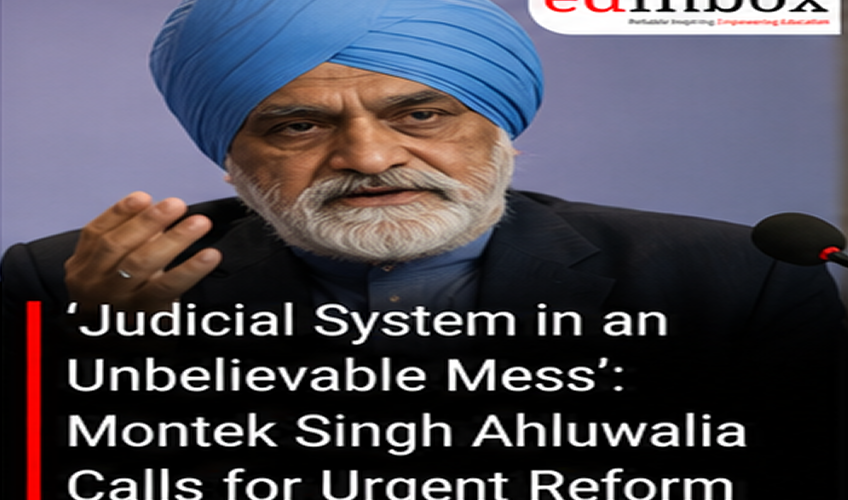
India’s judicial system is in an “unbelievable mess” and urgent reforms may need to be led by the judiciary itself, former Planning Commission Deputy Chairman Montek Singh Ahluwalia has said.
In an interview with ThePrint, Ahluwalia, who played a key role in India’s 1991 economic reforms, said the Centre may have limited ability to overhaul the judicial system and suggested that the Supreme Court could take the lead in reforming the system.
“Quite honestly, the judicial system is in an unbelievable mess. Unfortunately, I don’t think the central government can set it right,” Ahluwalia said, adding that judicial reform would have to come from within the judiciary.
His comments come amid concerns over the enormous backlog of cases across Indian courts.
Over 11 Lakh Cases Pending for More Than 20 Years
According to data provided by Union Minister of State for Law and Justice Arjun Ram Meghwal last month, 11,73,509 cases had been pending for more than 20 years across the Supreme Court, High Courts and district and subordinate courts as of July 16, 2026.
The Allahabad High Court had the highest number of cases pending for more than two decades, with 1,61,598 cases.
Across the Supreme Court and High Courts, more than 4.52 lakh cases had remained pending for over 20 years.
Separately, Supreme Court Justice MM Sundresh said in April that around 4.81 crore cases were pending across courts in the country.
Ahluwalia’s comments also come against the backdrop of concerns that judicial delays are affecting businesses and India’s broader economic ambitions.
Labour Law Reforms Need More Change
On labour reforms, Ahluwalia said the government had consolidated 27 central labour laws into four, but argued that substantive changes remained limited.
One major change has been the increase in the workforce threshold requiring government permission for retrenchment from 100 to 300 workers.
Ahluwalia noted that the threshold had earlier been reduced from 300 to 100 in 1980, meaning the latest change largely restores the position that existed around 1990.
However, he said the Centre had given states greater flexibility to raise the threshold further through their own legislation.
States Should Compete for Investment
Ahluwalia urged states to use this flexibility to attract more domestic and foreign investment.
He suggested that states seeking to compete with countries such as Vietnam, Malaysia and Indonesia could consider raising the threshold to 1,000 or even 5,000 workers, depending on their economic strategy.
He also called for a shift in how businesses engage with governments.
According to Ahluwalia, industries should focus more on state governments rather than concentrating their lobbying efforts on New Delhi, as a significant share of business compliance requirements falls under state jurisdiction.
He argued that competitive labour policies, easier compliance and stronger state-level reforms could help India attract investment and accelerate economic growth.
The comments underline two major challenges for India’s development agenda—judicial efficiency and state-level economic reforms—both of which Ahluwalia believes require significant attention if the country is to achieve its long-term growth ambitions.



 Edinbox Team


Add comment