

 Nibeditaa Speaks
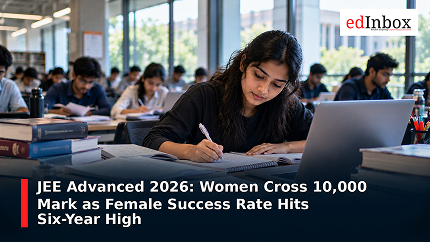
Women candidates have crossed the 10,000 mark for the first time in JEE Advanced 2026, recording the best-ever result in six years. As per the reports published by the exam conducting body, Indian Institute of Technology Roorkee, 10,107 female candidates qualified for JEE Advanced 2026, which was held by IIT Roorkee this year.
The report contains detailed information about the registration, turnout, and qualification results of the examination for various categories. The female candidate’s success rate increases to 23.4%. Out of 43,112 female candidates who registered for JEE Advanced 2026, 40,562 appeared for both papers of the examination, out of which 10,107 female candidates cleared the examination.
This marks a female candidate’s success rate of 23.4%, which is comparatively higher by 1.7% than the success rate of 21.7% recorded in 2025. In other words, one out of every four female candidates who appeared for both papers of JEE Advanced 2026 has qualified for the examination.
The report also highlighted the gender gap between the number of male and female candidates who applied, appeared, and cleared the examination. For instance, out of 1,44,276 male candidates who registered for JEE Advanced 2026, 1,39,131 appeared for both papers and 46,773 cleared the examination.
The overall number of candidates who appeared for both papers of JEE Advanced 2026 stands at 1,79,694, out of which 56,880 candidates have qualified for the examination. A total of 3,814 supernumerary seats and 37 gender-neutral seats reserved for the admission of female candidates
The JEE Advanced 2026 examination also witnessed the introduction of 3,814 supernumerary seats for female candidates apart from the 37 gender-neutral seats for the admission to Indian Institutes of Technology (IITs).
However, the supernumerary seats and gender-neutral seats reserved for the admission of female candidates should not be confused with each other.
The increase in the number of qualifying female candidates for JEE Advanced 2026 could have long-term implications for the representation of women in IITs. However, the final outcome will rely on the candidates’ admission choices, programme preferences, and overall performance in JEE Advanced.
Additionally, as per reports published by IIT Roorkee, an increase in the number of qualifying female candidates for JEE Advanced 2026 was recorded across various categories.
For instance, out of the total number of candidates belonging to the Scheduled Caste (SC) who appeared for JEE Advanced 2026, 15,856 candidates have qualified for the examination.
Similarly, out of the total number of Scheduled Tribe (ST) candidates who appeared for JEE Advanced 2026, 6,379 candidates have qualified for the examination, which marks an increase from the number of qualifying SC and ST candidates recorded in 2025.
Particularly, the number of qualifying SC candidates increased by 9.8% and the number of qualifying ST candidates increased by 8.1% compared to the corresponding numbers recorded in 2025.
Qualifying female candidates across different categories
On the other hand, the number of qualifying candidates across different categories decreased slightly in the General category. For instance, out of the total number of candidates belonging to the General category who appeared for JEE Advanced 2026, 15,883 candidates have qualified for the examination, compared to 16,154 qualifying candidates in 2025. Furthermore, the performance of the General Economy Weaker Sections (GEN-EWS) category improved slightly in comparison to the performance recorded in 2025.
Specifically, the number of qualifying GEN-EWS candidates increased from 6,291 to 6,377, whereas the general category’s qualification rate decreased from 43% to 39.8%.
In addition, the Open BC-NCL category’s qualification rate decreased from 18.2% to 17.5%, and the number of qualifying OBC-NCL candidates decreased from 12,606 to 12,385. Nearly 1.8 lakh candidates appeared for both papers of JEE Advanced 2026
JEE Advanced 2026 was conducted on May 17, 2026, and the results of the examination were declared on June 1, 2026. Both papers of the examination witnessed the participation of 1,79,694 candidates. Particularly, Paper 1 was conducted from 9 a.m. to 12 p.m., whereas Paper 2 was conducted from 2:30 p.m. to 5:30 p.m.
Indian candidates who appeared for the examination had to qualify for the examination by securing a position among the top 2.5 lakh successful candidates who appeared for the BE/BTech paper of JEE Main 2026 in accordance with the eligibility procedure.
The relaxation in the cut-off for qualifying the examination
According to the reports published by the conducting body, the cut-off for qualifying for JEE Advanced 2026 was relaxed for various categories to ensure that adequate candidates appeared for the examination in accordance with the number of seats available.
In other words, the final number of candidates who qualified for JEE Advanced 2026 was not decided by a specific cut-off score.
The reports added that seats reserved for different categories and the overall admission requirements took into account the final decision to declare the result of JEE Advanced 2026.
JEE Advanced rank is not only for IITs
A JEE Advanced rank is not only valid for admission to IITs but can also be used for seeking admission to undergraduate courses offered by various other institutes.
For instance, the examination results can be used for seeking admission to Indian Institute of Science Education and Research (IISc), Bengaluru; Indian Institute of Petroleum and Energy (IIPE); Indian Institute of Space Science and Technology (IIST); and Rajiv Gandhi Institute of Petroleum Technology (RGIPT). However, the admission requirements differ from one institute to another.
What the increase in female candidates’ results means
Although crossing the 10,000 mark in terms of the number of qualifying female candidates is certainly a positive sign for women’s participation in the technical education sector, it will take years before this increase starts reflecting on the overall representation of women in IITs.



Add comment