

 Nibeditaa Speaks
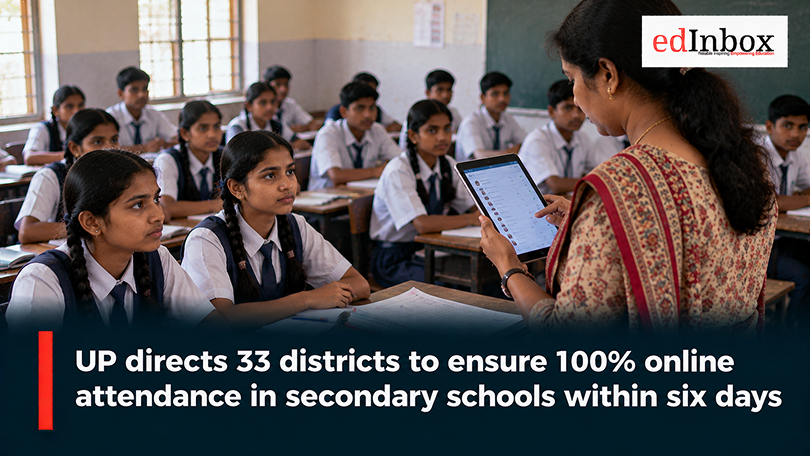
The Uttar Pradesh Madhyamik Shiksha Parishad has directed education officials in 33 districts to ensure 100% daily online attendance of students, teachers and non-teaching staff in secondary schools within six days, after extremely low compliance was reported across several districts.
The directive, issued by Board Secretary Bhagwati Singh, makes it mandatory for government, government-aided and self-financed secondary schools to record daily attendance through the Board’s designated web portal or mobile application.
The Board’s district-wise data has highlighted significant gaps in implementation. Bhadohi recorded the lowest compliance, with none of its 196 secondary schools submitting online attendance. Unnao reported attendance from only two of its 417 schools, resulting in a compliance rate of 0.48%.
Mirzapur followed with online attendance submitted by three of 308 schools, or 0.97%. Farrukhabad recorded 1.06%, with three of its 283 schools submitting attendance, while Saharanpur reported 1.14%, with four of 351 schools complying.
Several other districts also recorded attendance submission rates below 2%. These included Gonda at 1.36%, Prayagraj at 1.53% and Chitrakoot at 1.69%.
The Board’s data showed that the problem extended well beyond the lowest-performing districts. Chandauli recorded 4% compliance, Kanpur Nagar 4.39%, Mainpuri 5.10%, Siddharth Nagar 5.22% and Agra 5.76%. At the higher end of the reported figures, Gorakhpur recorded 9.90%, Deoria 9.87%, Firozabad 9.67%, Aligarh 9.65% and Hardoi and Banda 9.39% each.
District officials told to improve compliance
The Board has viewed the low figures as an indication of non-compliance with its attendance directions and inadequate supervision. District education officials have consequently been instructed to ensure that schools begin using the online attendance system without delay.
District inspectors have been specifically asked to ensure that attendance is recorded for students, teachers and non-teaching employees in all government, aided and self-financed secondary schools.
The six-day deadline puts the responsibility on district-level officials to monitor implementation and ensure that schools regularly use the prescribed digital platform.
Digital attendance and school accountability
The move reflects the state’s wider push towards digitising school administration. Online attendance can provide education authorities with a centralised mechanism to monitor student and staff presence and identify gaps in school-level reporting.
However, the extremely low submission rates also raise questions about the implementation of digital systems at the school level. Ensuring compliance will require more than issuing deadlines. Schools need functional digital infrastructure, reliable internet connectivity, trained staff and regular monitoring to make technology-based attendance meaningful.
With the Board setting a six-day deadline, the immediate priority for the 33 districts will be to bring every secondary school onto the prescribed system and establish consistent daily attendance reporting.
The directive therefore places both schools and district authorities under greater scrutiny, with online attendance emerging as an important tool for strengthening administrative accountability across Uttar Pradesh’s secondary education system.





Add comment