

 Nibeditaa Speaks
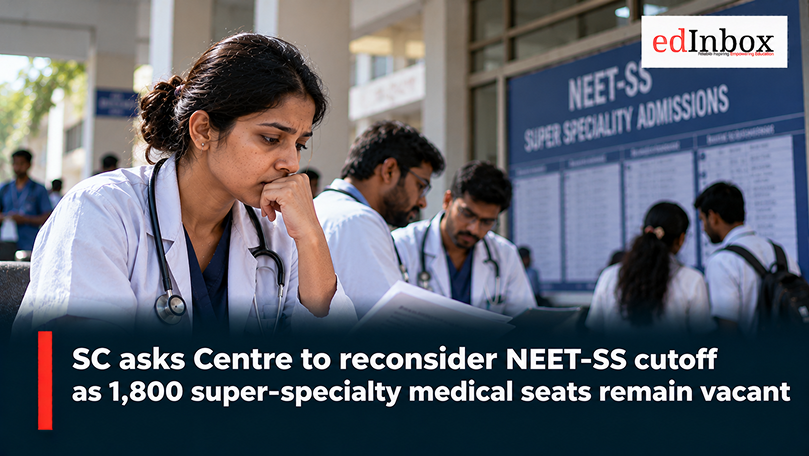
The Supreme Court has asked the Centre to reconsider its decision not to relax the qualifying percentile for NEET-SS 2025 after more than 1,800 super-specialty medical seats remained vacant even after two rounds of counselling.
A bench of Justice Pamidighantam Sri Narasimha and Justice Alok Aradhe said the large number of unfilled seats was a “compelling” reason to reconsider the cutoff. The court directed Additional Solicitor General Aishwarya Bhati to convey its concerns to the Union Health Ministry and seek an appropriate decision. The matter will be heard next on September 17.
“Having examined the matter from different perspectives, we are of the opinion that it may be necessary to reconsider the decision for reducing the cut-off percentile,” the bench observed, pointing to the substantial number of vacant seats.
The Centre had earlier informed the court that it had decided against reducing the NEET-SS 2025 qualifying marks after consultations among the Health Ministry, the Medical Counselling Committee (MCC) and the National Medical Commission (NMC).
Bhati told the court that, in accordance with the Supreme Court’s directions in the 2023 Kevin Joy case, the MCC would conduct a “special stray round” to fill vacant super-specialty seats, but without relaxing the prescribed percentile.
The petitioners, however, argued that this would not be enough. Advocate Rashmi Nandakumar said nearly 2,000 seats could remain vacant unless the eligibility criteria were relaxed. She pointed out that in previous years, authorities had resorted to mop-up and stray vacancy rounds, as well as reductions in qualifying criteria, when large numbers of super-specialty seats remained unfilled.
She urged the court to ensure that vacant seats are offered through a further mop-up or stray vacancy round rather than allowing them to lapse.
The issue has particular significance because the vacant seats include disciplines such as cardiology, cardiothoracic surgery, neurosurgery, oncology and haematology. Senior counsel P Wilson, appearing for service doctors in Tamil Nadu, argued that allowing these seats to go unused would mean wasting both training capacity and public investment at a time when India needs more highly trained specialists.
For doctors who have already appeared for the examination, the delay is also becoming a professional and financial burden.
The NEET-SS examination was held in December 2025 and its results were announced a month later. Yet, despite two rounds of counselling, thousands of doctors are still waiting while seats they seek remain vacant.
“How can so many doctors, physicians and surgeons, be kept on wait for such a long time?” asked physician Dr R Sathish. He noted that unlike many undergraduate candidates, super-specialty aspirants are often already working doctors and family earners. Some, he said, had left their jobs in February while waiting for admissions.
The controversy also revives the question of how far qualifying standards should be relaxed to prevent seats from going unused. According to former NMC postgraduate board member Dr K Senthil, authorities in earlier years had reduced the qualifying cutoff to zero after regular counselling, allowing candidates who had appeared for the examination to compete for vacant seats.
Such a move could immediately expand the pool of eligible candidates, but experts caution that it does not address the deeper reasons behind unfilled super-specialty seats, including limited employment opportunities, modest salaries, demanding working conditions and uncertain career progression.
The Supreme Court’s intervention therefore puts the focus on a difficult balance: protecting academic standards while ensuring that scarce and highly specialised medical training capacity does not simply expire unused.
fter two counselling rounds, prompting SC intervention.




Add comment