

 Nibeditaa Speaks
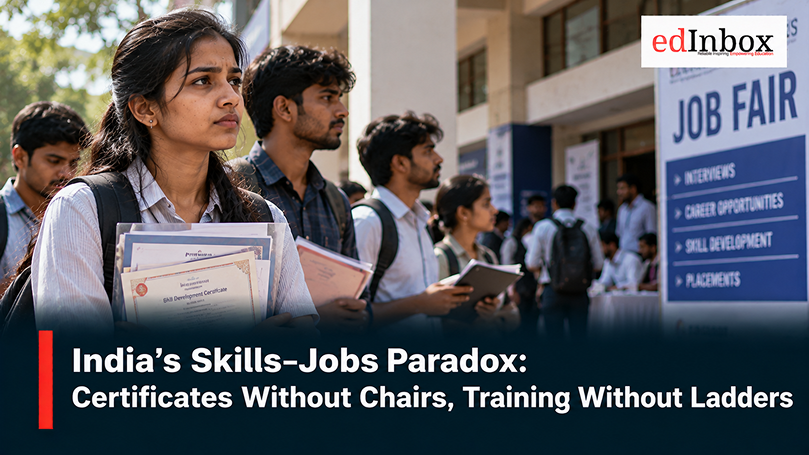
India is producing certificates at scale. The harder question is whether it is creating enough jobs to use them. India has built an enormous skilling machinery, but the labour market has not kept pace. That is the uncomfortable contradiction at the heart of the country’s employment debate: millions are being trained and certified, yet the economy is still struggling to create enough productive, secure and adequately paid work. A certificate may help a young person enter the queue for a job. It cannot, by itself, create the chair.
Government figures show the scale of the effort. More than 2.27 crore beneficiaries have reportedly passed through PMKVY, Jan Shikshan Sansthan and the National Apprenticeship Promotion Scheme, while PMKVY 4.0 alone reported 27.08 lakh people trained by December 2025. But scale cannot be confused with capability, just as certification cannot be confused with employment.
The Comptroller and Auditor General’s performance audit makes the gap harder to ignore. Between 2015 and 2024, PMKVY 1.0–3.0 involved an outlay of ₹14,448.90 crore, with 1.10 crore candidates certified. Of the 56.14 lakh certifications audited, only 23.18 lakh—about 41 per cent—were reported as placed. The audit also identified weak demand analysis, irregular placement evidence, major regional variations, delays and unpaid benefits. Placement rates fell sharply across different phases and varied dramatically between states.
The deeper problem is how success is defined. “Trained” measures an activity. “Placed” measures a reported transition. Neither necessarily tells us whether someone remained employed, used the skill, earned a living wage or received social protection. Decent work requires more: earnings, stability, safety, dignity and a pathway to progress.
India is therefore at risk of building a certificate economy around a labour market that does not sufficiently reward skills. The Periodic Labour Force Survey figures cited in the analysis underline the quality problem: a large share of workers remain self-employed or in casual labour, while many regular non-agricultural workers lack written contracts, paid leave or specified social security.
The mismatch begins even before a student completes training. The system has often measured what training providers can deliver rather than what employers actually need. The CAG found inadequate micro-level skill-gap information and no sufficiently developed long-term strategy linking economic plans to occupational demand. The result is a peculiar mismatch: construction accounted for a far larger share of estimated skill requirements than of fresh PMKVY training, while electronics received a disproportionately large share of training.
Apprenticeships offer a missing bridge. Real workplace learning teaches what classrooms cannot—how to handle equipment, maintain quality, work safely, meet customers and function within a team. It also allows employers to assess workers before making hiring decisions. Yet apprenticeship participation remains uneven, particularly among smaller enterprises, where the cost of supervision and training can discourage participation.
There is another barrier that cannot be solved inside a classroom: geography. A job is not truly accessible to a young woman who cannot travel safely, find childcare or secure accommodation. Nor is it accessible to a rural worker who cannot finance relocation and the first month of expenses. Gender-neutral training targets can therefore produce profoundly unequal outcomes. Transport, childcare, hostels, safe workplaces and local recruitment are not peripheral welfare measures; they are part of employment infrastructure.
Nor should India assume that another certificate will automatically produce higher wages. Pay depends on productivity, the value of output, bargaining power and enforcement of labour standards. A short training course cannot transform a low-productivity firm into a high-paying employer. The Economic Survey 2024–25 figures cited in the analysis—that more than 53 per cent of graduates and 36 per cent of postgraduates are underemployed below their qualification level—point to a broader structural problem: education and credentials are expanding faster than suitable employment.
The answer is not to abandon skilling. It is to redesign what the country means by success.
Public money should follow verified capability and sustained employment rather than enrolment and certificates. Training should be built backwards from demonstrated employer demand. Every substantial vocational programme should include supervised workplace learning. Providers should receive funding progressively, tied to completion, demonstrated skills, employment or viable self-employment, and retention.
Industrial policy, too, must begin reporting the employment it actually creates: jobs, median pay, apprenticeship conversion, women’s participation and social-security coverage. MSMEs should be treated as partners rather than merely consumers of trained labour, with shared laboratories, mentors and support for supervised learning and productivity improvements. A meaningful Digital Skills Passport should record what a worker has actually done and demonstrated, rather than merely displaying another certificate or QR code.
Most importantly, India needs the courage to stop programmes that repeatedly fail. Public dashboards should reveal provider- and district-level outcomes. Employment claims should be independently verified. Job roles without demonstrable demand should not be expanded simply because they produce attractive enrolment numbers. The real measure should be the cost of producing a graduate who remains in relevant employment or a viable enterprise after 12 months, above a published earnings threshold.
India does not have a skilling problem in isolation. It has a jobs architecture problem.
The country has built classrooms, centres, assessments, dashboards and certificates. What remains unfinished is the bridge connecting those investments to productive work. The next generation of skilling policy must therefore ask harder questions: Did an employer actually need this skill? Did the learner demonstrate it in practice? Did the job last? Did earnings improve? Could the worker progress? Did the employer become more productive? And did public money create new work—or merely relabel existing vulnerability?
If the answer is yes, scale it. If not, redesign it or stop it.
The ambition cannot be to train Indians to wait more efficiently for jobs. It must be to build an economy in which learning, enterprise and employment form one system—one that creates enough chairs, pays people properly for sitting in them, and gives them a ladder to climb once they arrive.





Add comment