

 Nibeditaa Speaks
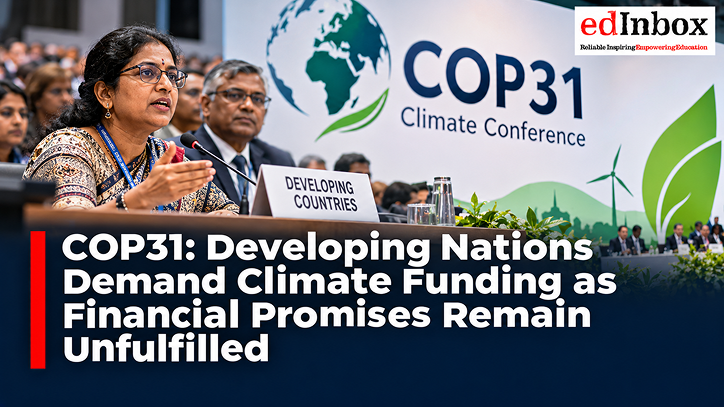
For countries already struggling with rising sea levels, devastating floods and increasingly severe weather, climate finance is not a distant policy debate. It is the money needed to protect homes, rebuild communities and prepare for the next disaster. Yet, as world leaders gather at COP31 in Antalya, Türkiye, vulnerable nations are once again asking wealthy countries to deliver on their financial promises.
The growing frustration centres on the gap between climate commitments and the money actually reaching developing countries. Small island nations, which contribute relatively little to global greenhouse gas emissions but face some of the worst consequences of climate change, are particularly concerned.
Under an agreement reached at COP29 in 2024, developed countries committed to providing at least $300 billion annually in climate finance to developing nations by 2035. The broader ambition is to scale up funding from all sources to $1.3 trillion annually by the same year.
However, progress remains slow, raising doubts about whether these targets can be achieved.
Climate Finance Competes with Global Priorities
Geopolitical tensions, military spending and domestic economic pressures have complicated international climate financing. The withdrawal of funding by the United States has added to concerns about the availability of resources for developing nations.
For smaller countries, the consequences are particularly serious. Repeated climate disasters leave governments spending heavily on recovery, leaving little money for long-term adaptation.
Solomon Islands Prime Minister Matthew Wale has warned that his country is struggling to escape this cycle of destruction and reconstruction. Marshall Islands President Hilda Heine has also questioned why climate security does not receive the same urgency as military security.
A Growing Gap Between Promises and Delivery
An analysis presented by Brazil found that approximately $137 billion in climate finance was mobilised in 2024. However, projections suggest that the world could fall around $840 billion short of the $1.3 trillion annual target by 2035 if current trends continue.
High borrowing costs, limited public budgets and complicated funding procedures remain major obstacles for developing countries seeking financial assistance.
COP31 Faces the Challenge of Turning Commitments into Action
The focus at COP31 is increasingly on making existing financial commitments work rather than announcing new targets.
Australia’s COP31 negotiating president Chris Bowen has called for climate finance to become faster, simpler and more accessible.
Some vulnerable countries are also exploring their own funding initiatives. The Solomon Islands has pledged $400,000 for climate initiatives, while the Bahamas has committed $75 million towards protecting and restoring seagrass meadows.
The challenge, however, cannot be addressed through individual contributions alone. Developing countries need predictable financial support, accessible funding mechanisms and greater international cooperation.
For communities living with the daily consequences of climate change, another funding delay means another year of uncertainty. The real test of COP31 will be whether countries can turn their promises into financial support before the next disaster strikes.





Add comment