

 Nibeditaa Speaks
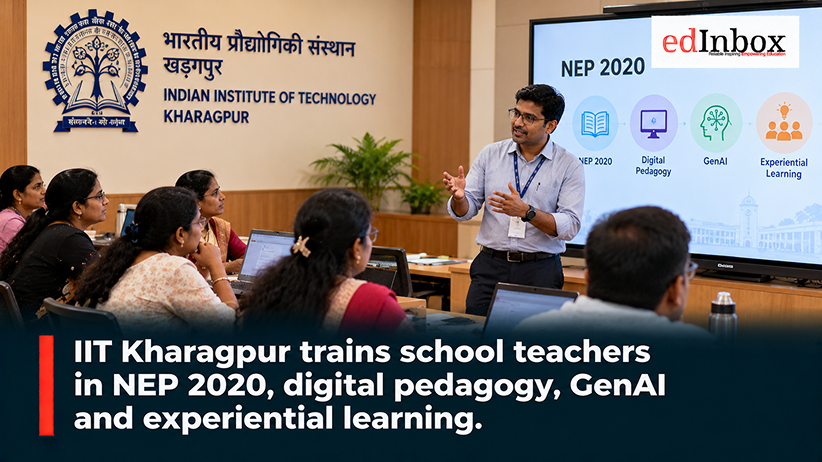
The Indian Institute of Technology Kharagpur’s Centre for Interdisciplinary and Convergent Technologies (CIDCT) has conducted a five-day training program to upgrade school teaching practices by incorporating the National Education Policy (NEP) 2020, digital pedagogy and Generative AI. The training program was conducted for Post Graduate Teacher (PGT) Chemistry and Trained Graduate Teacher (TGT) Work Experience stream.
The training focused on evolving new pedagogical practices consistent with the goals of NEP 2020. The programme blended modern teaching-learning practices as well as hands-on, technology-based modules to provide a comprehensive teacher development package.
The participants were trained in Outcome-Based Education, Assessment, Lab-based learning, Generative AI, Computational thinking, IoT, Microcontrollers, 3D Printing, Raspberry Pi and Project-based learning.
It is expected that these multidisciplinary, skill-based modules will contribute to the overall development of teachers at the school level. In addition, the course aimed to demonstrate the relevance of such futuristic technologies in school education rather than restricting them to higher education or niche areas of teaching-learning.
The participants also interacted with the Virtual Reality Lab and Nehru Museum of Science and Technology at IIT Kharagpur. This enabled them to experience first-hand the value of such immersive, experiential avenues for students. These interactions were expected to motivate participants to adopt similar resources and strategies in school education.
Director of IIT Kharagpur Prof. Suman Chakraborty also spoke with the participants on the broader role of IITs in building an ecosystem for education. “IITs have the potential to be ‘mentors of mentors’ by sharing best practices and providing such immersive experiences,” he added. “They can mentor not only schools and colleges but also universities, NITs, IIITs and even local ecosystems such as MSMEs, hospitals, local governments, start-ups and so on. This mentoring role would cut across all levels of education and research.”
Prof. Chakraborty has previously spoken about IITs needing to evolve from being “islands of excellence” to “enablers and mentors” for NITs, IIITs, universities, colleges, schools, MSMEs, hospitals, local governments, and start-ups. He has advocated for a mentoring framework for ecosystems by the IITs and IISc, wherein these institutes could share their best practices with junior institutes, as well as offer immersive experiences such as workshops and projects to students at local levels.
The five-day training programme thus aimed to bridge the gap between policy and practice. It can be argued that as schools move towards greater reliance on digital tools and AI in teaching, training packages such as these will be critical to evolving a more experiential, interdisciplinary and skill-based pedagogy.





Add comment