

 Nibeditaa Speaks
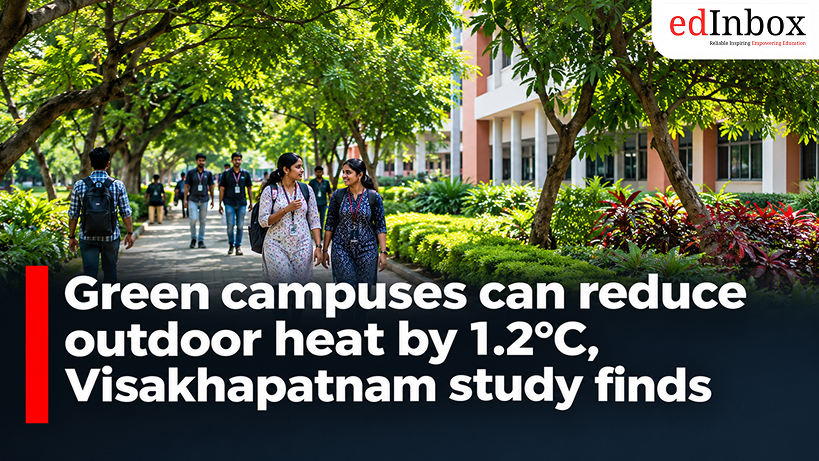
Green spaces could play an important role in making educational campuses cooler and more comfortable for students, according to a field study conducted in Visakhapatnam. Researchers found that a vegetated courtyard recorded temperatures up to 1.2 degrees Celsius lower than a courtyard dominated by exposed hard surfaces, highlighting the potential of campus greenery in reducing outdoor heat.
The study, titled ‘Microclimate and User Perception in Vegetated and Non-Vegetated Educational Courtyards: A Paired Field Study in Visakhapatnam, India’, was conducted by K Sai Sri Laasya, an M.Arch student, and Sai Gautham Kumar Gujjula, Assistant Professor, at the School of Architecture, GITAM, Visakhapatnam.
Published in the International Journal of Latest Technology in Engineering, Management & Applied Science, the research examined how vegetation influences courtyard temperatures, humidity and people’s perceptions of outdoor comfort.
Vegetated courtyards record lower temperatures
The researchers monitored two educational courtyards, a vegetated space identified as GSB and a non-vegetated space identified as SACB, on 10 dates between July 23 and August 8, 2026.
Air temperature and relative humidity were measured at four locations in each courtyard at 9 am and noon.
The findings showed that the vegetated courtyard remained cooler on all 10 monitoring days at both observation times.
At 9 am, the average air temperature in the green courtyard was 29.27°C, compared with 29.98°C in the non-vegetated courtyard. By noon, the difference had widened, with temperatures averaging 29.43°C and 30.63°C, respectively.
The temperature gap increased from 0.72°C in the morning to 1.20°C at noon. Researchers also found that temperatures in the vegetated courtyard rose by just 0.16°C between the two observation periods, compared with a 0.65°C increase in the non-vegetated space.
Relative humidity was also higher in the vegetated courtyard, averaging 79.58% in the morning and 79.20% at noon. The corresponding figures for the non-vegetated courtyard were 76.06% and 75.81%.
Students report better outdoor comfort in green spaces
The study also examined how people experienced the two environments through a survey of 21 courtyard users, approximately 90% of whom were students.
At the vegetated courtyard, 54.5% of respondents described the thermal conditions as comfortable, while the remaining 45.5% considered them neutral. None reported uncomfortable conditions.
In comparison, only 20% of respondents at the non-vegetated courtyard reported comfortable conditions, while 20% described the environment as uncomfortable.
The difference was particularly noticeable in perceptions of prolonged outdoor stays and activity suitability. Around 90.9% of respondents at the green courtyard gave positive ratings for both spending at least 30 minutes outdoors and using the space for activities. At the non-vegetated courtyard, the corresponding figure was just 20%.
Furthermore, 81.8% of respondents at the vegetated courtyard considered the shade effective and reported a significant or very significant cooling effect from vegetation.
Implications for educational campus planning
The researchers attributed the observed differences partly to the shade provided by trees and plants, cooler planted surfaces and moisture released through vegetation, which can influence the surrounding energy balance.
However, they cautioned that the temperature difference cannot be attributed to vegetation alone, as other environmental and site-related factors may also influence microclimatic conditions.
The findings underline the importance of integrating green courtyards, shaded outdoor spaces and vegetation into educational campus planning. As rising temperatures increasingly affect outdoor activities, campus design that considers local microclimates could help create more comfortable environments for students and faculty.



 Miss Kanishka


Add comment