

 Nibeditaa Speaks
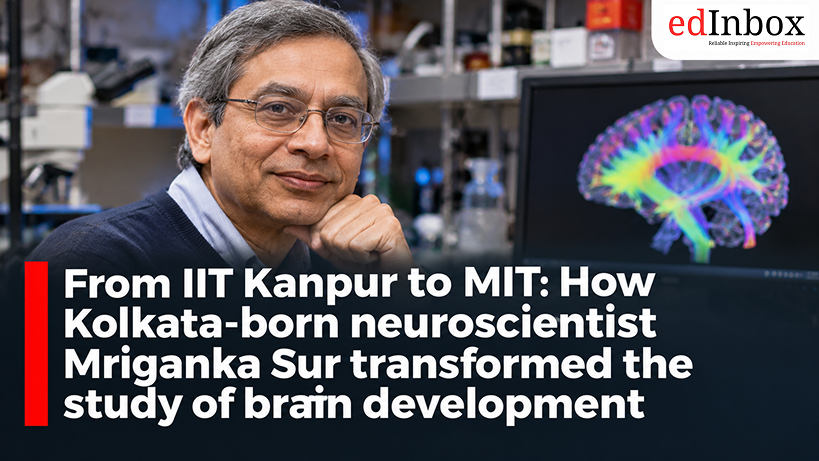
An electrical engineering graduate from IIT Kanpur, Professor Mriganka Sur built an internationally recognised neuroscience career by combining engineering principles with experimental brain research. His work on neural circuits and brain plasticity has helped deepen scientific understanding of how the brain develops and adapts to experience.
Can an electrical engineer become a neuroscientist? Nearly five decades ago, Professor Mriganka Sur demonstrated how knowledge from one discipline could open new possibilities in another. Born in Kolkata, Sur graduated from the Indian Institute of Technology (IIT) Kanpur in 1974 with a degree in Electrical Engineering. He subsequently moved to the United States, where his academic journey took him through Vanderbilt University, Stony Brook University and Yale University before he joined the Massachusetts Institute of Technology (MIT).
His career represents an early example of interdisciplinary research, long before artificial intelligence and computational neuroscience made connections between engineering, biology and technology more prominent.
Today, Sur is recognised internationally for his research into how the brain develops, organises information and adapts to sensory experiences. His academic contributions have earned him prestigious honours, including Fellowship of the Royal Society and the N.R. Narayana Murthy Distinguished Chair at IIT Madras.
From IIT Kanpur to a doctorate in electrical engineering
According to IIT Kanpur’s official alumni profile, Sur completed his BTech in Electrical Engineering in 1974. He then joined Vanderbilt University in Nashville, Tennessee, where he obtained his master’s degree in 1975 and PhD in Electrical Engineering in 1978.
Following his doctorate, he continued at Vanderbilt as a postdoctoral associate between 1978 and 1980. He subsequently joined the Department of Neurobiology and Behavior at the State University of New York at Stony Brook.
It was during this phase that his academic interests increasingly moved towards understanding the brain and its complex networks of neural connections.
How engineering principles helped explain brain wiring
Instead of leaving his engineering background behind, Sur brought its analytical and experimental approaches into neuroscience.
His research focused on the cerebral cortex, the outer layer of the brain responsible for several complex functions, including perception, memory and higher-level information processing.
A central question guiding his work was whether the brain’s organisation is primarily determined by genetic instructions or shaped by sensory experiences such as vision, hearing and touch.
One of his laboratory’s notable experiments involved rerouting the optic nerve of newborn ferrets towards the auditory cortex, a brain region normally associated with processing sound.
Researchers observed that cells in the auditory cortex developed characteristics associated with visual processing and began responding to visual information.
The experiment provided important evidence of neuroplasticity, the brain’s ability to reorganise its neural connections and functions in response to changes in sensory input and experience.
MIT’s Simons Center for the Social Brain identifies cortical development and plasticity as central themes of Sur’s research.
A career connecting engineering, neuroscience and education
Sur’s academic journey highlights the possibilities created when researchers move beyond traditional disciplinary boundaries. His work demonstrates how engineering-based thinking can contribute to understanding biological systems, particularly the intricate networks through which the human brain processes information.
His association with institutions such as MIT and IIT Madras also reflects the continuing importance of international academic collaboration and interdisciplinary research.
For students considering careers in science and technology, his journey offers an important lesson: an undergraduate degree does not necessarily determine the limits of a research career. The ability to question established boundaries, acquire new knowledge and connect ideas across disciplines can lead to entirely new areas of scientific discovery.


 Miss Kanishka


Add comment