

 Nibeditaa Speaks
With hundreds of seats unfilled at private deemed medical universities in Tamil Nadu and Puducherry, the cost of medical education has renewed concerns over affordability. A fresh counselling round remains uncertain.
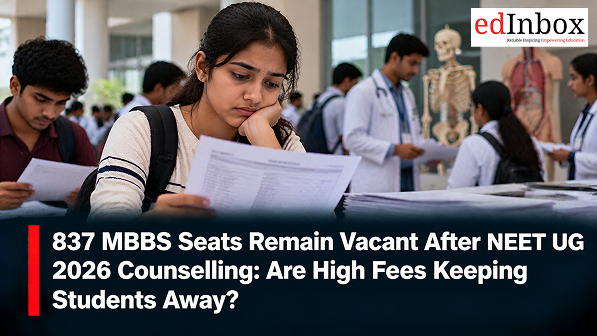
More than 800 MBBS seats reportedly remained vacant after the NEET UG 2026 stray vacancy round, even as thousands of students compete for admission to medical colleges across India. The vacancies have raised questions about whether the high cost of private medical education is putting some seats beyond the reach of aspiring doctors.
According to the college-wise figures reported after the final scheduled counselling round, 837 MBBS seats remained unfilled across Tamil Nadu, Puducherry and Karnataka. The Medical Counselling Committee (MCC) has published the official vacancy and allotment records on its website.
Of the total, 824 seats were reportedly vacant at deemed medical universities in Tamil Nadu and Puducherry. The remaining vacancies included one seat at AIIMS Madurai and 12 at Chettinad Hospital and Research Institute in Kolar, Karnataka.
While vacant seats do not establish that fees were the sole reason candidates declined admission, the figures have drawn attention to the financial burden of pursuing an MBBS degree at private institutions.
Four colleges account for more than 350 vacant seats
A significant share of the reported vacancies was concentrated in four medical colleges.
Shri Sathya Sai Medical College and Research Institute in Chennai had 188 vacant seats, followed by Meenakshi Medical College and Research Institute in Kancheepuram with 117. Mahatma Gandhi Medical College and Research Institute in Puducherry reported 92 vacancies, while Sree Balaji Medical College and Hospital in Chennai had 82.
Together, these four institutions accounted for 479 vacant seats, based on the reported figures.
The numbers raise an important question: when medical colleges have seats available but students do not take them up, what role does affordability play?
MBBS tuition can exceed Rs 20 lakh a year
The cost of studying medicine at private deemed universities can be substantial even before accommodation, food, travel and other expenses are considered.
Published fee information cited in the report lists annual MBBS tuition at Shri Sathya Sai Medical College and Research Institute at Rs 21 lakh and at Mahatma Gandhi Medical College and Research Institute at Rs 24 lakh. Meenakshi Medical College’s 2025–26 admission brochure lists annual tuition at Rs 23 lakh.
Across some deemed medical universities in Tamil Nadu and Puducherry, annual tuition reportedly ranges from Rs 23 lakh to Rs 35 lakh.
At these rates, tuition alone can amount to more than Rs 1 crore over a five-year period, depending on the institution and the applicable fee structure. Additional expenses can increase the overall cost of obtaining the degree.
For families financing medical education through savings or loans, the financial commitment can be a decisive consideration. Students must also weigh the cost of a particular college against their other admission options and the long-term implications of borrowing to fund their education.
However, the available vacancy figures do not establish why individual candidates declined or failed to take admission. Affordability is a plausible concern, but determining its precise role would require data on candidate preferences, withdrawals, fee-related decisions and admission outcomes.
Will MCC conduct another counselling round?
The remaining vacancies have also prompted questions about whether another counselling round could provide eligible NEET UG 2026 candidates with an opportunity to secure an MBBS seat.
The MCC has published the allotment results for the stray vacancy round, which was the final scheduled round at the time of the report. A further round could be considered only if the competent authorities decide to permit it and announce the relevant procedures.
Candidates should not assume that vacant seats will automatically reopen for admission. Any additional round would depend on an official notification specifying eligibility, registration requirements, seat availability and other applicable conditions.
For now, the reported vacancies highlight a persistent challenge in medical education: the availability of a seat does not necessarily mean that a student can afford to accept it. The extent to which fees contributed to the unfilled seats, however, remains to be established.



 Miss Kanishka



Add comment