

 Nibeditaa Speaks
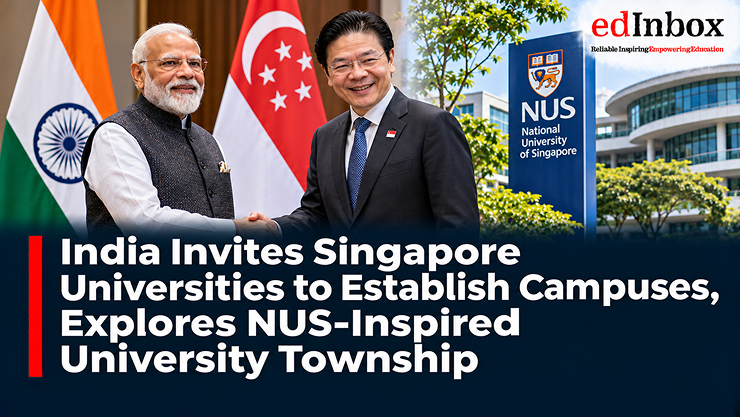
India is looking to strengthen its international higher education partnerships by inviting Singaporean universities to establish campuses in the country and seeking expertise in developing integrated university townships modelled on the National University of Singapore (NUS).
India is exploring a new approach to higher education that goes beyond building individual university campuses. The government wants to develop integrated academic townships where universities, research centres, skill development institutions and residential facilities operate within a shared ecosystem. Singapore’s experience in building such academic environments could play an important role in shaping this vision.
Union Education Minister Pralhad Joshi extended an invitation to Singaporean universities to establish campuses in India during his bilateral meeting with Singapore’s Education Minister Desmond Lee on Sunday. The meeting took place at Singapore Management University (SMU), following the inauguration of the fourth Singapore-India Hackathon.
Joshi also sought Singapore’s assistance in developing India’s proposed university townships, drawing inspiration from NUS University Town, an integrated academic and residential ecosystem designed to encourage collaboration, learning and social engagement.
In a post on X, the education minister said both countries discussed expanding cooperation across school education, higher education, vocational skilling, research and innovation. The discussions also explored opportunities for deeper institutional partnerships and greater academic mobility.
What are India’s proposed university townships?
The university township initiative was announced in the Union Budget 2026-27, which proposed developing five integrated academic zones near major industrial and logistics corridors.
Unlike conventional university campuses, these townships are envisioned as interconnected education hubs bringing together multiple universities, colleges, research institutions, skill development centres and residential infrastructure.
The idea is to create an environment where students, researchers, faculty members and industry professionals can interact beyond traditional classroom boundaries. Proximity to industrial and logistics centres could also strengthen industry-academia partnerships, encourage applied research and improve employment opportunities for graduates.
The Ministry of Education has initiated consultations with state governments, academic institutions and industry representatives to develop the framework for these proposed townships.
Why is Singapore’s university model important?
NUS University Town offers an example of how academic infrastructure can be integrated with student life and research activities. Its ecosystem combines residential facilities, teaching spaces, study clusters and common areas, encouraging students and researchers from different disciplines to interact.
For India, adapting elements of this model could help create more collaborative learning environments, particularly as universities face growing expectations to connect education with research, entrepreneurship and industry requirements.
The discussions between the two ministers also covered mutual recognition of academic qualifications, teacher and student exchange programmes, joint capacity-building initiatives and stronger industry-academia linkages.
What it could mean for Indian higher education
The invitation to Singaporean universities comes as India seeks to internationalise its higher education sector and attract reputed foreign institutions. Allowing overseas universities to establish campuses in India could expand access to international academic programmes while creating opportunities for research partnerships and faculty exchanges.
However, the success of university townships will depend on more than international collaborations or physical infrastructure. Affordable access, academic autonomy, research funding, quality faculty and meaningful industry participation will be equally important.
If implemented effectively, the proposed townships could reshape India’s higher education landscape by bringing teaching, research, innovation and employment closer together. The challenge will be ensuring that these developments create accessible centres of academic excellence rather than exclusive educational enclaves.






Add comment