

 Nibeditaa Speaks
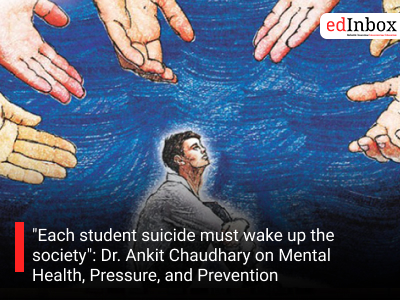
Indian student suicides have been increasing at a alarming rate, and that has been triggering essential dialogues on mental health, academic pressure, and societal pressures. Though every incident is heart-wrenching, practitioners maintain that these are not isolated incidents but signs of a greater failure in the system.
To know the root causes and probable solutions, Edinbox scribe interviewed Dr. Ankit Chaudhary, Assistant Professor of Psychiatry, National Institute of Mental Health Rehabilitation, Sehore. During this frank conversation, Dr. Chaudhary reveals why suicides are infrequently impulsive actions, how social media has infused new forms of stress, and what common measures families, schools, and policymakers need to undertake to protect youthful lives.
Q: Student suicides are usually portrayed as unexpected, shocking families and friends. Are they that unpredictable?
Dr. Chaudhary: Students are constantly trying to meet expectations of parents, teachers, peers, and society. Though we claim every child is unique, in fact, they are compared against a stiff set of academic standards. This conflict between individuality and external expectation is the point where pressure mounts.
Family dynamics also changed dramatically. With the emergence of social media, students are more likely to relate to cyber friends than actual siblings. The perfected, glamorous lives presented on the web instill unrealistic expectations.
And this is extremely serious. They reason, “No one will get it, and I will be worrying my family for no good reason.”This is where awareness is extremely important. We must elucidate that mental health issues are not flaws, but illnesses that need treatment, just like illnesses of the body.
Q: Schools do offer counseling, but obviously, it’s not sufficient. What else can be done?
Dr. Chaudhary: The professionals in schools are very few in comparison to the requirement. Aside from that, the education system has to change from creating poisonous competition towards healthy collaboration. Every student needs to feel they can do something well. Early warning signs can be detected through regular screenings at schools, and in time referrals for higher centers have to be made when the situations are serious.
Task forces may be set up to examine student suicides, determine patterns, and act where necessary. Notably, policy needs to prioritize mental health as much as academic success.
Q: Any message for society in general, what would it be?
Dr. Chaudhary: Even one suicide must rattle us as a society. They are not individual tragedies but warning signs that something in the system is seriously amiss. If we recognize and fix honestly the pressures students are subjected to—whether social, familial, or institutional—these numbers must come down considerably. Education must finally be a complete and enjoyable experience and not a chore that drives young minds to desperation.
Dr. Ankit Chaudhary’s words serve as a grim reminder that suicides among students are avoidable if society takes responsibility together.




 Pooja Khanna


Add comment