

 Nibeditaa Speaks
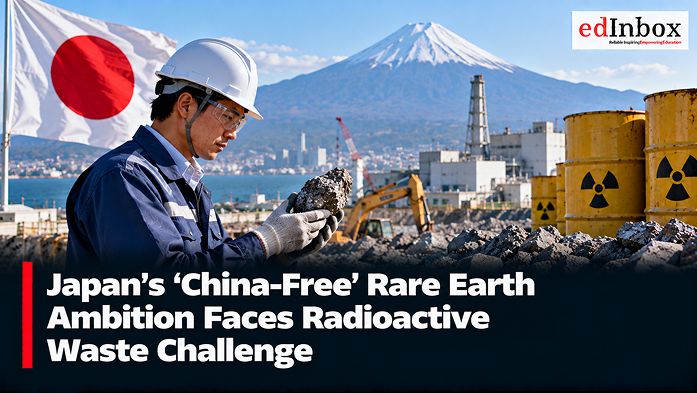
Japan’s breakthrough in recovering rare-earth-rich mud from the deep sea marks a technological milestone. But questions over radioactive waste, refining capacity and environmental safeguards could complicate its bid to reduce dependence on China.
Japan’s effort to secure a domestic supply of rare earths from the Pacific Ocean has reached a critical stage. The country has demonstrated that it can retrieve mineral-rich mud from the seabed, but a more difficult question remains: who will refine it, and how will the radioactive waste generated during processing be handled?
In February 2026, Japan became the first country to continuously recover rare-earth-rich mud from a depth of 6,000 metres off Minamitorishima, its easternmost island, and bring it aboard a vessel. The achievement was significant for a country that depends on China for about 90% of its rare-earth supply. A diplomatic dispute in 2010, which disrupted Chinese exports to Japan, had exposed the risks of relying heavily on a single supplier.
However, the project faces an environmental and industrial challenge that could undermine its promise.
Rare-earth mud naturally contains radioactive elements, including thorium and uranium. A 2016 Japanese study found that in the mineral-rich sediment layer, thorium concentrations were comparable to those of terbium, a valuable heavy rare earth. While Japan’s marine research agency JAMSTEC maintains that the average thorium concentration across the recovered mud is around 15 parts per million, it has not disclosed the actual measurements taken during the latest test.
JAMSTEC said in July that no significant levels of harmful or radioactive substances had been detected. Project officials argue that the concentrations are comparable to naturally occurring levels in marine sediments and do not require special management.
Scientists, however, caution that the risk may emerge during refining rather than extraction. Processing can concentrate rare earths by 50 to 100 times, potentially concentrating thorium alongside them. Julie Klinger of the University of Wisconsin–Madison has warned that even low initial concentrations could become a regulatory concern in the final product or waste stream.
Thorium poses its greatest health risks when inhaled or ingested, particularly through prolonged exposure to contaminated dust. Experts also point out that refining can generate radioactive residues, filter cakes and other waste requiring safe disposal.
Japan’s proposed domestic refining chain remains uncertain. Three companies reportedly considered for the process — Proterial, Shin-Etsu Chemical and Mitsui Kinzoku — have not confirmed concrete plans to handle the seabed material. Mitsui Kinzoku has said it does not accept radioactive raw materials, while Proterial reported no specific examination of the project.
The regulatory picture is equally unclear. Japan’s Nuclear Regulation Authority has said the seabed mud is not classified among designated raw materials under existing law. Consequently, responsibility for managing any resulting waste would rest with the operator.
The challenge reflects a wider problem in the global rare-earth industry. According to the International Energy Agency, China accounted for 61% of global rare-earth mining and 91% of refining and processing in 2024. Its dominance is built not only on access to minerals but also on its willingness to undertake the difficult refining process.
Japan could also expand recycling and urban mining, although less than 1% of global rare-earth demand is currently met through recycling.
The Minamitorishima project may help diversify Japan’s mineral supply, but recovering mud is only the first step. Without a transparent assessment of environmental risks, a confirmed refining partner and a credible radioactive-waste management plan, the country’s deep-sea breakthrough may remain far from a viable alternative to China.





Add comment