

 Miss Kanishka
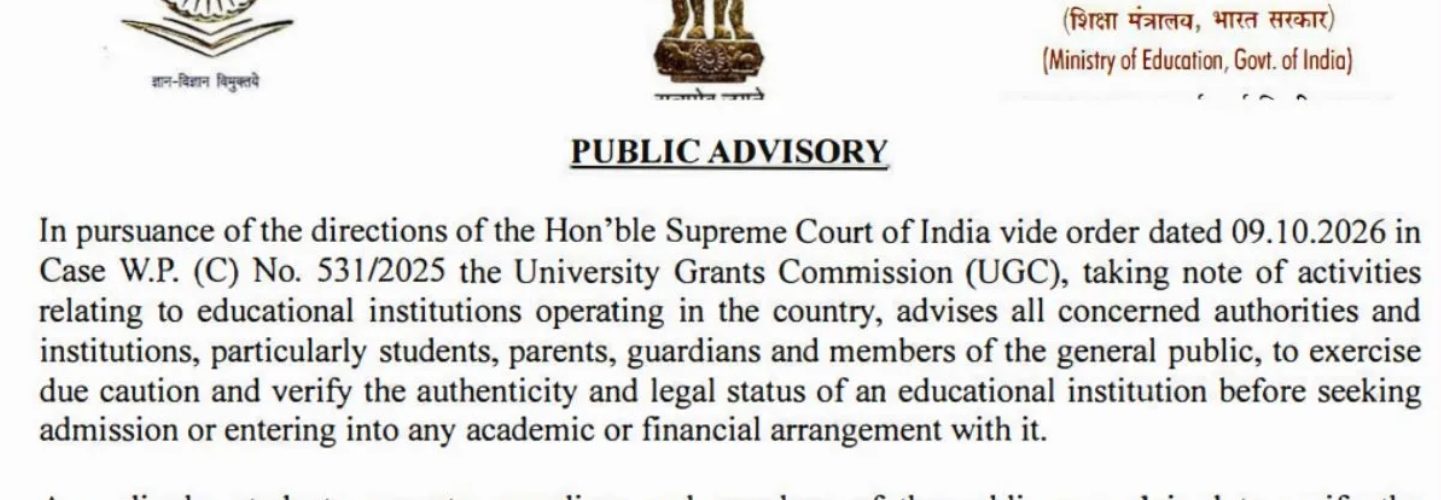
With university admission decisions approaching, the University Grants Commission (UGC) has urged students and parents to verify the legal status and authenticity of higher education institutions before taking admission or making any academic or financial commitment.
In a public advisory dated 17 November 2026, the UGC asked students, parents, guardians and other members of the public to exercise caution while choosing an institution. The advisory follows directions issued by the Supreme Court of India on 9 October 2026 in a case concerning fraudulent educational institutions.
The commission has also warned students against relying solely on advertisements, websites, brochures and social media posts to establish whether an institution is recognised or authorised to award degrees.
The concern is significant. According to the UGC’s latest available list, published in February 2026, 32 institutions have been identified as fake universities across India. Students should therefore check an institution’s credentials before paying an application fee or accepting an admission offer.
4 Things Students Should Check Before Taking Admission
The UGC advisory highlights four important areas that students and parents should verify before enrolling in a higher education institution.
1. Legal Recognition of the Institution
Check whether the institution has been legally established or recognised under the applicable laws. Students can consult the category-wise list of universities available on the UGC website to verify an institution’s status.
2. Authority to Offer the Course and Award Degrees
An institution’s existence does not automatically mean it can offer every programme or award every qualification. Students should confirm whether it is legally authorised to conduct their chosen course and award the relevant degree or qualification under the UGC Act, 1956, and other applicable laws.
3. Required Regulatory Approvals
Some programmes require recognition, approval or permission from specific statutory and regulatory authorities. Students should check whether the institution and the particular programme have the necessary approvals wherever applicable.
4. Validity of the Course and Mode of Study
The UGC has also asked students to verify whether the programme and its mode of delivery are permitted. This includes checking the validity of distance education, online programmes, off-campus centres and study centres, wherever relevant.
How to Verify a University’s Recognition
Students can visit the official UGC website and consult its category-wise list of universities. The commission also maintains a list of fake universities, which is useful when checking an institution’s credentials.
For programmes governed by other statutory or regulatory authorities, students should consult the respective authority’s official website to confirm the required approvals.
The UGC has specifically advised students not to rely only on claims made in promotional material. An institution’s website or admission brochure should not replace independent verification through official sources.
Verify Before You Apply
Choosing a university involves more than comparing course fees, campus facilities and placement claims. Students should also establish whether the institution is legally authorised to offer their chosen programme and award the qualification.
A few minutes spent checking official records can help students avoid invalid qualifications, financial losses and complications later in their academic or professional journey. Before accepting an admission offer for 2027, verify the institution, the course and the mode of study through the relevant official sources.






Add comment