Are you fascinated by food, crops, biology, and agriculture? If yes, Agriculture might be your calling. Students with inclination towards these have a unique mindset as well as skillset that if polished can make them build a lucrative career. There are several roles and opportunities in India’s agriculture sector and to access them, the first step is  taking the Agriculture Entrance Test for securing a seat in the top agriculture college. 

AIACAT, also known as All India Agriculture Common Aptitude Test, is one of the latest entrance exams accepted in over 80 top universities in India offering B.Sc. and M.Sc. Agriculture programs. The online test conducted on a national level simplifies the admission process and is hassle free and future proof to passionate Indian students who are willing to make a difference in the future of farming.​

What is AIACAT?

AIACAT is an online entrance examination of UG/PG agriculture of 60 minutes with no negative marking,  designed for agriculture aspirants.  The exam is designed to test one’s knowledge of agricultural science, biology, environmental science and rational thought, which is in line with innovative programmes that will equip you with real-world challenges such as sustainable farming and food security.​

How To Give AIACAT?  

To take the exam, the candidate must have either a mobile, laptop or desktop, and the registration must be done via its official website. The registration fee is to be paid during enrollment through UPI/ Paytm. 

This agriculture entrance test is easier and convenient, opening doors to 80+ top universities. Once the candidate has given the exam, the results can be expected in 2-3 days. Soon after, the qualified candidates can book counselling and secure a seat in their desired campus.

Why AIACAT? 

Nationwide recognition ensures smooth entry to top colleges. Unlike lengthy exams, AIACAT's quick process lets you start your career faster. 

Agriculture Degrees via AIACAT

Agriculture powers 45-50% of India's jobs, and AIACAT acts as the stepping stone towards these lucrative job opportunities. Here are some of the things graduates pursue: 

  • Research Roles: Develop crop varieties, pests at ICAR.
  • Govt Jobs: Permanent jobs in Ministry of Agriculture, NABARD.
  • Agri-Business: Supply chain, marketing in leading companies (
  • Entrepreneurship: Start organic farms, agro-processing.
  • International Gigs: NGOs, sustainable development, FAO, IFAD.
  • Food Industry: Packaging, quality control, big brand packaging.

As agri-economy in India is booming and, AIACAT qualifiers can secure high-demand jobs in agronomy, rural development, and more, and make their passion fruitful for all.​

The reason why Indian Students should take AIACAT

Farming is not only farming but innovation! AIACAT opens the door to research opportunities, entrepreneurship, and sustainability, and helps passionate students find the right university that will equip them with the right skills to resolve the food security crisis in India. 

All-in-all, AIACAT stands as the second best option after top entrance exams for agriculture aspirants with its easy format, zero negative marking and direct links to the university. It is  a good choice for Class 12th pass-outs or grads. Visit the official  site of AIACAT for more info: https://aiacat.com/ 
Agriculture, a word that has the generations running from the start of time. It is an important part of India's economy, food security, employment, and rural development. For any student who is passionate about farming, sustainability, and innovation, agriculture courses in India bring a wide range of opportunities. Here are five key reasons why studying agriculture is a smart and future-ready career option:

1. Diverse Career Opportunities in Agriculture and Allied Sectors

Agriculture in India is a very diversified sector, ranging from crop production to horticulture, animal husbandry, fisheries, forestry, agro-processing, and more. Students who have pursued agriculture can find careers as agricultural officers, researchers, farm managers, agribusiness specialists, food safety inspectors, and consultants. There is also an increasing demand for agri-tech specialists and organic farming specialists. The sector offers regular employment opportunities across government departments, private companies, research organizations, and NGOs.

2. Practical Learning and Hands-on Experience

Agriculture courses not only provide theoretical inputs but also include fieldwork, internships, and laboratory involvement for students. Students learn about soil health, the management of crops, control of pests, farm machinery, and modern techniques of precision farming and hydroponics. These hands-on training make graduates job-ready, equipping them with employable skills in line with industry requirements.

3. Contribution to National Food Security and Sustainability

With the Indian population surging at a never-before rate, the country needs scientifically trained professionals to meet the growing demand for production. Agriculture graduates develop new varieties of crops, decrease the use of chemicals, promote organic farming, and apply methods of water conservation. Their role is critical in addressing climate change, maintaining ecological balance, and safeguarding the food security of the nation.

4. Entrepreneurship and Agri-Business Opportunities 

A degree in agriculture can empower the students to become entrepreneurs by starting a farm, agri-product business, organic food store, or agri-tech startup. Government schemes give financial aid, training, and subsidies, especially for encouraging youths in agriculture entrepreneurship. This sector offers scope for innovation and leadership in a niche market. 

5. Improvements in Technology and Farming Research 

The agriculture industry is one of the fastest-evolving sectors with the latest use of drones, AI, remote sensing, and biotechnology. Agriculture graduates with digital and scientific skills are required for the deployment of such innovations. This opens lucrative career pathways in research, policy-making, and technology deployment within the country and abroad. 

A career in agriculture is not only about growing crops, it is a commitment to social, environmental, and economic causes. With higher job security, wide-ranging opportunities, scope for entrepreneurship, and the chance to contribute to food and environmental security, agriculture promises a rewarding and respected profession to Indian students. Agriculture would be the perfect field for those in search of a career that masterfully balances science, technology, sustainability, and social service.

Note: Students seeking to  build a career in agriculture must enroll for AIACAT (All India Agriculture Common Aptitude Test) and get easy admission to the top universities in India offering agriculture courses. 

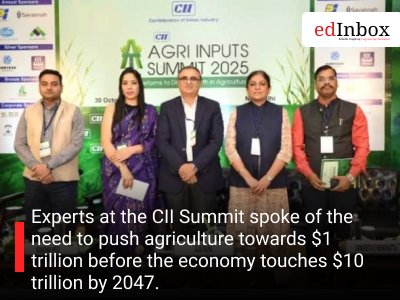
Acceleration in the agriculture sector would not be complete without India's quest to emerge as a $10 trillion economy by 2047. According to industry experts at the CII Northern Region Agri Inputs Summit, agriculture needs to grow from about $450 billion now to $1 trillion in order to contribute toward the economic vision of India. With almost 46% of India's population dependent on agriculture, the share of this sector in GDP remains close to 15%, indicating an imperative need for policy reforms and technology adoption besides more investments.

Technology and policy reforms can power the next Green Revolution in India.

Ajay Rana, chairman of the CII Northern Regional Committee on Agriculture and also head of the Federation of Seed Industry of India, said scientific innovation has already demonstrated transformative impact. Adoption of hybrid maize seed has for instance jumped from 15-20% to almost 90% in the last two decades, proof that technology-driven policy can multiply farm productivity. For the full realization of agriculture's potential, he went on to say, widespread adoption of technology, modern agri-inputs, and farmer-centric innovation would be required.

India needs clear, consistent, science-based agri policies

The summit saw demands for predictable and science-based regulatory frameworks from various participants. Rana also proposed a National Agricultural Technology Council to ensure harmonisation of policies between Centre and states on time-bound approvals on seeds, crop protection products, and new farming technologies. Inconsistent state regulations, coupled with sudden bans, discourage private investment in this sector, leading to slow innovation in agri-inputs, experts said. Four Pillars of Rural Growth: “Seed to Market” Strategy Emphasising adherence to the government's vision of "Seed to Market" in enhancing rural resilience, speakers outlined four pillars to agricultural empowerment-seed, insurance, credit (bank), and market access-which would, over time, empower farmers to be more productive, reduce their risk, and have better income stability. Agri-Input Sector Could Double to $120 Billion Long-term policy reforms could double the value of the agri-input industry from $60 billion to $120 billion, increase exports, and make agriculture a core driver of national growth, say experts.

Commerce minister Piyush Goyal also shared this tale earlier this week that a US-India bilateral trade deal is set to be concluded by December this year.

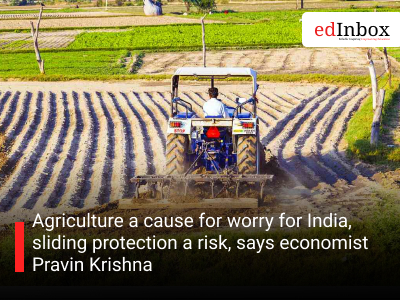
India's challenges in liberalizing the agrifood industry in free trade agreements are "important," and a protection sliding scale--to be eliminated over a period of time--could be an option in negotiations with the US, says Johns Hopkins University economist Pravin Krishna.

Krishna, Distinguished Professor of International Economics and Business at Johns Hopkins University, who was in Delhi for the Kautilya Economic Conclave, 2025, told Fortune India that every country, including India, has its own fears on topics like these.

"I do agree that Indian agriculture is an exposed sector. It is a large sector. Poor livelihoods depend on the sector," Krishna told Fortune India.

"And this is a big worry for India. The question is, how do we respond to it? To what degree do we insulate the farmers?" Krishna said.

He suggests a sliding scale of protection only for farming for a period of time. "We must have a sliding scale of protection where we sign the deal now and say in 15 or 20 years, the sliding scale of protection can progressively be withdrawn. This way, nobody has time to make arrangements," he said in a Fortune India interview.

"The other option is to exclude agriculture altogether. And negotiate on everything else. So I believe, in theory, everything's on the table. So one can negotiate," Krishna said.

"So, how does one deal with that real economic moral question, while doing the other things, is a question that the government must consider," Krishna said.

India-US trade talks resumed after they were suspended following the action by the Trump administration to impose a 50% import tariff on Indian products. This includes 25% punitive tariffs on the purchase of Russian oil.

The US wants access to India's dairy and agricultural market, which is not acceptable to the Indian side. Official negotiations collapsed in August this year when the US called off a visit by a trade delegation towards the end of August.

Optimism for trade progress in talks between trading counterparts was rekindled as Prime Minister Narendra Modi on Thursday backed the U.S.-brokered trade deal between Israel and Hamas and also called U.S. President Donald Trump.

"SPOKE to my friend, President Trump and congratulated him on the success of the historic Gaza peace plan. Also reviewed the good progress achieved in trade negotiations. Agreed to stay in close touch over the coming weeks," Modi wrote in an X post.

On Tuesday, Commerce Minister Piyush Goyal also mentioned that a US-India bilateral trade agreement is likely to be finalized by December this year.

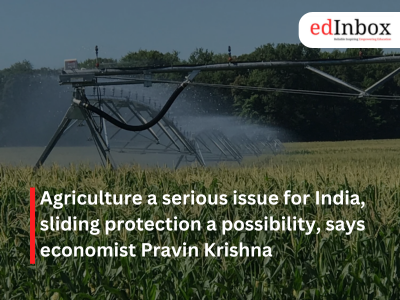
India's apprehensions regarding opening up the agriculture sector in bilateral trade deals are "important", and a sliding scale of protection--to be phased out over a time period--could be a possibility in negotiations with the US, said economist Pravin Krishna of Johns Hopkins University.

Krishna, a Chung Ju Yung Professor of International Economics and Business at Johns Hopkins University, who was in Delhi attending the Kautilya Economic Conclave, 2025, informed Fortune India that all countries, including India, have their issues on issues such as these.
"I do think India has a vulnerable agricultural sector. It is a big sector. A majority of the poor are dependent on the sector," Krishna explained to Fortune India.

"And agriculture is a very big worry for India. The issue is, how do we deal with this? How much do we safeguard the farmer?" said Krishna.
He proposes a sliding scale of protection purely for agriculture for a particular duration. "Should we have a sliding scale of protection where we sign the agreement now and say in the next 15 or 20 years, the sliding scale of protection could be removed incrementally. This way, everyone has time to adapt," he said in an interview with Fortune India.

"The second choice is to exclude agriculture entirely. And discuss everything else. So I believe, in the abstract, everything is available. So one can negotiate," Krishna added.

"So, how does one address that real, economic moral issue, while doing the other things, is a question which the government must consider," Krishna said.

India-US trade negotiations resumed after a temporary suspension due to the Trump administration's move to impose a 50% duty on Indian imports. This comprises 25% punitive tariffs for importing Russian oil.

The US is seeking access to India's dairy and agricultural markets, which is not acceptable to the Indian side. Formal negotiations derailed in August this year following the cancellation of a visit by a trade delegation in late August.

Expectations of breakthrough in trade negotiations between the trading partners brightened after Prime Minister Narendra Modi on Thursday greeted the U.S.-facilitated trade agreement between Israel and Hamas and had a call with U.S. President Donald Trump.

"Spoke to my friend, President Trump and congratulated him on the triumph of the historic Gaza peace plan. Also reviewed the satisfactory progress made in trade talks. Agreed to remain in close communication in the weeks ahead," Modi stated in an X post.

Earlier this week, Commerce Minister Piyush Goyal too has stated that US-India bilateral trade agreement is expected to be finalized by December this year.

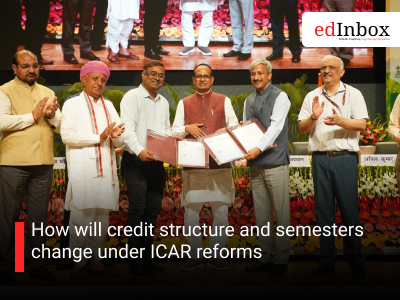
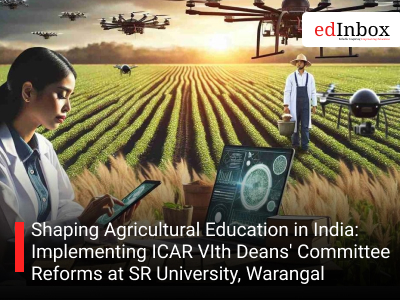
On a broad restructuring by the Indian Council of Agricultural Research (ICAR), agricultural universities' credit and semester system will see a significant transformation to keep pace with the National Education Policy (NEP) 2020. The reforms will be implemented through the Sixth Deans' Committee, established in 2021, which has been assigned the task of redesigning course structures, credit weights, and academic streams for all undergraduate courses in agriculture and allied sciences.​

Flexible Credit Framework

The ICAR credit system will incorporate NEP 2020's central principle of flexibility. Students shall be in a position to earn credits and transfer them from one institution or field of study to another through the Academic Bank of Credits. This implies that skills-based courseware, entrepreneurship courses, and internship courses will all have academic value. Credits will also be calibrated to enable experiential learning, internships, and innovation projects — the central areas for converting students from job seekers to job creators.

Multi-Exit and Re-Entry Options

Breaking with the classical fixed four-year framework, under the new regime, students will be able to enter and re-enter programs at several points. Students can earn a certificate after one year, a diploma after two, and a full degree after three or four years. The architecture is such that, in case students discontinue studies for personal or professional reasons, they can do so without loss of progress, capturing the spirit of NEP's focus on lifelong learning.​​

Outcome of the Reforms

The Sixth Deans' Committee visualizes graduates as technically competent, entrepreneurial, and world-class. Having uniform credit standards and flexible semesters, the new system is designed to enhance the Gross Enrolment Ratio in agricultural education while producing graduates more poised for agri-business, research, and innovation.

The Sixth Deans' Committee of the ICAR VI Deans' Committee has significantly transformed agricultural education in India to address the new needs of the agriculture industry and the guidelines of the National Education Policy (NEP) 2020. 

Key Area of Emphasis and Reforms Implemented:

1. Programme Structure and Length:

The committee had recommended a 4-year B.Sc. (Hons.) Agriculture programme with a point of exit after:

1st year: Certificate in Agriculture Sciences

2nd year: Diploma in Agriculture Sciences

4th year: B.Sc. (Hons.) in Agriculture Sciences

Multi-entry and exit-entry mechanism under NEP 2020 provides students with flexibility with depth of knowledge for students taking the whole degree.

2. Standardization of Curriculum Across Universities:

Same curriculum was adopted in all agricultural universities to ensure uniform academic standards and learning outcomes nationwide.

Courses were simplified to include major agriculture disciplines while removing antiquated material.

3. Skill Development and Experiential Learning:

The Student READY (Rural Entrepreneurship Awareness Development Yojana) program has been further boosted to offer practical training.

Hands-on practice, internships, and rural agricultural work experience (RAWE) must be provided to students to make them more practical along with theoretical.

Greater focus on skill-based learning provides students with the means to achieve self-employment and entrepreneurial prospects.

4. Reforms and Credit System Evaluation:

Flexible learning Choice-Based Credit System (CBCS) was suggested by the committee.

Academic Bank of Credits (ABC) system allows students to store and transfer credits from one institution to another.

50:50 internal-external evaluation proportion has been suggested for an even-evaluation plan.

5. Degree Standardization and Terminology

All the degrees now have a standardized nomenclature such as B.Sc. (Hons.) Agriculture, B.Sc. (Hons.) Horticulture, B.Tech. Agricultural Engineering, etc.

The intent is to keep it simple and uniform in higher education degrees all over the nation.

6. Infrastructure and Faculty Development:

VI Deans' Committee has a minimum infrastructure requirement for establishing new colleges of agriculture, which are as follows:

Modern laboratories Research farms Libraries and computer centers

Teacher upgradation schemes have been proposed to keep the teachers on par with newer teaching practices and newer technology in agriculture.

7. Research and Innovation Integration:

More emphasis on technology adoption in agriculture including: Precision agriculture, remote sensing, GIS. Artificial Intelligence (AI) based crop monitoring.

Facilitating research collaborations between Universities, ICAR Institutes, and Private Agri-Tech companies.

8. Way Forward and Long-term Impact:

VI Changes to Deans' Committee aim at:

Reform India's agriculture education.

9. Implementation and Current Status:

Most of the universities have followed the recommendations of the Sixth Deans' Committee.

The ICAR has made it mandatory for all accredited agricultural universities to follow.

SR University School of Agriculture has been able to implement the ICAR VIth Deans' Committee recommendations, harmonizing its agricultural education system with national standards. This standardizes the course, enhances skill development and experiential focus, and imparts industry-focused skills and practical exposure based on modern agricultural practice

This reform will go a long way in fueling the Atmanirbhar Bharat (Self-reliant India) drive by making future generations of agri-innovators and policy-makers stronger.

More Articles ...