Government of Ireland offers €10,000 scholarships to international students, application process to start on January 29
 Teline V
Best News Template For Joomla
Teline V
Best News Template For Joomla
Hansraj College, one of the prominent constituent colleges of Delhi University, has made an official announcement for inviting applications for 41 non teaching posts as part of DU Recruitment 2026. The recruitment drive is to fill the permanent vacancies of various administrative and laboratory roles. The eligible and interested candidates can apply for the posts through the Samarth Recruitment Portal, and the last date of submission of the application is February 5, 2026.
These positions are the ones that mainly concern the academic and administrative workings of the college. In detail, the recruitments have been announced for one Administrative Officer, five Laboratory Assistants, three Junior Assistants, three Library Attendants, and 29 Laboratory Attendants.
The department of Laboratory Attendant posts has been increased recently, which clearly shows the college's requirement of technical and supporting staff.
The process of application submission is fully online. Applicants have to go to the official recruitment portal dunt.uod.ac.in, fill up the application form, upload the relevant documents, photographs, and signatures, and then submit the form. They are suggested to thoroughly go through the eligibility criteria, age limits, and reservation provisions given in the detailed notification at www.hansrajcollege.ac.in.
According to DU Recruitment 2026 instructions, the intended written examination comprising Paper I & Paper II will be the major component of the selection process. Candidates applying for certain posts may also have to go through a skill test or interview. The college has pointed out that the ultimate choice will be based on the candidates' showing at the selection stages only, following the University of Delhi rules.
This recruitment is a great chance for the candidates who wish for a stable, permanent job in a central university set up. Furthermore, all those chosen will be on the rolls of Hansraj College, New Delhi, and the Delhi University service rules will be their governing body.
Since the last date for submission of applications is 5th February 2026, the aspirants are recommended to avoid the last minute rush and finish the online application process little early. For news, examination information, and eligibility criteria for different posts, candidates should refer only to the official web pages of Hansraj College and Delhi University to safeguard themselves from getting misled.
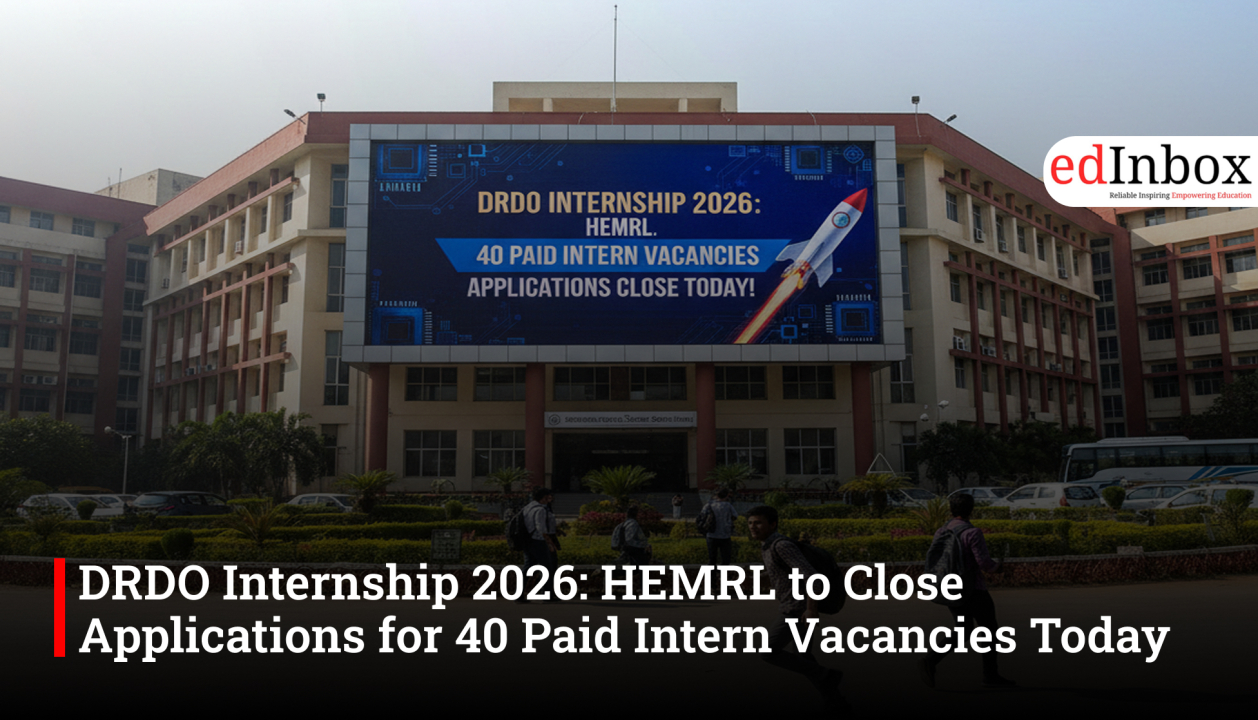
The High Energy Materials Research Laboratory (HEMRL), which is the top research facility of the Defence Research and Development Organisation (DRDO), will end the submission of applications for the DRDO Internship 2026 programme today January 27, 2026. The internship program is designed to create 40 paid intern positions where students and young researchers can enjoy the privilege of working closely with advanced defence research through the practical experience.
HEMRL that is in Pune is a vital node in India's network of defence research, and more so with the focus on the development of high energy materials for strategic and tactical applications. With this internship programme, the laboratory essentially provides a platform for the academic talent to get exposure to the research environment and challenges encountered in the defence sector.
Interested and eligible candidates are required to apply through the offline mode. Applicants must complete the prescribed application form and send the duly filled documents to The Director, HEMRL, Sutarwadi, Pune – 411021. As per the official notification, applications received after the deadline will not be accepted under any circumstances.
The internship programme is structured to provide selected candidates with direct mentorship from experienced DRDO scientists and technical experts. Interns will be involved in laboratory-based research, data analysis, and project-related activities, enabling them to understand the practical application of theoretical knowledge. The focus areas primarily include high-energy materials and allied domains, which are crucial to India’s defence preparedness.
According to DRDO, the internship programme aims to create a connection between the students' theoretical knowledge and practical research, in particular for those students studying engineering, science and technology, related subjects.Furthermore, the paid internship will offer a stipend and the exact information about it is available in the official guidelines.
Candidates should check the eligibility criteria, stipend, duration of the internship and the papers very carefully before applying. All the details and the official application form are available on the DRDO website, drdo.gov.in.
Since the application window closes today, candidates who are eligible should go ahead and complete the process as well as ensure that they send their applications on time. The DRDO Internship 2026 at HEMRL is regarded as a golden opportunity for candidates who wish to get an initial understanding of India's defence research and development sector.
India Post will release the India Post GDS Recruitment 2026 notification on January 31, 2026 for 28,740 Gramin Dak Sevak (GDS) vacancies across the country. This major government job opportunity targets 10th pass candidates with no written exam, selection based purely on Class 10 marks. Applications open at indiapostgdsonline.gov.in from January 31 to February 14, 2026.
|
Event |
Important Date |
|
Notification Release |
January 31, 2026 |
|
Online Application Starts |
January 31, 2026 |
|
Last Date to Apply Online |
February 14, 2026 |
|
Fee Payment Deadline |
February 16, 2026 |
|
Application Correction Window |
February 18-19, 2026 |
|
First Merit List |
February 28, 2026 |
India Post GDS Recruitment covers three main positions:
Total Vacancies: 28,740 posts (tentative) across all 23 postal circles and union territories. Circle-wise and category-wise breakup available in official notification.
Essential Qualifications:
No written exam – Merit list prepared based on Class 10 marks.
Application Window: Jan 31 to Feb 14, 2026 (23:59 hrs)
India Post GDS Salary Structure 2026
|
Post |
Salary Range |
|
GDS |
₹12,000 - ₹29,380 |
|
BPM |
₹12,000 - ₹29,380 |
|
ABPM |
₹12,000 - ₹29,380 |
Additional Benefits: DA, medical allowance, social security schemes, 26 days paid leave.
Multiple merit lists if vacancies remain after the first round.
Exact circle-wise vacancies in official notification, but previous trends:
✅ Boost 10th Marks: Merit-based selection
✅ Prepare Documents: 10th certificate, ID proof, address proof
✅ Choose Right Division: Apply within 1 division only
✅ Check Circle Notification: Some circles release advance vacancy details
Apply Online: https://indiapostgdsonline.gov.in
Notification PDF: Available Jan 31, 2026
Helpline: Check notification for circle-wise numbers
India Post GDS Recruitment 2026 offers 28,740 stable government jobs for 10th pass youth. No exam, merit-based selection makes this golden opportunity for rural and small-town candidates. Prepare documents now and apply between Jan 31-Feb 14 at indiapostgdsonline.gov.in
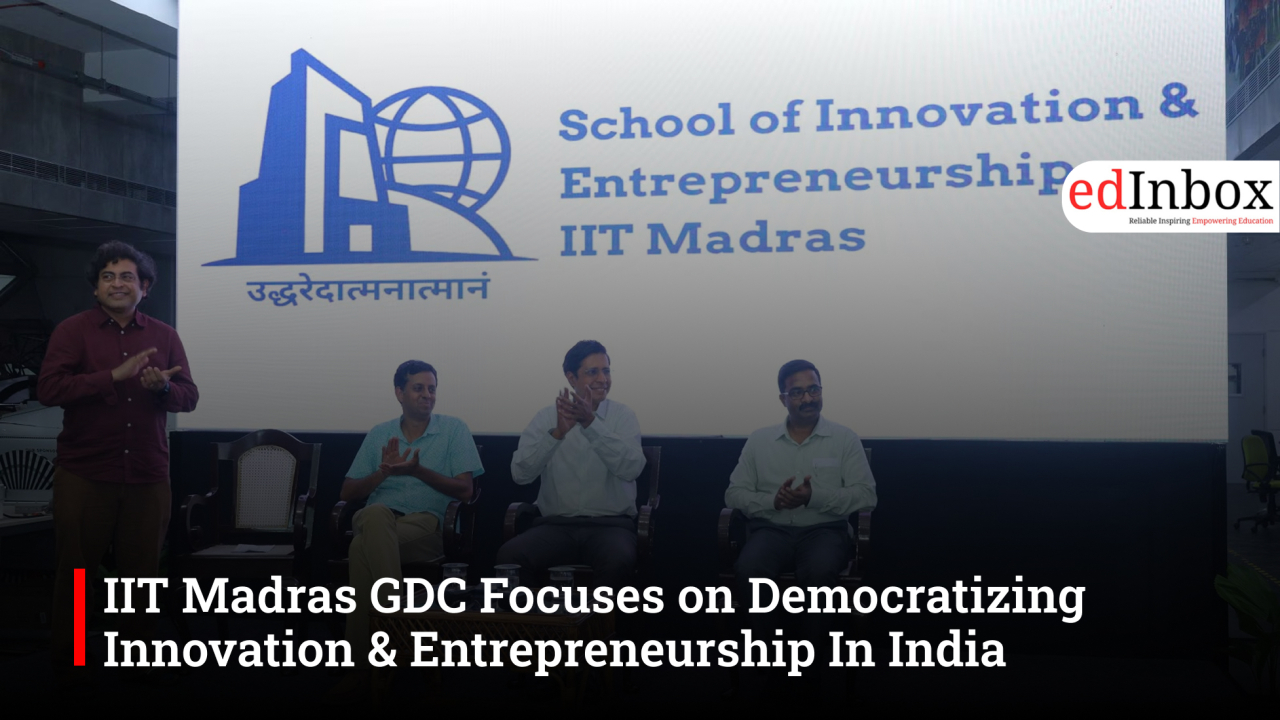
Indian Institute of Technology Madras’ (IIT Madras) Gopalakrishnan-Deshpande Centre for Innovation and Entrepreneurship (GDC) organised its sixth Annual GDC Symposium, themed 'Democratising Innovation and Entrepreneurship in India'. Organised on Saturday, the symposium brought national focus on the role of the entrepreneur as the central driver of India’s deep-tech and innovation-led growth. More importantly, the symposium debated how to increase the focus of policymaking, mentorship and funding on “building capable entrepreneurs” as a missing piece of the scaling innovation puzzle in India.
The symposium highlighted a critical gap in the ecosystem — the sustained development of an entrepreneurial mindset and skills. The speakers pointed out that although technology, funding, and infrastructure are necessary, the most significant factor for an entrepreneur's long term success is mentoring, nurturing, and building the capabilities of the individuals involved, particularly in deep, tech startups that require a lot of time before becoming profitable.
For years, the banking sector had depended on past data, fixed rules and human judgement to make decisions about critical functions. Credit granting, trading and identifying fraud were all conducted according to an understandable and predictable pattern. The coming of AI disrupts this pattern as it relies on probabilities instead of fixed rules. Algorithms scan a vast amount of information, detect changing trends and redefine their view of risk. The transformation from traditional rules to intelligent dynamic thinking will be the main factor that determines which companies will be successful or unsuccessful over the next few years.
Being a country with the most diverse population, a robust digital public infrastructure, and a wide proliferation of real time payments, India's banking sector provides an unparalleled setting for the large- scale use of AI. From AI, powered credit evaluation for MSMEs to fraud detection across UPI and mobile banking, algorithms are playing an increasingly significant role in determining how trust and access are being delivered in one of the world's fastest growing financial ecosystems.
Credit assessment has always been a form of forecasting. Traditional underwriting relied on documented income, collateral and records of repayment. Today, AI expands this view by examining behavioural traits, digital interactions, micro-spending patterns and contextual indicators that were earlier invisible. When used responsibly, this leads to a remarkable widening of financial inclusion. Small merchants, gig workers and customers without long credit histories can be assessed more accurately, which allows them to access credit that would otherwise be out of reach.
However, the same technology introduces new responsibilities. Complex models often do not reveal their internal reasoning in clear terms. Without strong governance, there is a real risk that hidden biases or correlation traps can influence outcomes. The institutions that succeed will be those that view AI-based credit systems as transparent pipelines that must be continuously audited and validated, rather than black boxes that simply produce numbers.
Trading has always rewarded speed, but AI has pushed this speed into a different realm. Modern trading engines absorb global economic signals, alternative datasets and market microstructure patterns at scales beyond human capacity. Reinforcement learning agents can identify opportunities that last only fractions of a second. They learn from the environment, try actions and adjust strategies without waiting for human input.
Regulators will increasingly look at AI the same way they looked at capital adequacy after the global financial crisis. Stress tests, scenario simulations and common governance standards will become essential. Responsible deployment of AI will require continuous monitoring, clear audit trails and human oversight at critical checkpoints.
AI is capable of performing a huge amount of work, but that doesn't mean human judgement is no longer necessary. Quite the opposite, the value of domain knowledge is actually rising. Model governance, ethical reasoning, responsible AI deployment and grasping the systemic impact are some of the areas where seasoned experts are absolutely essential. The future of finance is going to be created by human insight and machine intelligence. Those institutions that acknowledge this symbiotic relationship will be able to lead with assurance and stamina.
The automated economy is clearly no longer a speculative scenario. We see it unfolding now as algorithms determine the credit flow, direct the market changes and identify fraud cases. The issue has shifted from 'Will AI transform finance?' to 'How wisely will this transformation be guided?'. Properly managed, AI can be a great enabler of financial inclusion, a tool for strengthening institutions and an enhancer of the overall stability of financial systems. On the other hand, without proper regulation, these tools can become a source of hidden risks and a driver of further inequalities.
The coming year is a great moment for the financial sector to become more resilient and fair. The real task is making innovation and governance develop in tandem.Finance has always depended on foresight. Today, that foresight must extend to the algorithms that silently shape the choices, risks and opportunities of the automated economy.
During his keynote address, Lakshmi Narayanan, co-founder and former vice chairman, Cognizant Technology Solutions, said, “Scientists and researchers can be entrepreneurial in more ways than one. Besides launching startups to bring their innovations to market, scientists can also be equally impactful by solving difficult technological challenges within the framework of large corporations or government projects. Such successful outcomes are also entrepreneurial successes, which GDC and IIT Madras should encourage.”
Shivkumar Kalyanaraman, CEO, Anusandhan National Research Foundation (ANRF), delivered the second keynote address via videoconferencing and explained the programmes and initiatives of ANRF for catalysing research and translation into impact. ANRF has operationalised a number of programmes in the current financial year, including multiple ANRF MAHA mission-mode programmes across sectors such as electric mobility, 2D materials, AI for science and engineering, medtech and critical raw materials.
ANRF has also rolled out Pair and PM Professorship programmes for uplifting research in emerging institutions, ATRI translational programmes and fundamental research programmes including ANRF ARG, PM ECRG, NPDF, Ramanujan Fellowship, JC Bose Grants, National Science Chair and convergence centres at the intersection of humanities, social sciences and science and technology. The Rs 1 lakh crore RDI patient capital fund is also being operationalised, housed within ANRF with the Department of Science and Technology as the anchor ministry.
The symposium was about whether India is investing enough and the right areas to train entrepreneurs who relate to the idea of Viksit Bharat 2047. Among other things, the conversations highlighted that it is through the sharpening of ones business acumen, resilience, and decision making skills that the amazing researches will become solutions for the market.
On the occasion, V Kamakoti, Director of IIT Madras responded, "At IIT Madras education and entrepreneurship are being democratised on a massive scale." The online BS programme has enabled nearly 50,000 students, many from financially weaker families to access quality education. IIT Madras is also enabling startups and entrepreneurs from across India to learn from its labs, incubators, faculty and GDC programmes.”
A panel discussion on ‘How Policy in India is Enabling Democratization of Innovation and Entrepreneurship’, chaired by Kris Gopalakrishnan, chairman, Axilor Ventures, featured Lakshmi Narayanan, Shashank Shah, director (senior specialist – education), NITI Aayog; and Adithya Jain, co-founder and CEO, Tvasta Technologies. Shah referred to NITI Aayog’s ongoing study, with GDC IIT Madras as the knowledge partner, covering over 100 incubators across 18 States. The study will provide policy inputs to advance incubation ecosystems in higher education institutions to support India’s goal of becoming a global startup capital.
On the sidelines of the symposium, around 15 deep-tech startups from across India showcased their innovations, offering policymakers, investors and mentors direct insight into the aspirations and challenges of India’s next generation of founders.
In a landmark ruling aimed at addressing India’s growing student mental health crisis, the Supreme Court has directed all higher education institutions (HEIs) to adopt comprehensive and enforceable measures for suicide prevention, emotional well-being, and inclusive campus support systems.
The court made it clear that mental health cannot remain a “soft concern” or a token policy item. Rather, it should be a central institutional responsibility. In its key instructions, the highest court has directed universities and colleges to fill teacher vacancies that have been pending for a long time, to disburse SC/ST/OBC scholarships on time and not to penalise students for administrative failures.
Significantly, the court has stated that a student cannot be physically turned out from the hostel, disallowed to take the exam or be stripped off the academic programme on the grounds of delayed scholarship payments which is the unreasonable practice that has been putting financially and emotionally vulnerable students in distress for a long time. Such protections will also be extended to online students, thus, enhancing the concept of institutional accountability.
The instructions to the National Task Force on mental health in higher education (HEI) were based on findings from a survey it had conducted that revealed deep systemic gaps. Six out of ten HEIs reportedly do not have a trained mental health professional, while three out of four do not have a full time counsellor, says the Survey. Even if support is available, students do not seek help due to stigma, mistrust, and fear of getting an academic penalty.
The survey also revealed that students belonging to marginalized groups, scheduled castes/scheduled tribes/other backward classes, minorities, persons with disabilities, transgender students, women, and first generation students, are under more pressure than others. On top of the discrimination, ragging, recess by family, chronic shortage of faculty, and extreme financial insecurity, the heavy academic workload worsens their situation.
The Supreme Court has ruled that all student deaths of unnatural causes are to be reported to the police immediately, without exception. It doesn't matter if the student lived far away or took courses online or offline. Educational institutions will have to regularly activate anti, ragging and anti, harassment cells in order to be fully compliant; the cells can no longer be mere legal formalities.
In addition to these measures, universities and colleges have been guided to recruit counsellors without delay, team up with external mental health experts, and carry out regular stress audits on campus in order to spot the main causes of pressure well ahead of any tragedies.
In a rare moment of institutional introspection, the court criticised universities for forming “token committees” after suicides while avoiding responsibility. It was suggested that institutions should consider what they termed as "institutionally normalised stressors", overpacked curricula, departments with insufficient staff, exclusionary practices, and bureaucratic cruelty.
This decision is a landmark shift: away from blaming students as individuals and towards acknowledging mental health as a systemic problem. If these measures are truly put into practice, Indian campuses could be fundamentally changed. They will no longer be known as pressure cookers but as places where students can be safe, treated with dignity, and really learn.

Research Explorer Ruhr (RER) is a fully funded, two, week summer program for international students around the world. It will be held in the vibrant Ruhr Area of Germany from June 21 to July 4, 2026. The program is a perfect academic exploration opportunity without application fees. The educational program is free of charge and travel expenses are covered to make sure that the most talented applicants are able to attend.
Through this program, you will be deeply involved in the research ecosystem in the Ruhr area. You will confer with your host research colleagues and tour the state of the art research facilities in order to prepare for a future, long, term postdoctoral position.
Professors from the following disciplines are participating in the Research Explorer Ruhr (RER) Summer Program.
Applicants worldwide are welcome to submit their applications.English is the only language used throughout the program.Only Final, stage doctoral candidates and early, career postdocs (within one year of their degree) are eligible for the Summer Program.PhD applicants who have given their thesis and postdocs of one year or less from abroad are encouraged to apply.
How to Apply for the Research Explorer Ruhr Summer Program 2026?
Applicants have to apply online from the official website. Choose the Research Area that is closely related to your field.