The rural school is not redundant. Its delivery model is.
India has largely won the battle to get children into school. The harder battle is ensuring that the classroom gives them the abilities they need for life. Across rural India, government schools remain physically present but are increasingly losing their place in family aspirations. The question is no longer simply whether a child is enrolled, but whether she can read with understanding, handle numbers, communicate across languages, use technology safely, question an AI-generated answer and imagine a livelihood beyond inherited occupations.
This is not an argument that every government school is failing or that private schools are automatically better. States such as Kerala, Himachal Pradesh, Punjab and Tamil Nadu show that public education can be effective and trusted. Nor is school consolidation inherently wrong. A tiny school with five children and one overburdened teacher may benefit from becoming part of a stronger school complex. But consolidation cannot become a convenient substitute for rebuilding public education.
The numbers expose the gap between access and learning. ASER 2024 found that 98.1% of rural children aged 6-14 were enrolled. Yet only 23.4% of Grade III children in government schools could read a Grade II-level text. By Grade V, the figure rose to 44.8%, compared with 59.3% in private schools. Mathematics is equally worrying. Only 27.6% of Grade III government-school children could solve a subtraction problem.
Among rural youth aged 14-18, ASER’s 2023 Beyond Basics survey found that just 43.3% could correctly solve a three-digit-by-one-digit division problem. About one in four could not fluently read a Grade II-level text in the regional language. Digital familiarity has not automatically translated into digital capability either. While 82.2% of 14-16-year-olds knew how to use a smartphone, only 57% had used one for education in the previous week, compared with 76% for social media.
This is where the promise of the National Education Policy 2020 meets the reality of the village classroom. NEP envisages foundational literacy and numeracy, multilingual learning, competency-based education, vocational exposure, digital learning and stronger teachers. NIPUN Bharat set Grade III as the target for foundational skills. That deadline has passed, while the learning gap remains.
The problem is therefore less about policy ambition than delivery. A curriculum cannot transform a classroom when there is no teacher, laboratory, library, reliable electricity, functioning toilet, transport or professional support. Rural schools are often handed reform as a PDF and expected to deliver it through compliance forms.
NITI Aayog’s 2026 analysis reinforces this concern. Government schools accounted for 49.25% of enrolment in 2024-25, down from 54.3% a decade earlier, while private unaided schools increased their share from 31.7% to 38.8%. More than one-third of schools have fewer than 50 students, while 1,04,125 schools have only one teacher. Infrastructure statistics also conceal functionality gaps: thousands of schools still lack usable toilets, drinking water or functional electricity, while internet access remains far from universal.
The decline of nearly 94,000 government schools between 2014-15 and 2024-25 must also be read carefully. Not every missing school record represents a physical closure; mergers, reclassification, data cleaning, demographic decline and migration all matter. But demographics cannot become an excuse for declining public trust.
For families, the decision is often simple. They see whether a child can read a paragraph, calculate wages, understand a bank message or complete an online form. A private school may not always provide better learning, but its English-medium promise, tests, uniforms, transport and perceived seriousness can signal a future. Government schools must respond by making learning visibly useful.
That means connecting mathematics to markets and farms, science to water and soil, language to communication and digital education to public services and livelihoods. Vocational education should introduce children to agriculture, repair, food processing, crafts, energy, healthcare, logistics and digital services without trapping them in caste or class-based occupations.
The answer is not simply to spend more. It is to spend differently. The Union’s 2026-27 education allocation is substantial, but the real test is whether money reaches the last mile as a functioning service. Remote, tribal, migrant and disability-heavy schools need greater support. Maintenance funds must be predictable, teacher vacancies filled and educators protected from excessive non-teaching duties.
Citizen scrutiny can help, but it must be lawful and responsible. The 2026 “School Thik Karo” campaign by the youth group Cockroach Janata Party brought cameras into schools and highlighted basic failures in water, toilets, electricity, classrooms, meals and teacher attendance. Such campaigns cannot replace professional inspections or become mob justice. But when a phone camera reveals what an official dashboard calls “available”, it exposes a real accountability gap.
There are also reasons for optimism. Karnataka’s Kotlapur government school, once virtually abandoned by families, reportedly rebuilt enrolment through stronger leadership, parent outreach, a language laboratory, library, basic amenities and community participation. By 2025-26, enrolment had reportedly risen to 42 students with four teachers.
The lesson from Kotlapur is both encouraging and uncomfortable: public schools can recover trust, but basic functionality should not depend on a heroic headmaster or community donations. Successful elements from Kerala, Tamil Nadu, Himachal Pradesh, Punjab and other states should be adapted locally rather than copied mechanically.
By 2030, India needs a simple rural school guarantee: safe classrooms, usable toilets, drinking water, electricity, accessibility, nutrition, libraries, play spaces and predictable maintenance. Schools with multiple grades need at least two trained primary teachers and access to specialist teachers through school complexes. Foundational reading, writing and numeracy must be assessed every year, followed by stigma-free catch-up support.
Digital and AI literacy must go beyond teaching children how to operate devices. Students should learn source verification, privacy, cybersecurity, bias, copyright and how to question an automated answer. Technology should strengthen judgement, not replace it.
School mergers must similarly be judged by travel time, safety, monsoon access, disability access, girls’ safety, attendance and learning—not merely administrative efficiency. Where consolidation is necessary, buses, bicycles, escorts or hostels may be required.
Most importantly, every rural child should have multiple routes forward. Schools should connect with ITIs, universities, apprenticeships, self-help groups, Krishi Vigyan Kendras, cooperatives and local enterprises. A child should be able to learn a practical skill without being told that it is the only future available to them.
The 2030 test is brutally simple: Can a rural child read a new text and explain it? Can she calculate, estimate and reason? Can she use English and digital tools without losing her home language? Can she challenge an AI answer? Can she learn a local skill without being trapped by caste or class? Can she remain in school through adolescence because food, transport, safety, health and hope are available?
A private tutor can sell English. A smartphone can deliver a lesson. A skill centre can teach a machine.
Only a strong public school can bring knowledge, citizenship, nutrition, dignity, community and opportunity together for every child—including the child whose parents cannot afford alternatives.
The rural school is not obsolete. What is obsolete is a model that mistakes enrolment for education, infrastructure for functionality and technology for learning. By 2030, India must judge its government schools not by how many buildings remain on a spreadsheet, but by how much power they give a child to understand, question, create and choose.
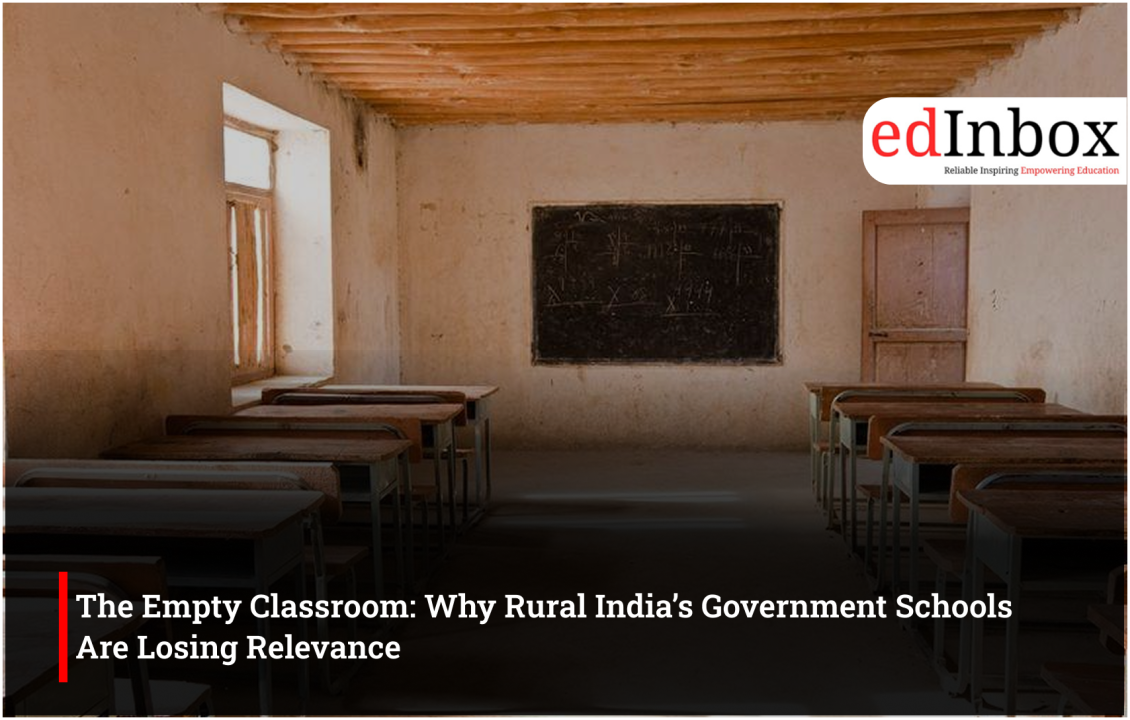
The Empty Classroom: Why Rural India’s Government Schools Are Losing Relevance
Typography
- Smaller Small Medium Big Bigger
- Default Helvetica Segoe Georgia Times
- Reading Mode