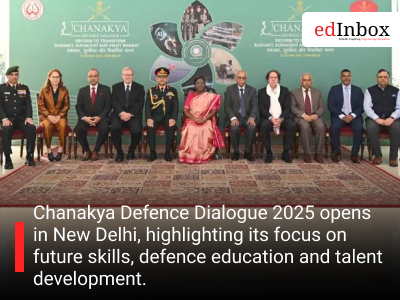
The Chanakya Defence Dialogue 2025, one of India's biggest platforms linking national security with future learning and research, began today at the Manekshaw Centre, New Delhi. Organized by the Indian Army in collaboration with the Centre for Land Warfare Studies (CLAWS), the Dialogue brought together military leaders, global scholars, defence-tech innovators, diplomats, and students to discuss how India must educate, train, and prepare its next generation for a rapidly evolving security landscape.
While inaugurating the event, Hon'ble President of India Smt. Droupadi Murmu said that the workforce needed during the forthcoming decades-civilian and military-must be 'technologically agile, ethically grounded, and future-ready'. The emphasis has to be on new curricula, state-of-the-art research ecosystems, and greater youth and women involvement in domains such as cyber security, space, AI, and cognitive warfare. The President referred to the opening by the Indian Army of fresh opportunities for young scholars and an upgrade of its own training structures, bringing military education in tune with the national vision of Viksit Bharat 2047.
The Chief of the Army Staff, General Upendra Dwivedi, while delivering the keynote address, highlighted that the security challenges for India have gradually become multi-domain, which demands new learning frameworks and inter-disciplinary exposure. He termed the long-term transformation roadmap of the Army—HOP 2032, STEP 2037 and JUMP 2047—as models that integrate technology, design thinking, operational learning and research collaboration between the military, academia and industry. General Dwivedi maintained that indigenisation, innovation ecosystems, organizational reform and military–industry–academia fusion are four pillars on which India’s next decade of defence capability will rest—the last dimension being an area where universities and think tanks will play a decisive role.
Announcing 2025 as the Ministry of Defence's "Year of Reforms," Defence Secretary Shri Rajesh Kumar Singh said self-reliance in defence manufacturing was also changing the face of technical education in the country. With 75% of the capital procurement budget being reserved for the domestic industry, he added that universities have to re-align their engineering, AI, robotics, material science and design courses to support India's growing defence industrial base. He underlined the great job prospects for talented graduates in defence R&D, manufacturing, simulation, and cyber areas.
NITI Aayog CEO Shri B.V.R. Subrahmanyam flagged the imperative for India's higher education institutions to prepare students for various global transitions: demographic shifts, climate stress, AI adoption, and new forms of warfare. He underlined the role that research universities can play in shaping long-term national security and economic resilience while urging stronger integration of defence studies, strategic affairs, and emerging technologies into mainstream academic programs.
Former Principal Scientific Adviser Prof. K. VijayRaghavan outlined a three-stage strategy to build India's scientific and technological edge. He called for:
- Short-term agility through startups and university-led innovation
- mid-term capability building with indigenous software and value-chain control, and
Long-term investments in basic sciences, such as biotechnology, materials research, and cognitive sciences.
He proposed the setting up of a Defence Technology Council to fast-track mission-driven academic and scientific collaborations.
On Day One, young scholars, students from defence universities, and academic experts attended thematic sessions on operational strategy, defence reforms, and civil–military fusion. The deliberations outlined the increasing scope of partnership between universities, skill development centres, and research institutions for India’s defence transformation.
Concluding the day, Chief of Defence Staff General Anil Chauhan said technology is changing the education and training requirement for the ‘Soldier of the Future’. Speaking at a time when AI, hypersonics, robotics and autonomous systems are redefining war, he said multi-domain competence, intense technical training and intellectual preparedness will be critical to India’s strategic tomorrow. Day Two will see a special session by the Raksha Mantri on reforms that will shape defence learning, technical skilling and long-term capability building. Spread over two days, CDD 2025 aspires to be a mega knowledge platform for students, educators, researchers and the defence community by further reinforcing the Indian Army's commitment to building a Sashakt, Surakshit aur Viksit Bharat through education, innovation and national capacity development.
Chanakya Defence Dialogue 2025 opens in New Delhi, highlighting its focus on future skills, defence education and talent development.
Typography
- Smaller Small Medium Big Bigger
- Default Helvetica Segoe Georgia Times
- Reading Mode