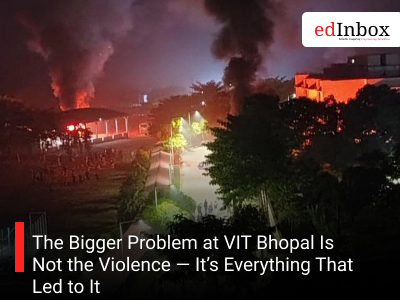
The burning of the Chancellor’s car, the vandalised buildings, and the looted sports lab at VIT Bhopal have shocked India’s higher education community. The visuals of destruction triggered panic among parents, fear among faculty, and a nationwide debate about campus discipline. Violence, under any circumstance, is unjustifiable. If students begin taking the law into their own hands, it risks becoming a dangerous blueprint for future unrest in Indian universities.
But to view this as a case of mere “student misbehaviour” is to overlook a deeper, long-boiling crisis. What unfolded on the VIT campus was not a sudden eruption—it was the consequence of long-standing infrastructural neglect, administrative misjudgment, and cumulative student frustration that had been building for years.
Chronic Water Shortage: A Crisis That Returned Every Summer
The centre of the anger lies in VIT Bhopal’s recurring water scarcity, a problem students say has existed since the campus opened. The institute houses nearly 15,000 students and more than 1,000 staff members in Sehore, one of Madhya Pradesh’s most water-scarce regions. Procuring sufficient water tankers—despite high expenditure—has become increasingly difficult.
“When we were in first year, the management abruptly declared a two-month holiday during May–June,” said a third-year B.Tech student. “We later learned the real reason—they couldn’t handle so many students because of the water crisis. There are only two canteens for thousands of us, the food is overpriced, and hostel fees are collected even when facilities are inadequate.”
For years, the crisis remained under control because admissions were low and most hostels stayed empty during COVID. But after 2023, with admissions rising sharply due to the AI boom and full-strength occupancy returning, the system collapsed. During the May–June 2024 heatwave, water shortage reached its peak. The administration underestimated the severity, triggering protests and eventually postponing exams as students were sent home.
A second-year Architecture student described the infrastructural mismatch:
“Our entire building has glass walls. Imagine attending classes in that heat. Air conditioning came only last year. Either there was no long-term planning—or they didn’t expect so many students to join.”Compressed Semesters and Cut-Down Recreation Built Silent Pressure
Alongside infrastructure stress, students faced tightening academic pressure. Internal documents and student testimonies show that VIT Bhopal shortened semesters, increased attendance requirements, and drastically reduced sports, cultural events, and recreation slots.
“Every six months, we have nearly three semesters,” said a first-year student living outside the campus. “There’s burnout everywhere. Last rainy season, some students went to a dam to relax and lost their lives. If campus life had recreation, maybe they wouldn’t have gone.”
Students connected frequent illnesses—including a widely reported jaundice wave—not just to hygiene issues but to:
- irregular rest
- compressed routines
- inadequate recreation
- mental and academic exhaustion
The cumulative effect was a campus running on pressure without pause.The Spark: A Warden–Student Incident
In this fragile environment, an alleged incident in which a hostel warden reportedly hit a student became the immediate flashpoint. What might elsewhere have been a disciplinary inquiry escalated within hours, leading to mass gatherings, chaos, and eventually unprecedented vandalism.
The university has now initiated inquiries into both the misconduct allegation and property damage. Faculty have expressed concerns over safety, while parents are demanding transparent protocols and improved communication.
The Real Problem: A System That Ignored Warning Signs
VIT Bhopal’s crisis highlights a broader issue in India’s rapidly expanding private higher education sector: growth without proportional infrastructure, student services, mental-health support, or grievance redressal.
The campus expanded admissions aggressively—especially during the post-AI boom—without:
- upgrading water and housing infrastructure
- strengthening recreational and mental-health resources
- improving student grievance systems
- ensuring academic schedules matched student well-being
Instead, the administration pushed discipline over dialogue. Students pushed frustration over patience. The result was a complete breakdown of trust.
Accountability on Both Sides
While the violence must be condemned unequivocally, the conditions that led to it cannot be ignored. A harmonious learning environment requires:
For the Institute:
- immediate infrastructure audits
- long-term water management plans
- restoration of sports and recreation
- transparent grievance systems
- clear codes of conduct communicated openly
For Students:
- recognition that violence has consequences
- responsible channeling of concerns
- participation in dialogue, not destruction
For Parents and Faculty:
- stronger engagement
- participation in safety and welfare committees
- bridging communication gaps
The Question Now
Can VIT Bhopal address the fundamental issues that led to this upheaval—before the campus becomes known more for unrest than academic excellence?
The incident is a warning not just for one institution but for India’s higher education system: when infrastructure, well-being, and communication fail, frustration fills the gap. And if left unaddressed, frustration finds its own explosive outlet.
VIT must act—early, decisively, and transparently—because the real danger is not the violence itself, but the ecosystem that made it feel inevitable.
The Bigger Problem at VIT Bhopal Is Not the Violence — It’s Everything That Led to It
Typography
- Smaller Small Medium Big Bigger
- Default Helvetica Segoe Georgia Times
- Reading Mode