The climate change issue has passed beyond a problem to be debated by scientists, it has become the challenge of how our current generation and the next generation are going to survive. In India, where extreme heat is now severe, flooding and droughts are increasing at rates that cannot be ignored, and air and water quality are severely compromised, climate change education is no longer an ‘option.’ It has become a critical life skill.
However, the major concern is are our schools ready to accept and act on this?
What about the children who will be adults and be capable of making decisions about climate change? Are they being taught climate change as a duty or simply another subject to study and memorize?
Why Is Environmental Education Still Limited to a Few Chapters?
In most Indian schools, environmental studies are confined to a few pages in textbooks. Students learn about pollution, global warming, biodiversity, and conservation—but only for exams.
What’s missing is lived experience. Children are rarely taught how their everyday choices—using plastic, wasting water, or excessive electricity consumption—directly impact the planet.
As a result, climate education becomes theoretical rather than transformative.
How the Climate Crisis Is Already Affecting Children
Children today are growing up amid extreme heat, polluted air, water shortages, and unpredictable weather. These are not future problems—they are today’s realities.
Education must go beyond facts and figures. It must empower students to become problem-solvers, not just passive learners.
NEP 2020 Showed the Way—But Is It Being Implemented?
India’s National Education Policy (NEP) 2020 recognizes sustainability and environmental awareness as essential learning components. However, lack of resources, insufficient teacher training, and exam-centric systems often prevent this vision from becoming reality.
How Can We Make Children “Climate-Smart”?
Environmental education should not just be about reading—it should be about living responsibly.
Students must learn:
- How to save water and energy
- Why plastic harms ecosystems
- How waste can be reduced
- Why trees matter
- What carbon footprint means
- And most importantly—what they can do
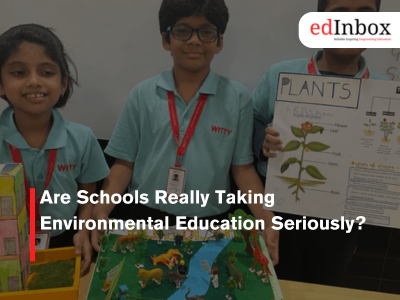
This can only happen if schools adopt project-based learning, field visits, gardening, recycling drives, and hands-on activities.
Is Our Education System Ready?
The truth is, India is still in the process of treating environmental education seriously. As long as schools remain obsessed with marks and rankings, climate change will stay confined to textbooks.
It is time we make environmental awareness not just part of the syllabus—but part of our mindset.
Because the children who understand the planet today
will be the ones who protect it tomorrow.
Are Schools Really Taking Environmental Education Seriously?
Typography
- Smaller Small Medium Big Bigger
- Default Helvetica Segoe Georgia Times
- Reading Mode