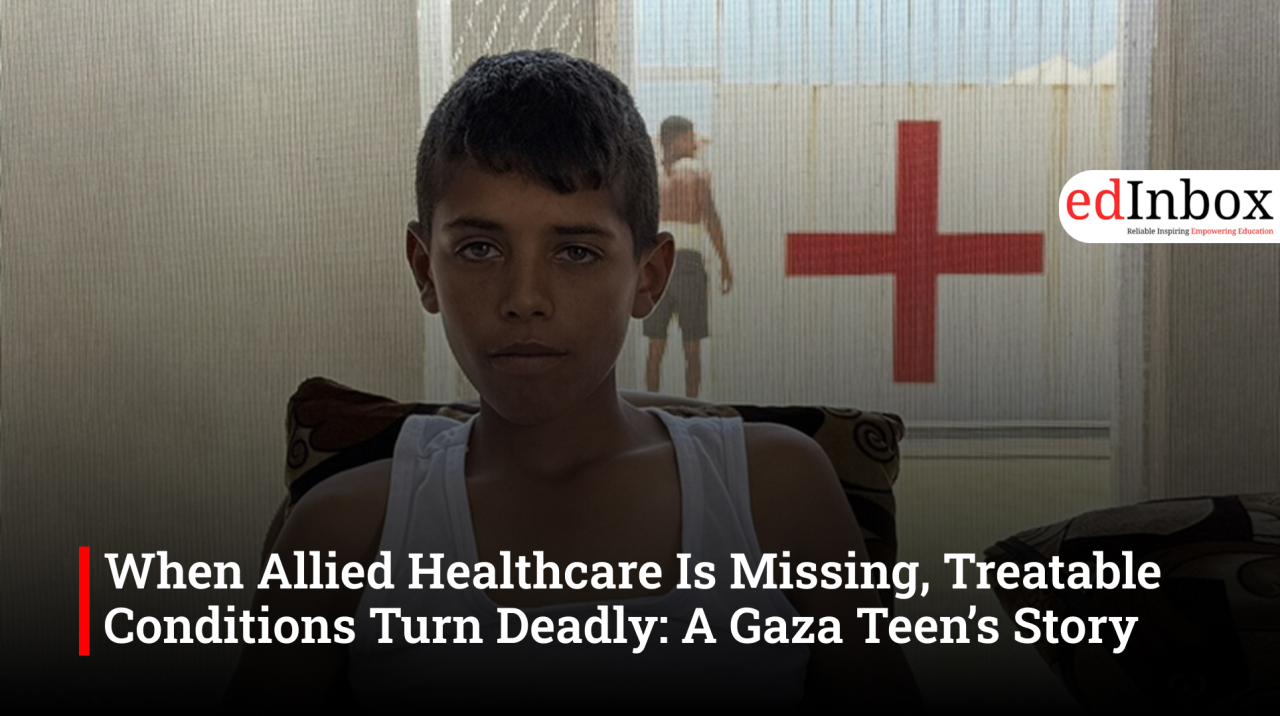
In the war torn Maghazi Refugee Camp in Deir al, Balah, Gaza, 16, year, old Shahid el, Athemne is undergoing a struggle that is way beyond her years. She is residing in an unstable tent and has very limited access to food, clean water, and healthcare. Shahid is afflicted with ichthyosisa rare hereditary skin disorder known as "fish scale disease."
On the 10th of January 2026, her health status was noted to have deteriorated severely, thus turning what is ordinarily a mild disease into a fatal one.
The narrative of Shahid is not only about war and eviction; it also serves as a powerful signal of a situation where a lack of allied healthcare provision is turning simple diseases into fatal ones. Allied health personnel such as dermatology nurses, clinical pharmacists, physiotherapists, nutritionists, wound, care specialists, and community health workers among others, are an integral part of effective management of long, term skin diseases such as ichthyosis. Lack of their presence in war, ridden places like Gaza leaves patients deprived of primary care including skin hydration therapy, prevention of infections, dietary guidance, and assistance in getting around.
What Is Ichthyosis and Why Care Matters
Ichthyosis refers to a spectrum of skin disorders mostly inherited that lead to excessive dryness, scaling, cracking, and skin inflammation. In the severest forms, the skin tends to crack and peel thus exposing the patient to infections, rapid loss of fluids and restricted movement. After doctors have established the diagnosis of the condition, its daily management depends to a great extent on allied healthcare professionals who make sure that patients have regular skin care, pain control, hygiene and rehabilitation.
In the advanced healthcare systems, patients having ichthyosis are being attended to by interdisciplinary teams of healthcare professionals working in great coordination. Nurses are the ones who put medicated emollients on the skin, pharmacists are the ones who facilitate the access to topical treatments, dietitians are the ones who take care of the patient's nutritional needs, and physical therapists are the ones who demonstrate how to do exercises so as to avoid joint stiffness resulting from frozen skin. Without that kind of assistance, Shahid's skin will keep on getting worse, thus putting her even more at the risk of complications.
When Healthcare Systems Collapse, Patients Pay the Price
Shahid's situation mirrors the general collapse of healthcare in Gaza, where medical facilities are running out of medicines, equipment, and qualified personnel. In cases like these, allied healthcare workers play a crucial role, frequently being the first and only source of care for patients at risk. Unfortunately, a lot of these roles are still unrecognized, under- resourced, or even nonexistent in emergencies.
This goes to show that healthcare is not simply the work of doctors and hospitals. The support system in healthcare is what upholds human dignity. Imagine if you were in a life threatening situation and the only thing preventing you from dying was access to care. If there were no allied health workers, survival would be a question rather than a hope.
A Call for Humanitarian Action
Shahid el, Athemnes sufferings can be called a human tragedy which highlights how crucial it is to provide not only medical aid but also thorough assistance from allied health professionals such as trained health workers. If she had received medical help at the right time, it would have been possible to bring her condition under control. On the other hand, if she continues not to get necessitated help, her situation will go beyond harm that can be reversed.
Her story is one of many but it is a story that calls for an immediate response. While the world is full of invisible caregivers whom it often neglects, Shahid has shown us that allied healthcare should never be left on the back burner. It is essential.
When Allied Healthcare Is Missing, Treatable Conditions Turn Deadly: A Gaza Teen’s Story
Typography
- Smaller Small Medium Big Bigger
- Default Helvetica Segoe Georgia Times
- Reading Mode