Stanford University has closed its Office of the Vice Provost for Digital Education, referred to as Stanford Digital Education, on January 15 due to budget cuts, thus killing a program through which for years low, income high school students gained access to Stanford, taught courses.
Since 2021, Stanford Digital Education coordinated efforts to offer online Stanford courses beyond campus. According to information published by the program, it reached 2,612 high school students across 103 schools in 22 states and Washington, D.C. The office’s closure also ended Stanford’s partnership with the National Education Opportunity Network, which delivered Stanford courses to Title I high schools serving students from low-income families.
University cites lack of long-term funding
In a statement to the Stanford Daily, Director of University Public Relations Charlene Gage said the initiative began with start-up funding but did not secure long-term financial support. She said the University chose to concentrate its digital education efforts in programs with established and sustainable funding models, pointing to the Center for Global and Online Education and Stanford Continuing Studies.
How the program worked
Through the National Education Opportunity Network partnership, Stanford professors taught remote courses alongside Stanford student teaching fellows, while high school teachers supervised students on site. Students who completed the courses received a Stanford transcript and grade. The courses drew national attention, including coverage by the Wall Street Journal and the Los Angeles Times.
Partner organization seeks continuation
Leslie Cornfeld, chief executive officer and founder of the National Education Opportunity Network, told the Stanford Daily that the organization had offered to cover the costs of continuing the Stanford program and remained hopeful it could resume. She said the courses helped students see themselves as belonging in elite academic spaces.
Faculty and student concerns
Faculty members involved in the program also expressed concern about its end. Drew Endy, a professor of bioengineering who taught a course through the partnership, said the classes aligned with Stanford’s founding mission to promote the public welfare. He said the program exposed students to fields they might not otherwise encounter.
Former Stanford Digital Education student teaching fellow Parth Sarin learned in June that the University planned to stop funding the program. Sarin told the Stanford Daily that uncertainty about the program’s future had grown over the past year and questioned the decision to end it, arguing that the costs were relatively limited and that faculty interest remained strong.
Impact on participating schools
High school educators who collaborated with the program indicated that the shutting down of the program left a big gap that is hard to fill. Lindsay Humphrey, an English teacher at Birmingham Community Charter High School in Los Angeles, informed Stanford Daily that the Stanford courses sparked great enthusiasm among the students and in some cases, helped them to see themselves going to very selective universities. Two pupils from her school who took part in the program subsequently went to Stanford.
Sara Schafer, an Advanced Placement coordinator at Topeka High School, said alternative university courses were arranged after Stanford Digital Education closed, but she viewed Stanford’s involvement as distinct. She said the program also played a role in introducing Stanford to students in regions with lower application rates.
Student experiences and access concerns Students who had the chance to be part of the program characterized it as highly exceptional. TaSheena Thompson, a Stanford undergrad who was raised in the Navajo Nation and also took multiple courses through the partnership while still in high school, shared with the Stanford Daily that the experience "taught her the kind of work a college student does and gave her the courage to go to college." She felt the termination of the program would only serve to further shut the door on students coming from similar backgrounds in the future. What no one knows for sure is what will happen next The university administration has not made any statement or indication about replacing the Stanford Digital Education office or bringing back the partnership. For the schools that depended on the program, its disappearance is like losing a door to a direct connection of low, income high school students to Stanford classrooms.
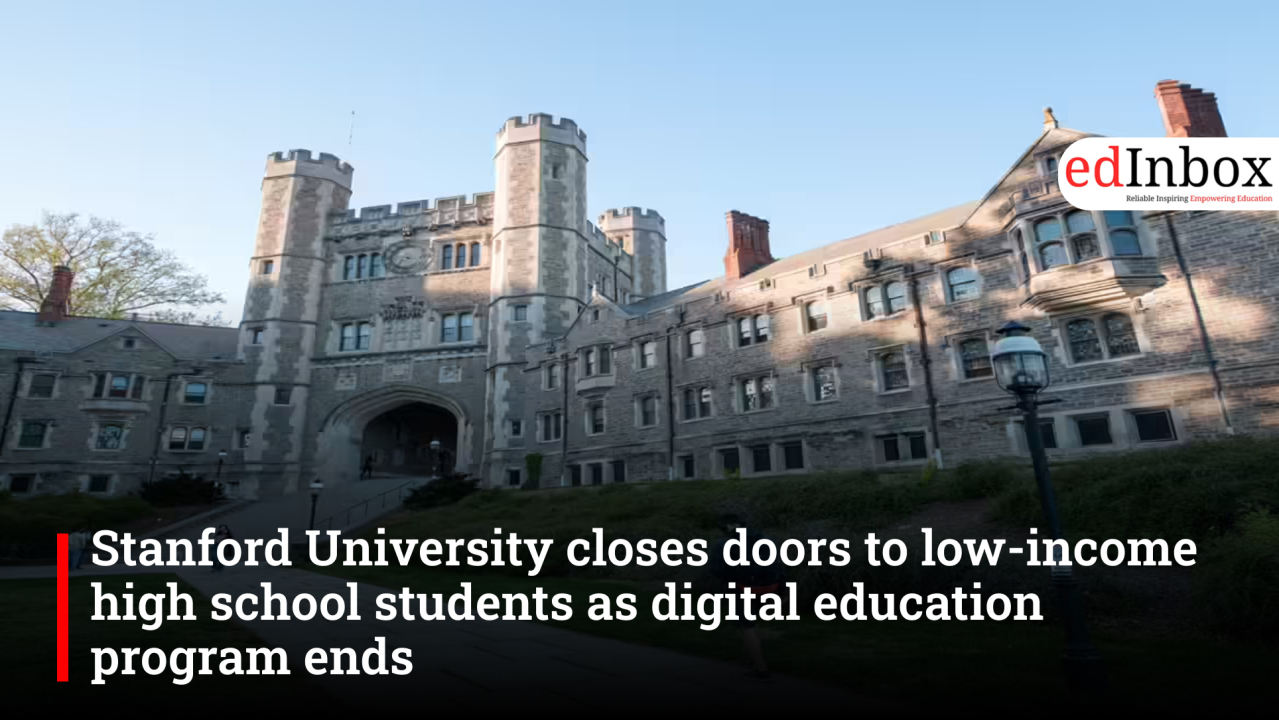
Stanford University closes doors to low-income high school students as digital education program ends
Typography
- Smaller Small Medium Big Bigger
- Default Helvetica Segoe Georgia Times
- Reading Mode