Over the years, special educator from Goa, Amelia Vaidya has understood that emotional problems are hardly ever loud. They show in small ways: a child who becomes quiet, an unexpected tantrum, or a student who used to be enthusiastic but now only looks down.
Schools when talking about mental health neglect that emotional states change with age, Amelia says. What a seven year old gets comfort from won't be enough for a sixteen year old who is stressed by exams or confused about his/her identity.
The overall situation is pretty much captured by her statement: Actually, schools have ramped up their efforts to integrate mental health education into their programs. But turning those lessons into genuine therapeutic aids remains a significant challenge.
One's mental health is just as important to be maintained as one's physical health.
On top of their academic work, students have to deal with problems such as social media comparison, peer pressure, and parental expectations. Many of them are experiencing anxiety, stress, and emotional exhaustion. To this end, schools are attempting to introduce mental health education. However, the process of doing so poses a whole new set of challenges.
Teachers: The First Line of Support
Schools often look to teachers as the first emotional anchors for students. While this trust is valuable, it also creates pressure.
“Teachers are often the first adults students confide in, but expecting them to handle mental health concerns without proper training can be unfair,” says Dr Neha Kapoor, child psychologist. “Mental health education works best when teachers are supported—not stretched.”
Teaching mental health is not the same as teaching mathematics or science. It calls for emotional sensitivity, behavioral understanding, and psychological awareness. A lot of teachers are already overloaded with their work and might not be sure of themselves if they had to talk about anxiety, depression, or trauma.
If there are no trained counselors or professionals who can give guidance, then it is very likely that mental health education will continue to be only at the surface level.
The Silent Weight of Stigma
Despite growing awareness, mental health is still a taboo in many schools. Some students feel embarrassed to share their struggles. Some parents believe emotional issues should be kept private.
“Students often want help but fear being judged,” says Anupreet Singh, school counsellor at Khaitan Public School, Noida. “Until mental health conversations feel safe and normal, many will stay silent—even when support is available.”
Students often express this quietly:
“I know the school talks about mental health, but I don’t feel comfortable saying I feel anxious.”
“If you say you’re stressed, people think you’re weak.”
Such stigma pushes students away from the very programs designed to help them.
School schedules are already packed—classes, tests, assignments, and activities. Mental health sessions often get rushed or treated as one-time workshops.
“Mental health learning cannot be rushed,” says education consultant Anil Sharma. “Emotional skills develop over time. Consistency matters far more than a single lecture.”
Interestingly, while policies like lightweight school bag guidelines aim to reduce students’ physical burden, emotional burdens still struggle to find space in the timetable.
One Program Cannot Fit Every Child
This is where Amelia’s observation becomes crucial. “Younger children and teenagers experience emotions differently,” she explains. “A lesson that comforts a primary school student may feel childish to a teenager dealing with exam stress.”
Psychologist Dr. Sameer Joshi is on the same page: "Mental health education has to evolve along with the child."
In clinical settings, psychologists observe children's behaviors, assess their emotional reactions, and figure out what kind of support would be suitable for their developmental stage. Unfortunately, schools tend to implement just one mental health program for the whole school thereby many students feel alienated.
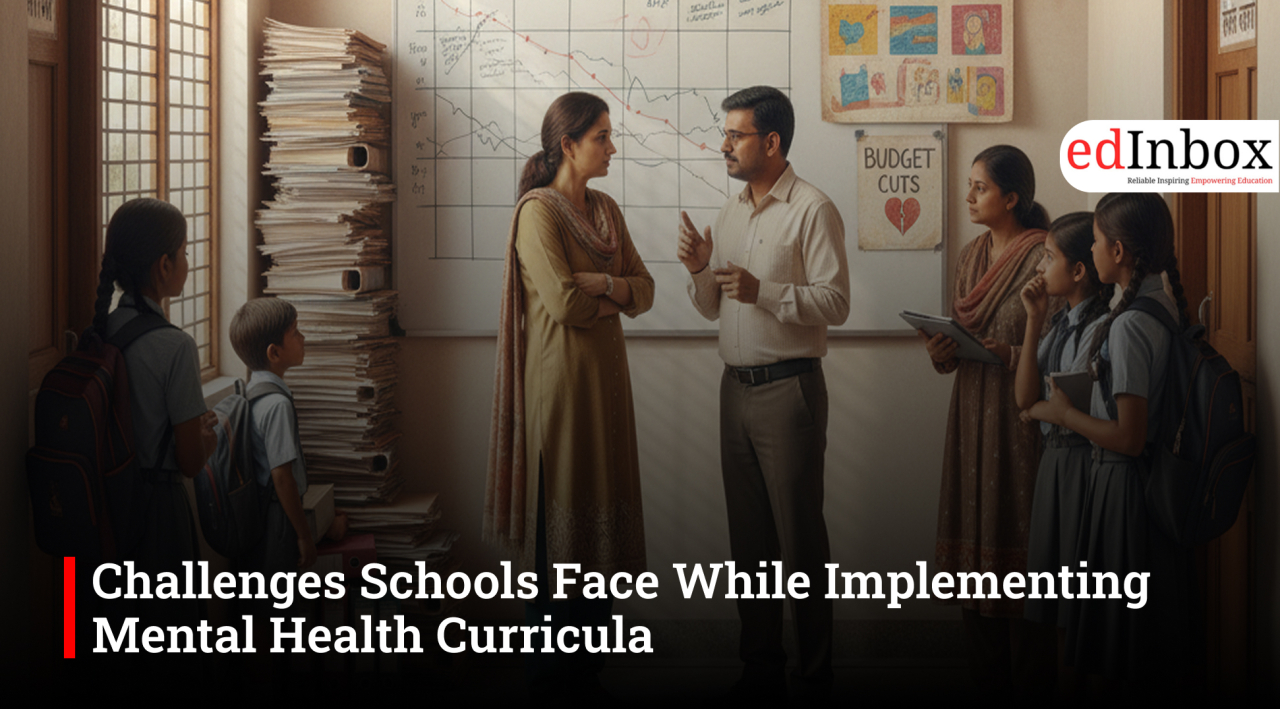
Most public schools lack the financial resources to have a full time counselor, provide student workshops, and teachers training. When budgets are reduced, the first programs cut are usually those for mental health.
Parental awareness is also a key factor. Some parents feel that discussing mental health will take up the children's time and attention which could be better spent on studies.School initiatives will have less impact if parents do not support them.
At the same time, teachers carry emotional burdens. They are the ones who have to be constantly there for the students who are upset without getting emotional support themselves, and this is what slowly drains their energy and leads to burnout in the end, the entire system suffers.
Challenges Schools Face While Implementing Mental Health Curricula
Typography
- Smaller Small Medium Big Bigger
- Default Helvetica Segoe Georgia Times
- Reading Mode