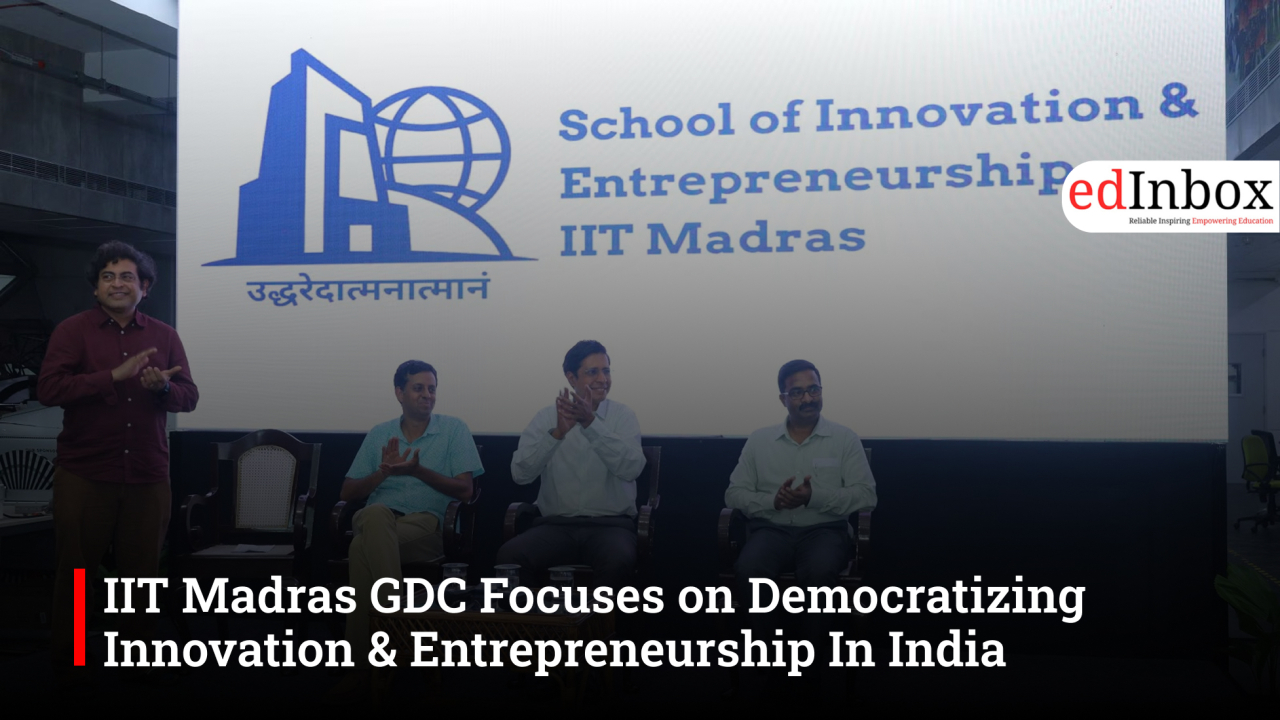
Indian Institute of Technology Madras’ (IIT Madras) Gopalakrishnan-Deshpande Centre for Innovation and Entrepreneurship (GDC) organised its sixth Annual GDC Symposium, themed 'Democratising Innovation and Entrepreneurship in India'. Organised on Saturday, the symposium brought national focus on the role of the entrepreneur as the central driver of India’s deep-tech and innovation-led growth. More importantly, the symposium debated how to increase the focus of policymaking, mentorship and funding on “building capable entrepreneurs” as a missing piece of the scaling innovation puzzle in India.
The symposium highlighted a critical gap in the ecosystem — the sustained development of an entrepreneurial mindset and skills. The speakers pointed out that although technology, funding, and infrastructure are necessary, the most significant factor for an entrepreneur's long term success is mentoring, nurturing, and building the capabilities of the individuals involved, particularly in deep, tech startups that require a lot of time before becoming profitable.
For years, the banking sector had depended on past data, fixed rules and human judgement to make decisions about critical functions. Credit granting, trading and identifying fraud were all conducted according to an understandable and predictable pattern. The coming of AI disrupts this pattern as it relies on probabilities instead of fixed rules. Algorithms scan a vast amount of information, detect changing trends and redefine their view of risk. The transformation from traditional rules to intelligent dynamic thinking will be the main factor that determines which companies will be successful or unsuccessful over the next few years.
Being a country with the most diverse population, a robust digital public infrastructure, and a wide proliferation of real time payments, India's banking sector provides an unparalleled setting for the large- scale use of AI. From AI, powered credit evaluation for MSMEs to fraud detection across UPI and mobile banking, algorithms are playing an increasingly significant role in determining how trust and access are being delivered in one of the world's fastest growing financial ecosystems.
Credit assessment has always been a form of forecasting. Traditional underwriting relied on documented income, collateral and records of repayment. Today, AI expands this view by examining behavioural traits, digital interactions, micro-spending patterns and contextual indicators that were earlier invisible. When used responsibly, this leads to a remarkable widening of financial inclusion. Small merchants, gig workers and customers without long credit histories can be assessed more accurately, which allows them to access credit that would otherwise be out of reach.
However, the same technology introduces new responsibilities. Complex models often do not reveal their internal reasoning in clear terms. Without strong governance, there is a real risk that hidden biases or correlation traps can influence outcomes. The institutions that succeed will be those that view AI-based credit systems as transparent pipelines that must be continuously audited and validated, rather than black boxes that simply produce numbers.
AUTOMATED TRADING
Trading has always rewarded speed, but AI has pushed this speed into a different realm. Modern trading engines absorb global economic signals, alternative datasets and market microstructure patterns at scales beyond human capacity. Reinforcement learning agents can identify opportunities that last only fractions of a second. They learn from the environment, try actions and adjust strategies without waiting for human input.
Regulators will increasingly look at AI the same way they looked at capital adequacy after the global financial crisis. Stress tests, scenario simulations and common governance standards will become essential. Responsible deployment of AI will require continuous monitoring, clear audit trails and human oversight at critical checkpoints.
THE ROLE OF HUMAN EXPERTISE
AI is capable of performing a huge amount of work, but that doesn't mean human judgement is no longer necessary. Quite the opposite, the value of domain knowledge is actually rising. Model governance, ethical reasoning, responsible AI deployment and grasping the systemic impact are some of the areas where seasoned experts are absolutely essential. The future of finance is going to be created by human insight and machine intelligence. Those institutions that acknowledge this symbiotic relationship will be able to lead with assurance and stamina.
The automated economy is clearly no longer a speculative scenario. We see it unfolding now as algorithms determine the credit flow, direct the market changes and identify fraud cases. The issue has shifted from 'Will AI transform finance?' to 'How wisely will this transformation be guided?'. Properly managed, AI can be a great enabler of financial inclusion, a tool for strengthening institutions and an enhancer of the overall stability of financial systems. On the other hand, without proper regulation, these tools can become a source of hidden risks and a driver of further inequalities.
The coming year is a great moment for the financial sector to become more resilient and fair. The real task is making innovation and governance develop in tandem.Finance has always depended on foresight. Today, that foresight must extend to the algorithms that silently shape the choices, risks and opportunities of the automated economy.
During his keynote address, Lakshmi Narayanan, co-founder and former vice chairman, Cognizant Technology Solutions, said, “Scientists and researchers can be entrepreneurial in more ways than one. Besides launching startups to bring their innovations to market, scientists can also be equally impactful by solving difficult technological challenges within the framework of large corporations or government projects. Such successful outcomes are also entrepreneurial successes, which GDC and IIT Madras should encourage.”
Shivkumar Kalyanaraman, CEO, Anusandhan National Research Foundation (ANRF), delivered the second keynote address via videoconferencing and explained the programmes and initiatives of ANRF for catalysing research and translation into impact. ANRF has operationalised a number of programmes in the current financial year, including multiple ANRF MAHA mission-mode programmes across sectors such as electric mobility, 2D materials, AI for science and engineering, medtech and critical raw materials.
ANRF has also rolled out Pair and PM Professorship programmes for uplifting research in emerging institutions, ATRI translational programmes and fundamental research programmes including ANRF ARG, PM ECRG, NPDF, Ramanujan Fellowship, JC Bose Grants, National Science Chair and convergence centres at the intersection of humanities, social sciences and science and technology. The Rs 1 lakh crore RDI patient capital fund is also being operationalised, housed within ANRF with the Department of Science and Technology as the anchor ministry.
The symposium was about whether India is investing enough and the right areas to train entrepreneurs who relate to the idea of Viksit Bharat 2047. Among other things, the conversations highlighted that it is through the sharpening of ones business acumen, resilience, and decision making skills that the amazing researches will become solutions for the market.
On the occasion, V Kamakoti, Director of IIT Madras responded, "At IIT Madras education and entrepreneurship are being democratised on a massive scale." The online BS programme has enabled nearly 50,000 students, many from financially weaker families to access quality education. IIT Madras is also enabling startups and entrepreneurs from across India to learn from its labs, incubators, faculty and GDC programmes.”
A panel discussion on ‘How Policy in India is Enabling Democratization of Innovation and Entrepreneurship’, chaired by Kris Gopalakrishnan, chairman, Axilor Ventures, featured Lakshmi Narayanan, Shashank Shah, director (senior specialist – education), NITI Aayog; and Adithya Jain, co-founder and CEO, Tvasta Technologies. Shah referred to NITI Aayog’s ongoing study, with GDC IIT Madras as the knowledge partner, covering over 100 incubators across 18 States. The study will provide policy inputs to advance incubation ecosystems in higher education institutions to support India’s goal of becoming a global startup capital.
On the sidelines of the symposium, around 15 deep-tech startups from across India showcased their innovations, offering policymakers, investors and mentors direct insight into the aspirations and challenges of India’s next generation of founders.
IIT Madras GDC Focuses on Democratizing Innovation & Entrepreneurship In India
Typography
- Smaller Small Medium Big Bigger
- Default Helvetica Segoe Georgia Times
- Reading Mode