Design Studies has been so misconceived by the public that there are people who think it is merely an art of decoration or a purely creative endeavour. On the contrary, it is a thorough, forward looking area of research that studies human behaviour in relation to making, using, experiencing and valuing things, products, spaces, visuals, interfaces, services, systems and even public policies.
Design, at its core, is about diagnosing genuine issues, gaining profound insights into people, dreaming of improved alternatives, and putting together solutions that do not only work but are also real, world meaningful.
In India, Design Studies has came a long way from being a niche, alternative career to becoming a mainstream, high, impact professional domain. As the nation embarks on mass, scale construction of digital platforms, infrastructure, consumer products, healthcare systems, education technologies, and sustainability solutions, design has become a strategic advantage. It is in time that thoughtful design if growth, competition, complex nature, or change arises. Maybe you are that person who instinctively notices what is confusing, inefficient, unfair, or broken and then you feel an urge to fix it. Design could be your most natural way of thinking.
The Three Layers of Design: People, Making, and Meaning
A great designer is not only a maker but also a deep thinker, researcher, storyteller, and an ethical problem solver. Studies in Design encompass three overlapping layers.
The human aspect refers to people's thoughts, feelings, behaviors, decisions, learning, and adaptation. This is the realm of empathy, psychology, user research, accessibility, inclusivity, and usability. To understand people is to lay the first stone of meaningful design.
Making refers to materials, technologies, methods, prototyping, production, cost, feasibility, and quality. It is the stage where ideas get turned into tangible products or genuine experiences, thus being aligned with the real constraints.
Meaning refers to culture, aesthetics, identity, storytelling, ethics, sustainability, and social impact. This is the layer where design turns into a potent force, influencing what people trust, remember, and value.
When these layers are in harmony, design is not only a form of art but also a strategic amalgamation of art, engineering, business sense, and social responsibility.
The Design Landscape: A Universe of Career Pathways
Design is not a single career; it is an ecosystem of diverse pathways. Students choose their direction based on interests—visual communication, products, digital systems, spaces, fashion, storytelling, technology, or social impact.
Communication Design shapes visual language through graphic design, branding, typography, illustration, motion graphics, packaging, and information systems. In India’s multilingual, media-saturated environment, this field is expanding rapidly as brands compete across digital platforms, retail, and entertainment.
Animation, VFX, and Game Design power the creative economy, encompassing character design, environment design, storytelling, visual effects, and interactive media. With OTT platforms, global studio collaborations, gaming, and immersive media on the rise, this sector is becoming a major employment engine.
Emerging Design Domains Students Often Discover Too Late
Beyond traditional paths, several research-led and systemic design fields are driving future growth.
Service Design focuses on end-to-end experiences in healthcare, banking, education, hospitality, and public services. In India, where large-scale systems often fail at the last mile, service design plays a critical role in improving usability, trust, and access.
Interaction Design extends beyond screens into devices, wearables, voice interfaces, smart environments, and connected systems. As AI integrates into everyday life, interaction designers shape how humans and technology coexist.
Sustainability and Circular Design address climate challenges through lifecycle thinking, material innovation, repairability, waste reduction, and regenerative systems. In the coming decade, sustainability will shift from optional to essential across industries.
Design Research, Strategy, and Management treat design as leadership. These roles focus on problem framing, user and market research, innovation direction, team management, and aligning design with long-term business and social value.
Why Design Is Growing So Fast in India
Design's development is very much in line with what is happening in the world around us. Consumers are no longer willing to put up with confused interfaces in apps, bad services, and products that have no consideration for them. There is a lot of competition and brands are forced to compete on trust, experience, and loyalty. Startups and big companies now see design as a growth engine that helps to cut down on costs, increase customer retention, and thus build credibility.
Governments, too, are using design to take a fresh look at how to make their systems more usable and inclusive thus letting their policies be more effective. As AI tools begin to take over routine task execution, the focus shifts to human skills that cant be replaced by machines such as problem pre, framing, judgment, taste, empathy, creativity, ethics, and systems thinking.
The Next Decade of Design Careers
Design careers in India will become not only wider but also more profound. Every sector, healthcare, education, fintech, climate, tech, mobility, manufacturing, smart cities, entertainment, and governance will need design expertise. And on top of that, companies will put money into design leadership, research, operations, and strategy rather than just getting designers to do surface level work.
Designers with hybrid skills who are capable of working with AI, data, and engineering teams will do well. But in the long run, it will be less about the use of tools and more about getting back to the design fundamentals: observation, visual reasoning, communication, prototyping, and the ability to clearly justify one's decisions.
Do Marks Matter in Design?
Marks matter, but portfolios matter more. Design is one of the few fields where your work speaks before you do. This can be liberating—allowing growth through projects regardless of background—but it also demands initiative. In design, progress is visible, and effort cannot be hidden.
Career Outcomes After Studying Design
Design graduates work as UI/UX designers, product designers, graphic and brand designers, motion designers, animators, game artists, interior and spatial designers, fashion and textile designers, service designers, design researchers, strategists, managers, and eventually creative directors. Many also become entrepreneurs, launching studios, D2C brands, fashion labels, media platforms, and design-tech startups. Your trajectory depends on what you choose to master.
Preparing for a Bachelor’s in Design
You do not need to be “born artistic.” You need curiosity, observation, and consistency. Start noticing everyday problems—confusing signage, inefficient packaging, poor interfaces—and try redesigning them. Build a habit of making: sketch daily, study composition and typography, take intentional photographs, and experiment with posters, storyboards, product sketches, or wireframes.
Learn basic digital tools without obsessing over software. Focus on outcomes. Tailor your practice to your interests—model-making for product design, motion studies for animation, or fabric and pattern exploration for fashion and textiles. For entrance exams, build a portfolio that demonstrates observation, problem-solving, experimentation, and clear thinking, and practice explaining your work confidently.
Preparing for a Master’s in Design
At the postgraduate level, expectations shift toward research and complexity. Choose a direction based on the problems you want to solve and build case-study-driven portfolios that show research, insights, iterations, and outcomes. Internships are crucial, as are writing and documentation skills that demonstrate structured thinking.
India’s Unique Advantage: Cultural Intelligence
India is not one user group but many. Designers who understand linguistic diversity, literacy differences, accessibility needs, rural–urban realities, and varied aspirations are uniquely positioned. Combining design skill with social awareness—education, healthcare, financial inclusion, sustainability—makes designers valuable across commercial and mission-driven sectors alike.
The Rule That Separates Hobbyists from Professionals
Do not pursue design because it looks cool. Pursue it as a craft and a responsibility. The decade ahead will reward designers who think deeply, make intelligently, collaborate well, and build solutions that are useful, ethical, beautiful, and scalable. Start early, stay curious, and let your work demonstrate not just what you can make—but how you think.
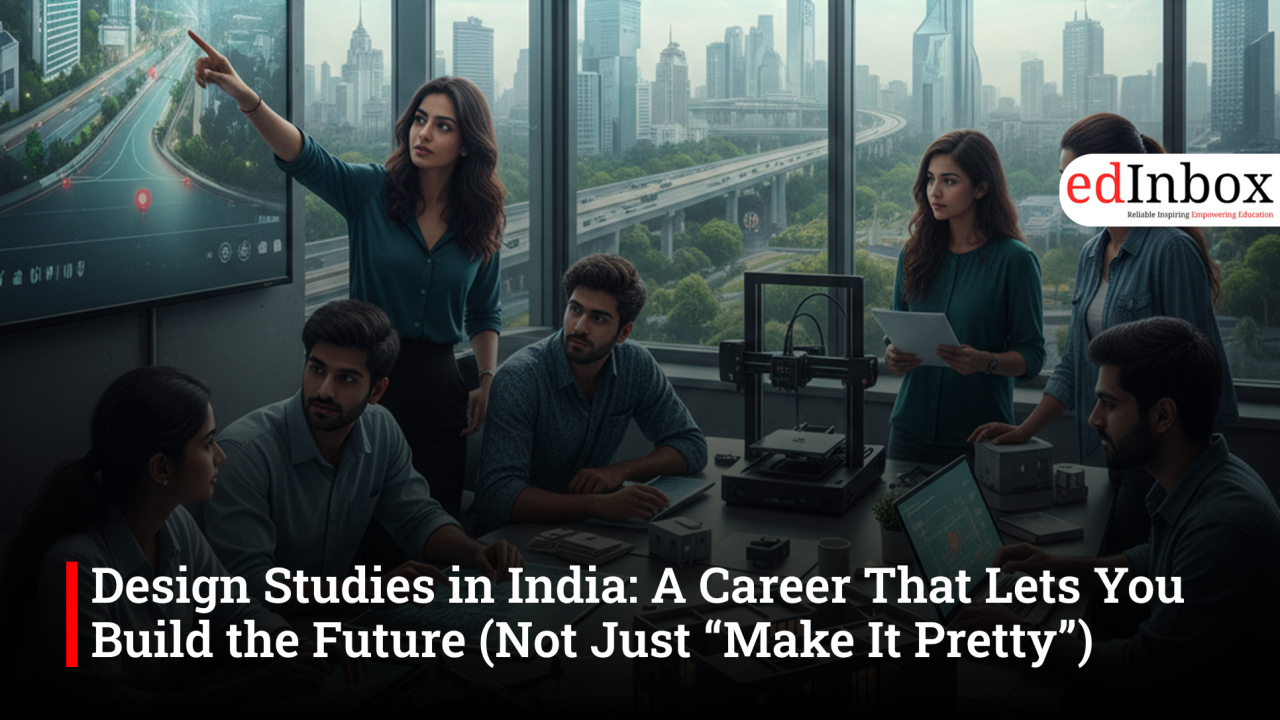
Design Studies in India: A Career That Lets You Build the Future (Not Just “Make It Pretty”)
Typography
- Smaller Small Medium Big Bigger
- Default Helvetica Segoe Georgia Times
- Reading Mode