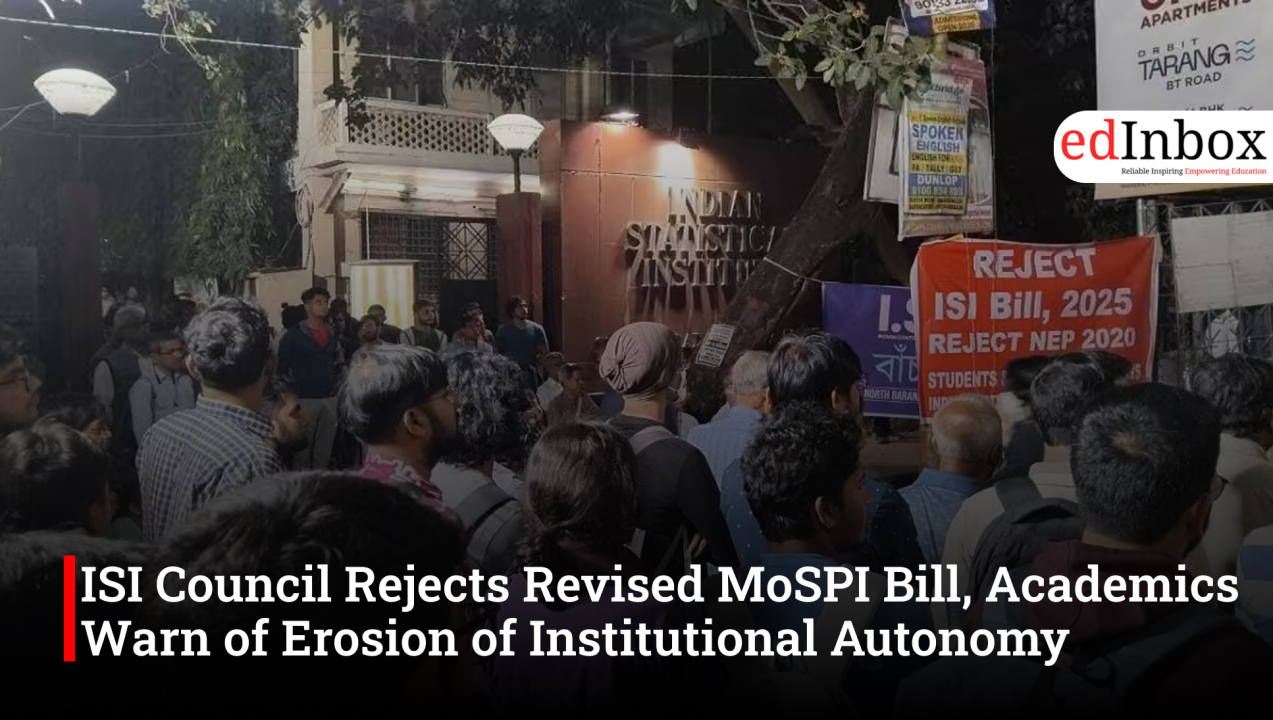
There has been a formal rejection by the governing council of the Indian Statistical Institute (ISI) of the revised draft of the ISI Bill by the Ministry of Statistics and Programme Implementation (MoSPI). The council also accused that the autonomy of the institute, its academic freedom, and the decentralized governance structure, are under threat.
During a meeting with the officials of MoSPI, the members of the ISI Council and Academic Council were questioning the reason for changing the institute's old society based governance model which has been operating smoothly for more than fifty years. Faculty members remarked that they have not come across any documented evidence indicating that the present structure has restricted decision making or the growth of the institution. On the contrary, they argued, ISI’s stability and global reputation stem directly from this model.
Academics made comparisons with top international institutions like the Max Planck Society and the University of Oxford, which are both run under extensive, society based governance frameworks. They raised a doubt about MoSPI's idea of turning ISI into an IIT or IIM model, i.e. having a smaller, government- nominated Board of Governors (BoG), and argued that such a model may not be fitting for a research intensive institution like ISI.
The Academic Council unanimously rejected the revised draft, describing it as "unacceptable." They particularly protested against the provisions that would give the BoG the power to start new academic programmes or courses. Faculty members warned that this might lead to the marginalization of academic decision, making by experts and the reduction of scholars' role in determining curricula and research agendas. They also pointed out that the small number of academics on the proposed BoG could be a factor in the domination of governance by administrative and external control.
Further apprehensions were expressed regarding ISI’s regional centres in Delhi, Bengaluru, Chennai, and Tezpur. Under the proposed framework, centre directors would be subjected to greater central oversight, potentially weakening their operational and academic independence.
While a few centre heads reportedly supported the idea of faster administrative decision-making, critics countered that similar governance reforms in the IIM system have not conclusively demonstrated academic or institutional benefits. Government officials also referred to the Indian Institute of Science (IISc), Bengaluru, as a model of excellence around the world whose identity continues to be preserved even after years without adopting an IIT/IIM, type governance approach.
The members of the Council asked MoSPI to consult extensively with stakeholders before bringing the Bill to Parliament. They warned against what they called a "very strange rush" to restructure one of the finest research institutions in India.
ISI Council Rejects Revised MoSPI Bill, Academics Warn of Erosion of Institutional Autonomy
Typography
- Smaller Small Medium Big Bigger
- Default Helvetica Segoe Georgia Times
- Reading Mode