India requires structural reforms in higher education to stop the phenomena of the increasing flow of students to international destinations leading to brain drain and outward remittances, the Economic Survey 2025, 26 stated.
India is the world's largest source country of international students, the survey pointed out, with 28 Indian students going abroad for every international student coming to India.
The number of Indians studying overseas has gone up from 685, 000 in 2016 to more than 1. 8 million by 2025, it stated.
On the other hand, students coming to India rose from less than 7, 000 in 2000, 01 to around 49, 000 in 2020, which is only about 0. 10 per cent of the total higher education enrolments.
This is very much below the leading host countries, where international students make 10 to 40 per cent of total students.
Restoring the balance, yearly outward remittance under the studying abroad component has reached $3. 4 billion in FY24, with Indian students mostly being concentrated in a few host countries, including Canada, the United States, the United Kingdom, and Australia.
Similarly, annual outward remittance under the ‘studies abroad’ component has increased to $3.4 billion in FY24, with Indian students highly concentrated in a small group of host countries, including Canada, the United States (US), the United Kingdom (UK), and Australia. The attractiveness of these countries is being driven by perceived quality, work rights, migration pathways, and strong branding, the survey highlighted and suggested that countermeasures were required. These comprise, among other measures, forcefully marketing India as a prime global education center by using the National Education Policy (NEP) and updated University Grants Commission (UGC) guidelines to allow foreign branch campuses, mutual recognition of qualifications, and student exchange programmes.
Besides, the "Study in India" campaign may also utilize the quality markers like the National Assessment and Accreditation Council (NAAC) and the National Institutional Ranking Framework (NIRF), and not only the global rankings, to present a compelling case for foreign students.
The initiative wants to leverage India's STEM education and innovation capacities to work with its time tested strengths in Ayurveda, philosophy, and classical arts to present to the Global South a compelling, affordable option.
The suggestion comes when India has been finding it hard to seize a large portion of the international student market although the number of mobile students globally has increased from 2.2 million in 2001 to 6.9 million in 2022. Among the BRICS bloc as well, more than 80 per cent of inbound mobility is accounted for by Russia and China, whereas India's share is still at single digits level, it added.
Continuing to be a main destination in South Asia, India attracted four, fifths of the students from Nepal, Afghanistan, Bangladesh, and Bhutan, however, the country's regional share has been decreasing since 2011, the report states.
The report also mentioned that due to the rising competition from other regional hubs, India's value proposition must be updated if the country wants to stay attractive to its neighbors.
This hardly means program diversification beyond full degrees, e.g. summer schools, semester, abroad modules, heritage and philosophy tracks, yoga and Ayurveda certificates, and innovation or rural, immersion labs.
“These can be bundled with tourism circuits and tailored for BRICS and wider Global South partners,” the survey said.
The survey also highlighted the success of the Indian Technical and Economic Cooperation (ITEC) programme, which has trained over 200,000 individuals from 160 countries. It argued that by building an ecosystem that offers research and education of global standards at affordable costs, India can move beyond simple influence to create generational goodwill.
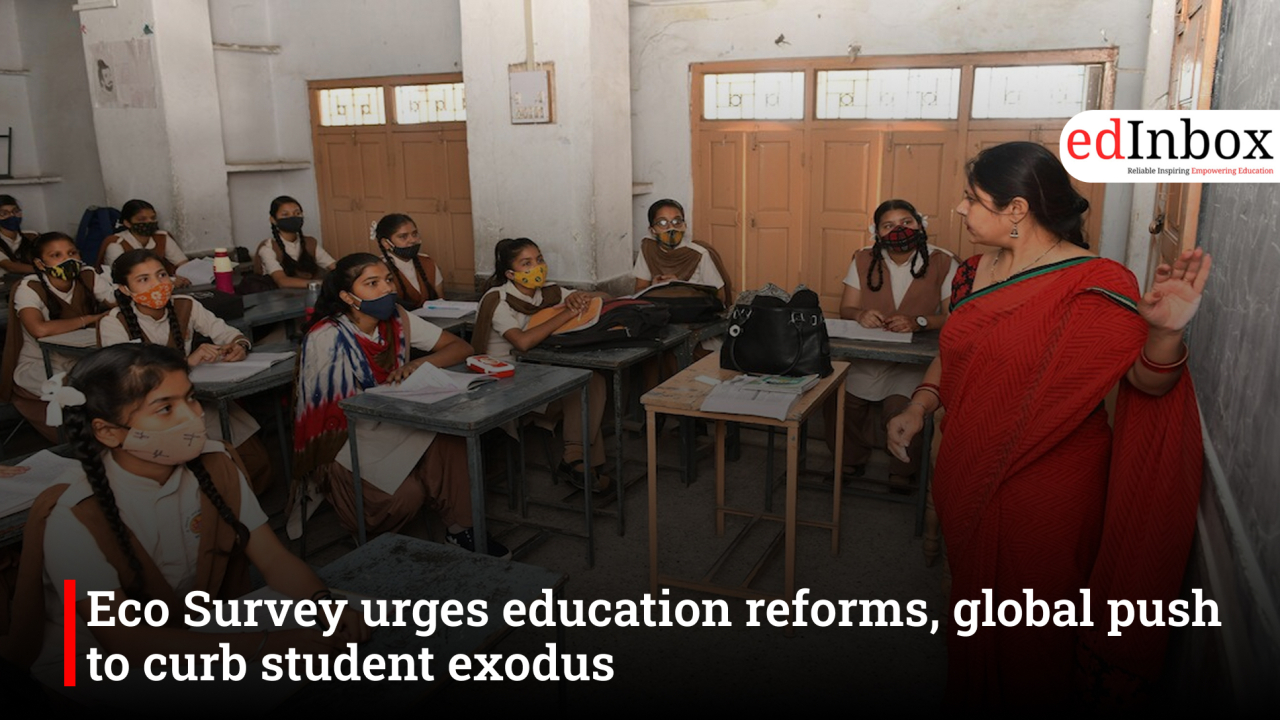
Eco Survey urges education reforms, global push to curb student exodus
Typography
- Smaller Small Medium Big Bigger
- Default Helvetica Segoe Georgia Times
- Reading Mode