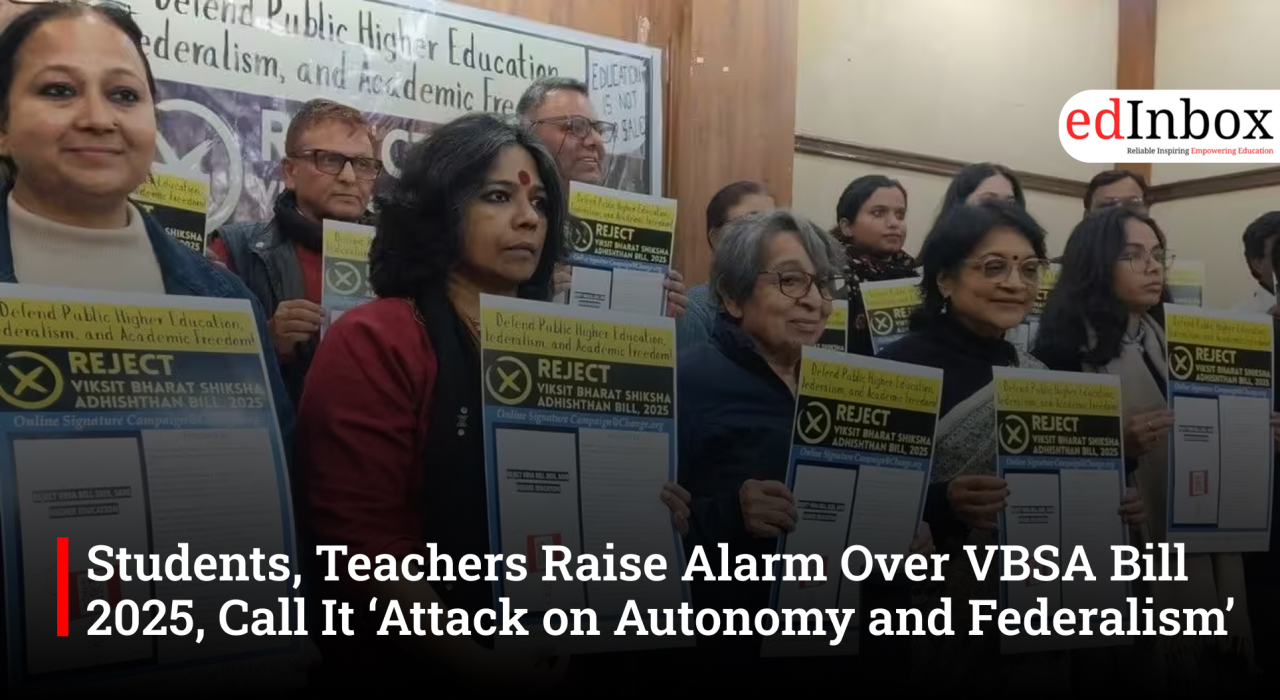
On 4th February, students and teachers associations as well as a few members of the parliament launched a nationwide campaign against the Viksit Bharat Shiksha Adhishthan (VBSA) Bill that was introduced in Parliament in December 2025. The bill which seeks to overhaul the present regulatory system for higher educational institutions has been opposed by various unions who have been calling it a threat to institutional freedom and federalism.
The VBSA bill was initiated with a notion of the establishment of a single topmost authority, Viksit Bharat Shiksha Adhishthan, that will regulate all HEIs in the country. It proposes to do away with UGC (University Grants Commission), AICTE (All India Council for Technical Education), and NCTE (National Council for Teacher Education) which have been regulating higher education in India for several years.
What’s the Reason Behind Protests?
Protestors of the VBSA Bill have three major concerns, including centralisation, autonomy, and federalism.
Centralisation
They fear that setting up a single, dominant authority to regulate higher education will lessen the role of states in education, as the authority will shift to the Centre.
Autonomy
Some varsities and academic bodies are stressed over the replacement of multiple authorities with a sole entity, which may restrict universities’ freedom in issues related to curriculum design, appointments, and academic decision-making.
Federalism
Another major issue, according to the protestors, is that the bill undermines the federal structure of India by exercising its power over state universities and higher education policies, taking away state governments’ authority to make academic decisions.
Due to these fears, students, teachers, and members of Parliament are seeking a revocation of the VBSA Bill.
After being presented in Parliament in the winter session, it was referred to a joint parliamentary committee post strong opposition from MPs and the chair of the parliamentary standing committee on education.
During the conference, the speakers emphasised that an implementation of the VBSA Bill will replace the UGC, AICTE, and NCTE with a single entity managed by the government.
“Universities will lose their autonomy, and institutions and faculty members who do not comply with the regulations will face penalties, including the suspension of funding. Without financial support, educational institutions will inevitably raise fees, making higher education unaffordable,” said Surajit Mazumdar, president of FEDCUTA.
“The fees at Ambedkar University Delhi already range from Rs 20,000 to Rs 25,000, which is higher than at many other public universities, and scholarships and fee waivers are often delayed or denied,” said Sharanya, treasurer of the AUD students’ council.
Students, Teachers Raise Alarm Over VBSA Bill 2025, Call It ‘Attack on Autonomy and Federalism’
Typography
- Smaller Small Medium Big Bigger
- Default Helvetica Segoe Georgia Times
- Reading Mode