Every Union Budget cycle revives a familiar argument: is India spending enough on education? Usually, the debate is boiled down to just one headline numberthe Ministry of Education's allocationsingle, handedly seen as the measure of national intent. However, such a narrow presentation ignores the core fact. Education outcomes depend not on the budget of a single ministry but on the overall public ecosystem's robustness and consistency.
The ability of a child to learn is not only inside the four walls of the classroom. It is influenced by nutrition, health, and sanitation, but also by transport, housing stability, digital access, and family income security. If any of these supporting systems get weak enough, it won't be enough for even the most cleverly designed education policies to make a big difference. In fact, education is the place where the flaws of different policies meet and get hidden from the eyes of the public.
Public facilities, such as schools, colleges, libraries, hostels, and laboratories, also have a social responsibility that they share. Government funding alone will never be enough to keep the quality high if the local people continue to see public infrastructure as something they can spend without thinking. It is a fact that when citizens care for their community, school property is protected, teachers are valued, and local institutions are involved, the public education systems last longer and work better. On the other hand, neglect and indifferent attitude result in the deterioration of even the best, funded facilities thus, the infrastructure turns into an empty shell.
This mutual dependence is most apparent in school education. While education departments are responsible for midday meal programs, the success of such programs cannot be separated from issues like food security, supply chains, and public health systems. In case nutrition budgets are cut or health services decline, attendance will fall and learning will be affected especially those first generation learners. Similarly, foundational literacy initiatives are also linked to early childhood care, anganwadi facilities, and maternal health, which are all beyond the direct control of the education ministry.
The higher education sector has a more profound and philosophical problem. Most of the time, universities are evaluated almost solely based on placement records and salary packages, which is why education is narrowly seen as a means to making money. This banalization of education as a mere employability tool is tantamount to neglecting the broader educational goals of innovation, social impact, and intellectual synthesis. We as a society need to engage in more discussions about research, problem solving, ethical leadership, and knowledge creation not so much about entry level salaries. Both educational institutions and families should change their perspective of education from merely a private economic return to a public good that drives innovation and social transformation.
The digitalization of education is even more the reason why the deficiencies of the educational ecosystem become obvious. There is no way that online learning, AI, powered classrooms, and digital testing can exist without a constant supply of electricity, a cheap internet connection, and appropriate devices. These are dependent on the delivery of power, telecom, and digital public infrastructure, sectors that are hardly taken into account in the education budget discussions.
Ultimately, education results cannot be separated from employment and economic policy. Skilling programs do not make sense if industrial growth, MSME support, and labor reforms do not lead to job creation. When graduates are underemployed, the blame is usually put on institutions while economic planning that is out of alignment is ignored.
If India truly wants better learning outcomes, higher quality research, and a workforce that is prepared for the future, it should stop thinking in silos. Funding education needs to be considered as one ecological system where, for instance, governmental departments cooperate, societies become involved, and the criteria for success are diverse including health, infrastructure, innovation, and employment.
So, the main point should not be solely the volume of India's expenditure on education but also the effectiveness, consistency, and combination of its investments in all aspects which enhance the value of education.
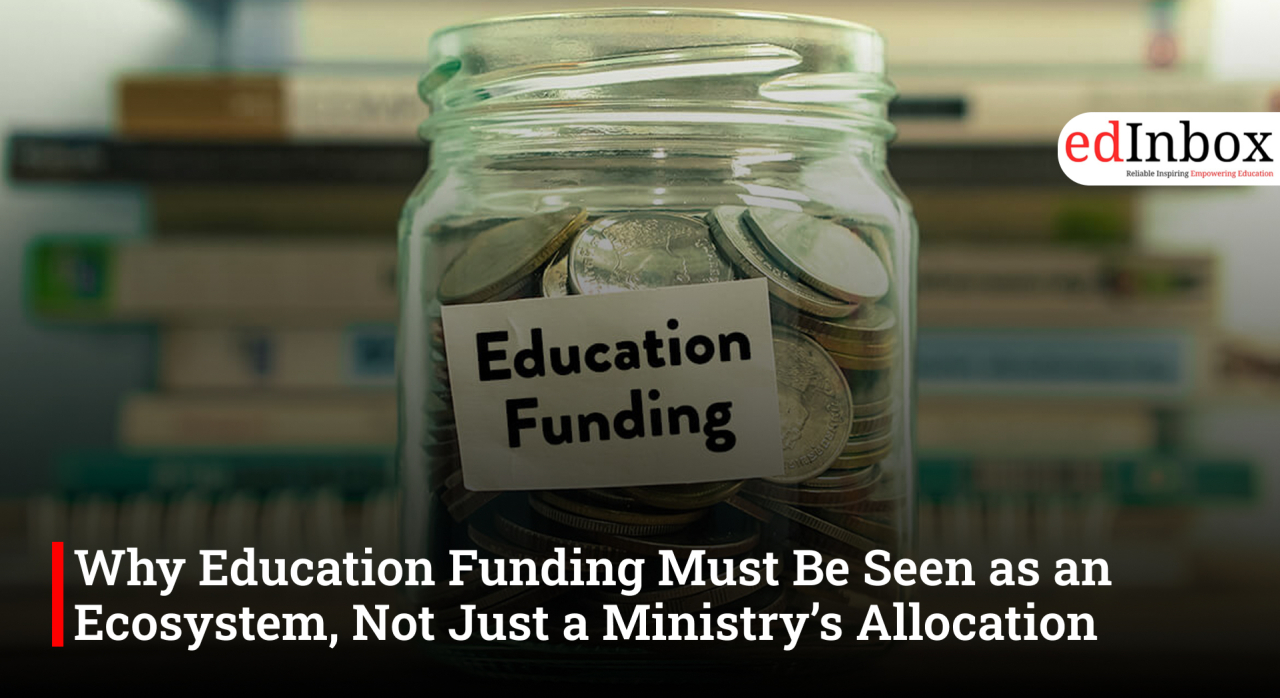
Why Education Funding Must Be Seen as an Ecosystem, Not Just a Ministry’s Allocation
Typography
- Smaller Small Medium Big Bigger
- Default Helvetica Segoe Georgia Times
- Reading Mode