Food is essential. It's true that our eating habits can change, but feeding the body will always require energy, and energy comes from food. At the most fundamental level, agriculture is an amazing natural biological cycle: plants take in carbon dioxide and, by photosynthesis, produce the food we need while also releasing oxygen into the air.
However, feeding a population as large as Indias cannot be solved by a simple ecological equation. It is a complex technological, economic, and governance challenge. A challenge, which in fact, now requires systemic rethinking.
Invisible cost of high input agriculture
In order to ensure food security, India has stepped up agriculture through the use of irrigation, chemical fertilizers, pesticides, and machinery. The results of these interventions have been such dramatic leaps in productivity. However, if we take a complete audit, we have to admit the costs as well. Today, in an epoch of multiple crises, food production systems are turning out to be very energy intensive, water, a limited natural resource, is extensively pumped, in many cases, from overexploited aquifers. Farming patterns are not always compatible with nature: e.g., is Punjab really the right place for water, guzzling paddy, or Maharashtra, for sugarcane?
At the same time, ensuring affordable food remains a legitimate and sensitive priority for both farmers and the Indian Government. Subsidies have played an important role in safeguarding food security. But distortions have emerged. Nearly 90 per cent of the cost of urea is subsidised. Predictably, overuse follows. The greening of crops is often mistaken for higher productivity, though that is not always the case. Excess nitrogen degrades soil health, reduces long-term efficiency and contributes to environmental pollution.
Restoring soil health
Encouragingly, initiatives such as the Soil Health Card Scheme represent an important shift. Instead of prescribing generic inputs, they focus on the specific condition of the soil and recommend appropriate amendments. Similarly, the PM Programme for Restoration, Awareness, Nourishment and Amelioration of Mother Earth (PM-PRANAM) incentivises States to reduce excessive chemical fertilizer use.
Soils are living systems. When crops grow, they do not merely synthesise carbohydrates; they draw minerals and micronutrients from the soil. If biomass is removed year after year without restoring balance, depletion is inevitable. Fertilizer application then becomes a compulsion rather than a calibrated intervention. Ecological security demands that we restore this balance.
Circular agriculture at the village level
Agriculture must shift from a linear to a circular model. Crop residue, instead of being burned, can be used for biogas production. The slurry from biogas plants, rich in nutrients, can be returned to the soil. If nutrient loops are closed locally, we create a circular economy at the village level, thereby generating clean energy while restoring soil fertility.Such decentralised approaches reduce waste, emissions and transportation costs. They also enhance local resilience, which is a critical requirement in an era of climate uncertainty.
Rethinking fertilizer efficiency
Next, conventional fertilizer application methods are inherently inefficient. Water-use efficiency in many systems is below 30 per cent, implying that nearly 70 per cent of applied nutrients are lost. But "loss" in this context means pollution. Nitrous oxide emissions contribute to climate change, while nutrient runoff contaminates groundwater.
Precision agriculture offers improvements, yet inefficiencies remain. Emerging solutions such as nano-fertilizers, designed for targeted delivery and higher absorption, show promise. If nutrient uptake approaches near-total efficiency, fertilizer demand declines and emissions are reduced correspondingly. Technology must now be aligned with ecological outcomes.Science must lead climate resilience
India will be significantly affected by climate change if we persist with business-as-usual crop varieties. Yet, we are not without scientific foundations. For decades, institutions such as the National Bureau of Plant Genetic Resources and CGIAR (Consultative Group on International Agricultural Research) research centres worldwide - including Bioversity International, now part of the Alliance of Bioversity International and CIAT (Centro Internacional de Agricultura Tropical- International Center for Tropical Agriculture) - have conserved extensive germplasm collections. Within these repositories lie genes that confer tolerance to heat, drought, flooding and other climate stresses.
Assuming that we have saved this biodiversity, the next question is what to do with it. One way is to embed stress, tolerant traits in new varieties, combining the traditional breeding methods, advanced genomic tool such as CRISPR (Clustered Regularly Interspaced Short Palindromic Repeats), based editing and other, if necessary, modern technologies to improve resistance, nutrient, use efficiency, and other such desirable characteristics. National programmes like National Innovations in Climate Resilient Agriculture (NICRA) serve as a launching pad for such research to move forward quickly. There's no cause for anxiety here. Science indeed provides answers; it is just guidance that is lacking.
Tackling post, harvest losses
Between the time a crop is harvested and when it is consumed, as much as 35 per cent of it could be lost. If such losses were stopped, it would be the same as food availability being increased by the same proportion i.e. without the need to bring more land under cultivation.
Earlier, limited access to energy constrained on-site storage and processing. Today, renewable energy changes that equation. Decentralised cold storage systems powered by solar energy, supported by financing mechanisms such as the Agriculture Infrastructure Fund, can operate at the village level. Refrigerated transport can reduce transit losses. Whatever we produce must be utilised efficiently.
Solar as a 'second crop'
Questions are often raised about the land availability for solar power. However, agriculture itself is a source of innovative solutions. Under schemes like PM, KUSUM (Pradhan Mantri Kisan Urja Suraksha evamUtthaanMahabhiyan), the farmers are being facilitated to install solar pumps and grid connected systems.
The frontier ahead is agro, photovoltaics, installing solar panels at heights that are most efficient and choosing crop varieties that will not lead to yield reduction. Food production is not necessarily a trade off. Rather, solar energy could be a dependable secondary source of income.
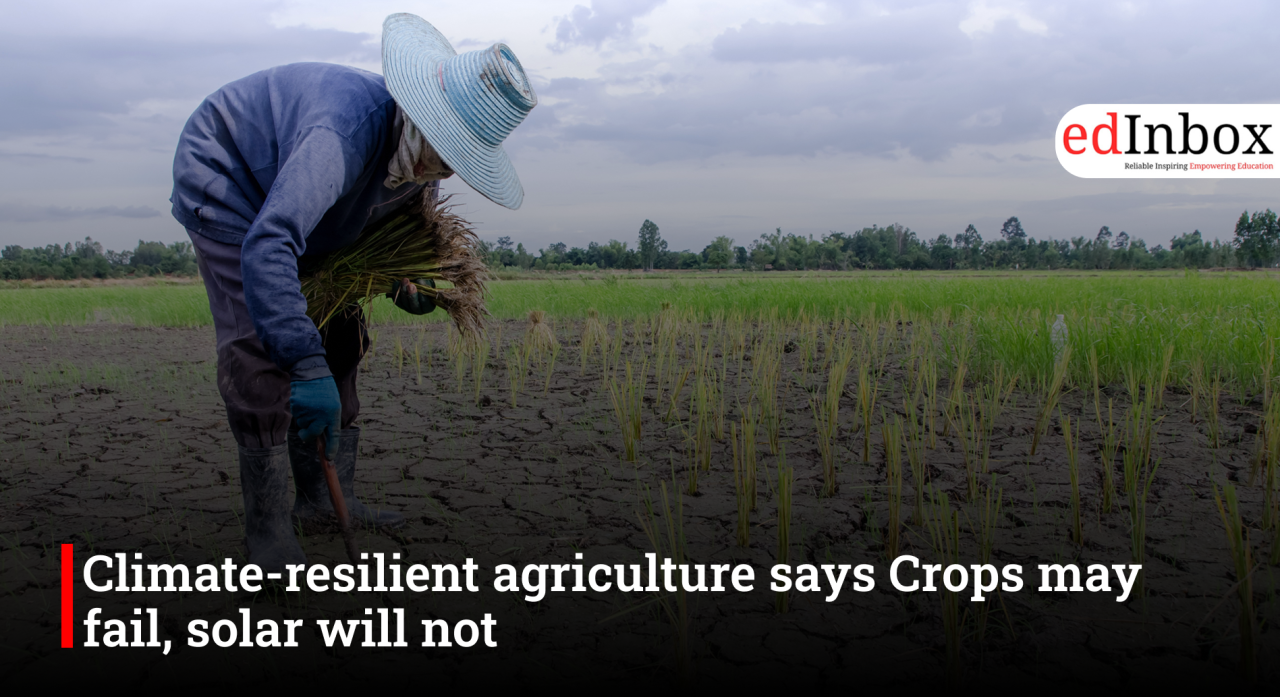
In bad weather, crops can fail but solar energy will not. By such diversification of income, agrarian distress can be alleviated to a great extent.
From food security to ecological security
The transition from food security to ecological security does not mean sacrificing productivity. It means producing intelligently, i.e., using resources efficiently, restoring soils, having resilient crops, lowering emissions and having diversified farmer incomes. This implies that subsidy programs must be in harmony with sustainability; also, research activities should be changed to focus only on climate adaptation; furthermore, circular bio, economies must be strengthened and additionally, renewable energy should be integrated in all stages of the value chain.
Such changes, in vision, voices and values, will be in the limelight of the debates at the next Silver Jubilee Edition of TERI's World Sustainable Development Summit. Agriculture, ecological security and climate resilience will be among the topics of the discussions along with other sustainability issues such as energy transitions, biodiversity conservation, and equitable development. It is not only imperative that we place ecological thinking at the center of our development model but also, this is the only way that we can secure our food systems and natural capital for future generations.
Climate-resilient agriculture says Crops may fail, solar will not
Typography
- Smaller Small Medium Big Bigger
- Default Helvetica Segoe Georgia Times
- Reading Mode