The government on Monday came out with PRAHAAR, the country’s first comprehensive national counter-terrorism policy and strategy. The strategy was released by the Ministry of Home Affairs (MHA) and it unveils a structured and intelligence-driven framework to prevent and deal with terrorism in all its manifestations.
The policy runs into eight pages and stresses the need to prevent terror attacks, put in place swift and proportionate response mechanisms, and improve coordination among different government agencies.
The policy prioritises a “whole-of-government” and “whole-of-society” approach that follows human rights and the rule of law.
A key element of the PRAHAAR policy is to tackle conditions that enable terrorism, including radicalisation.
It also stresses on the need to align and shape global efforts to combat terrorism.
The role of the Multi Agency Centre (MAC) and the Joint Task Force on Intelligence (JTFI), functioning under the Intelligence Bureau (IB), are asserted for real-time intelligence sharing and coordinated action.
The policy also highlights India’s strategy, stating that a proactive approach that prevents and counters terrorist threats remains the guiding principle.
“This approach is primarily ‘Intelligence-Guided’, in which primacy is accorded to intelligence gathering and its dissemination to executive agencies for neutralisation of threat. Operationalisation of Multi Agency Centre (MAC) along with the Joint Task Force on Intelligence (JTFI) in the Intelligence Bureau (IB) remains the nodal platform for efficient and real-time sharing of CT-related inputs across the country and subsequent prevention against disruptions,” it reads.
The policy further says, “close partnerships for counter terrorism operations have been created with Central Agencies and State Police Forces under the mechanism of Multi Agency Centre (MAC), and Joint Task Force on Intelligence (JTFI) in Intelligence Bureau (IB).”
The policy points out the fact that terrorists and extremists use the internet inappropriately for their various purposes such as communication, recruitment, and glorification of jihad. It also mentions that Indian Law Enforcement Agencies are persistently trying to stop such cyber activities, online networks of terrorist groups, and their propaganda and recruitment.
“Law enforcement agencies also regularly disrupt the overground workers (OGW) modules, through which terrorists are extended logistic, material and financial support. In recent times, the nexus between illegal arms syndicates and terrorist groups has emerged, and for combating it, coordinated interventions are being made by the intelligence agencies along with the respective Law Enforcement Agencies, in various Indian states,” the policy notes.
“Special emphasis is given to disrupting terror funding networks through the legal framework under Indian laws.”
The policy further points out that India faces terror threats not just on land but also in water and air.
“Capacities have been developed to protect the critical sectors of the Indian economy, including power, railways, aviation, ports, defence, space and atomic energy from state and non-state actors,” it mentions.
The policy document further highlights how international terrorist groups such as Al-Qaeda and the Islamic State of Iraq and Syria (ISIS) have targeted India in the past and continue to do so.
Terrorists’ handlers sitting across the border frequently employ the latest technologies, including the use of drones, for carrying out terror-related activities and attacks in Punjab and Jammu and Kashmir.
“Disrupting and intercepting terrorist efforts to access and use CBRNED (Chemical, Biological, Radiological, Nuclear, Explosive, Digital) material remains a challenge for Counter Terrorism (CT) agencies. The threat of state and non-state actors misusing drones and robotics for lethal purposes remains another area of concern, even as criminal hackers and nation states continue to target India through cyber-attack,” it points out.
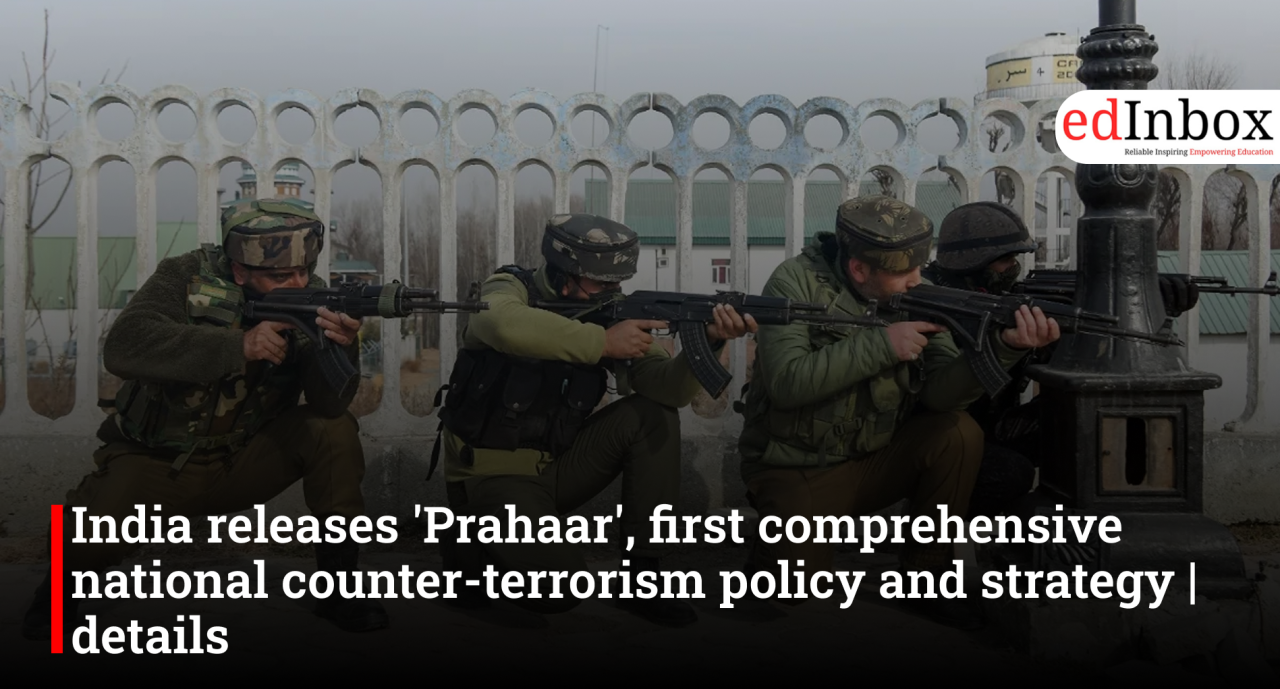
India releases 'Prahaar', first comprehensive national counter-terrorism policy and strategy | details
Typography
- Smaller Small Medium Big Bigger
- Default Helvetica Segoe Georgia Times
- Reading Mode