According to the World Health Organization (WHO), the world faces a health worker shortage of approximately 20% (~15 million)—a gap likely to widen rapidly under the current education system, driven by chronic diseases and an ageing population. Simultaneously, rapidly changing technologies necessitate reskilling the existing 65 million global health workers. This presents a massive challenge for the world.
Consequently, the global mobility of health care talent is rising. Countries like the US, Canada, Australia, and various European nations have been depending more and more on foreign, trained health workers. The OECD's International Migration Outlook draws attention to this trend by indicating that there are substantial proportions of foreign, trained doctors and nurses in the leading health systems.
This global deficit presents an opportunity for India. Historically, India has prioritised domestic sufficiency, making strides through changes in the National Medical Commission’s structure and policies. Our curriculum, regulations, and training remain distinct and tailored to local needs. The focus has been inward; in fact, global opportunities have often been viewed as a threat—a brain drain. However, this need not be a zero-sum game. It can be a win-win: The domestic market can continue to serve domestic requirements, while we simultaneously create a parallel export-oriented medical education ecosystem as a special economic zone.
This proposed Medical Education Global Centre of Excellence could be a sovereign play insulated from standard Indian regulations. It would allow free-market operations to attract investment, adopt global regulations and accreditations, and recruit health workers/faculty from India and abroad.
We should look closely at the Caribbean model and other such export- oriented models. Other nations, including Poland, have successfully deployed similar models to meet the standards of export markets like the US, UK, Canada, and Scandinavia.
Key lessons include:
Curriculum alignment: Adopting global curricula (e.g. USMLE), textbooks, and faculty.
Clinical integration: Tie-ups with global teaching hospitals for clinical rotations (e.g., the 2+2 year model).
Accreditation: Adopting major global standards.
Financial recognition: Securing recognition from the major target geographies department of education to ensure student eligibility for loans.
Investment: Encouraging for-profit colleges with global investors.
India ought to consider a Global Centre of Excellence route, export, driven medical education SEZ zones with different domestic regulations, taxation, and investment rules. These zones would provide medical, nursing, and allied health care training using internationally aligned curricula and supported by frameworks that facilitate global accreditation and workforce mobility. Such SEZs would open the door for collaborations between Indian institutions, the global private sector, and leading international universities and provide the necessary flexibility to comply with the destination country licensing requirements.
A selective incentive frameworke.g., tax holidays, GST/duty exemptions, and export incentives would lure private investments and reduce the cost of education. Utilizing India's large pool of clinicians and the visiting global faculty, this solution would enable students to acquire their foundational training in India and eventually migrate to residency or specialisation abroad without any hassle. Thus, a scalable, export, driven ecosystem is created which serves the global workforce demand.
To realise this vision, critical challenges must be addressed. Foremost is the deregulation of SEZ curriculums to meet diverse international standards, ensuring graduates are practice-ready and globally mobile. Equally important are frameworks allowing foreign university partnerships, private investment, and genuine educational autonomy. Crucially, these SEZs cannot be isolated clusters near ports like traditional SEZs; they must be designated zones near India's existing medical hubs. Not preventing existing Indian faculty and patient participation into the SEZ ecosystem is essential. Achieving the right balance at the intersection of domestic and SEZ rules will be key. A pathway to bridge-qualify for Indian practice (NMC registration) if the students choose to stay in India as well as choose other similar pathways to other export markets.
India is uniquely positioned to succeed here. We possess a vast diaspora of global faculty, a massive pool of aspiring medical students, and a reputation as a major investment hub. With the right policies, we can leverage these advantages to create a services factory for the world, mirroring the success of the tech services industry. The domestic healthcare sector and patients could also benefit from the spill-over knowledge and expertise from these SEZs. Our global pool of medical professionals and extended diaspora can be valuable connection to support Heal in India. Heal in India and Heal by India, therefore, can become two sides of the same coin, as health care starts transcending geographic boundaries.
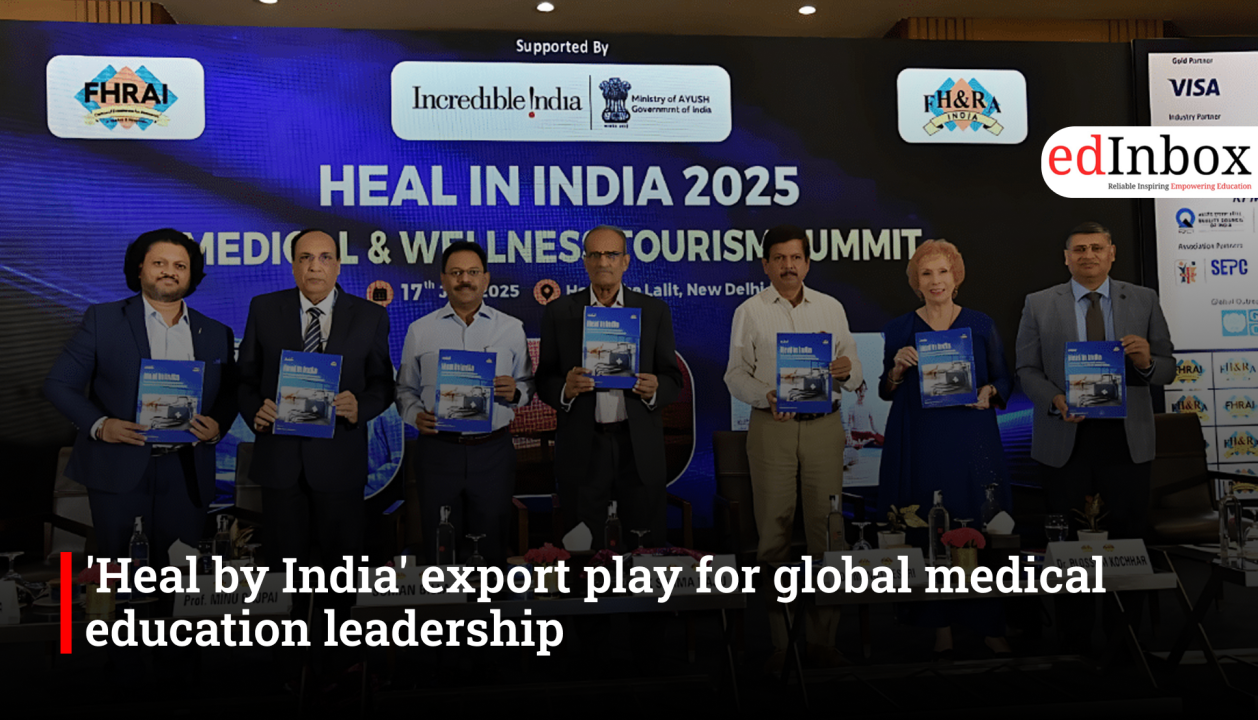
'Heal by India' export play for global medical education leadership
Typography
- Smaller Small Medium Big Bigger
- Default Helvetica Segoe Georgia Times
- Reading Mode