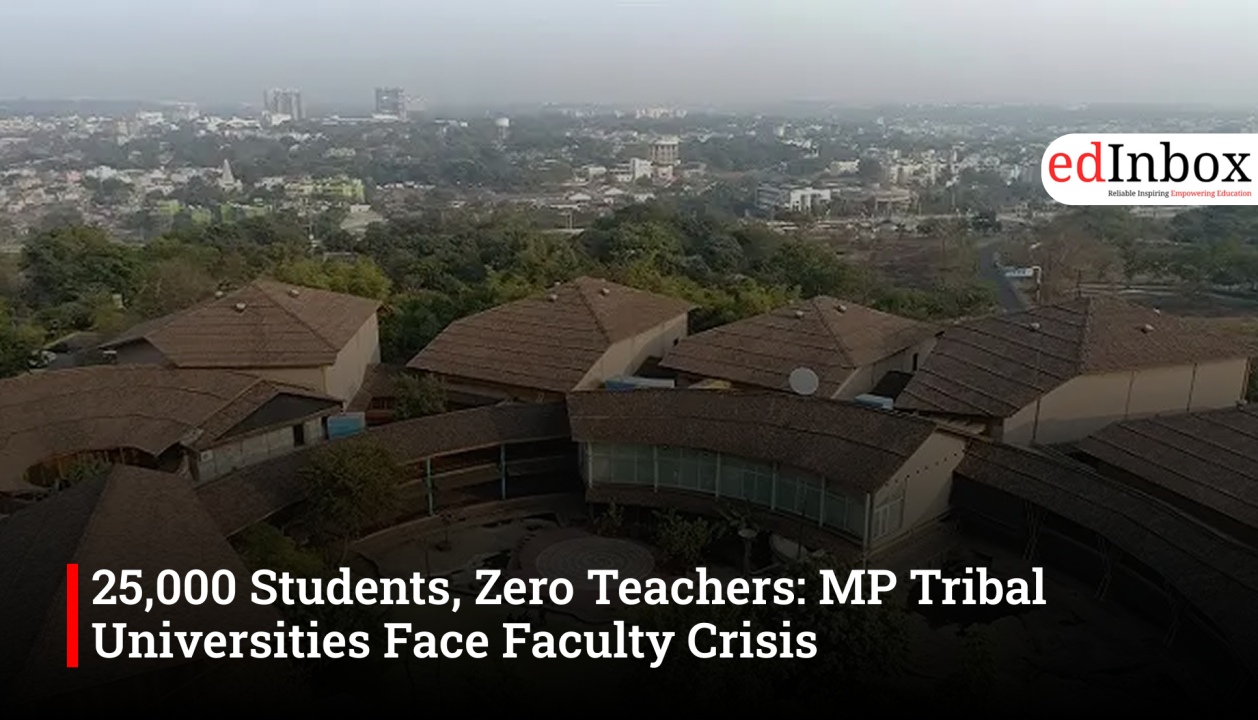
The names of tribal icons echo loudly in Madhya Pradesh during the election season. They are invoked in speeches, printed on banners, and held up as symbols of pride and inclusion. But once the votes are counted, the reverence appears to fade into silence. In Khargone district, that silence now hangs over Krantisurya Tantya Bhil University, a state university named after one of the most powerful symbols of tribal resistance. It has 25,000 students, 140 sanctioned teaching posts, and not a single permanent teacher in place.
Higher Education Minister Inder Singh Parmar in a written reply in the Madhya Pradesh Assembly, admitted that all 140 academic posts at the university are vacant. These vacancies are of 80 assistant professors, 40 associate professors and 20 professors. The university is currently running BSc agriculture, BA, BCom, and BSc courses, along with a PG commerce program, but it is completely dependent on temporary arrangements and deputation. Even the building itself is not permanent.
The disclosure was made after Congress MLA Dr Jhuma Solanki raised the issue with the government about the number of posts filled, the number of posts remaining vacant, and the recruitment schedule. The reply was laser clear in its devastation: none of the teaching posts have been filled, and no timeframe can be given as to when they will be. 25, 000 students have registered there, which means the institute is there only on paper and in name, whereas a university is supposed to have a stable faculty, regular teaching, timely examinations, and an academic structure that really works.
Solanki has alleged that the consequences are already being borne by students. She said exams are not being conducted on time, results are delayed, many courses that students may want to pursue have not even been started, and even when examinations are held, mark sheets are often not issued. Without mark sheets, scholarships are getting stuck. She also pointed to the absence of a functioning executive body and asked if the university's own decision-making structure is incomplete, who is running it, and in whose interest?
Khargone is not an isolated case. In Chhindwara, Raja Shankar Shah University, another institution named after a tribal icon, reportedly has 100 sanctioned teaching posts, all lying vacant. Students there have begun speaking openly about the academic collapse unfolding behind the university's facade. Vishwajeet Pal, a first-year BTech student, said multiple lectures are routinely missed and several papers remain uncovered.
Yash Power, another student, said they have too many subjects and far too few faculty members, with only two teachers handling what should be a much larger load. The result is a model of higher education in which classrooms are open and admissions are active, but actual teaching is painfully thin.
Professor Indra Prasad Tripathi, Vice Chancellor of Raja Shankar Shah University, informed that the state government had requested universities to submit action plans for the filling of vacant posts. He further stated that their institution had already submitted its plan. In his words, the target year is 2027, and the interview session is expected to be held in December 2026. However, that schedule deeply contradicts the political promises that are coming from the minister.
Inder Singh Parmar, Higher Education Minister, stated that the recruitment process would be completed in four to five months. Besides, a Detailed Project Report (DPR) has been prepared for a Rs 119, crore building project in Khargone, and construction will be started in the near future.
At Krantiveer Tatya Tope University, the same situation prevails as education in subjects ranging from undergraduate arts, science, and commerce to agriculture and postgraduate programs is being offered without permanent faculty members.
AK Mugdal, acting registrar, stated that the university has already communicated its staffing needs to the government and that recruitment will start shortly to ensure that there is faculty availability for the next academic session.
What makes the crisis difficult to dismiss as a one-off administrative delay is the scale revealed in another written Assembly reply. Across Madhya Pradesh's 17 government universities, 793 of the 1,069 sanctioned assistant professor posts are vacant. That means 74 per cent of all approved assistant professor positions remain unfilled. Across the state's public university system, only 276 assistant professors are currently in charge of teaching. Moreover, five universities do not even have an assistant professor on their faculty.
There is not a single assistant professor at Raja Shankar Shah University, Chhindwara, Krantiveer Tatya Tope University, Guna, Krantisurya Tantya Bhil University, Khargone, Maharaja Chhatrasal Bundelkhand University, Chhatarpur, and Rani Avantibai Lodhi University, Sagar.
The neglect becomes more explosive in combination with the political situation. It is estimated that about 22 per cent of the population of Madhya Pradesh is tribal. Out of the 230 Assembly seats of the state, 84 are tribal dominated, and 47 seats are reserved for Scheduled Tribes. Hence, the institutions which are named after the tribal heroes are not only the educational places but they are, at the same time, the potent political symbols.
The Madhya Pradesh government has a track record of publicly touting that it was among the first states to implement the National Education Policy (NEP). In the reality, the situation is quite different. The NEP is all about flexibility, multidisciplinary learning, and quality outcomes. However, in a number of state universities, students have difficulties in getting regular classes, holding exams on time, getting results, mark sheets, and gaining access to the courses they have been promised.
25,000 Students, Zero Teachers: MP Tribal Universities Face Faculty Crisis
Typography
- Smaller Small Medium Big Bigger
- Default Helvetica Segoe Georgia Times
- Reading Mode