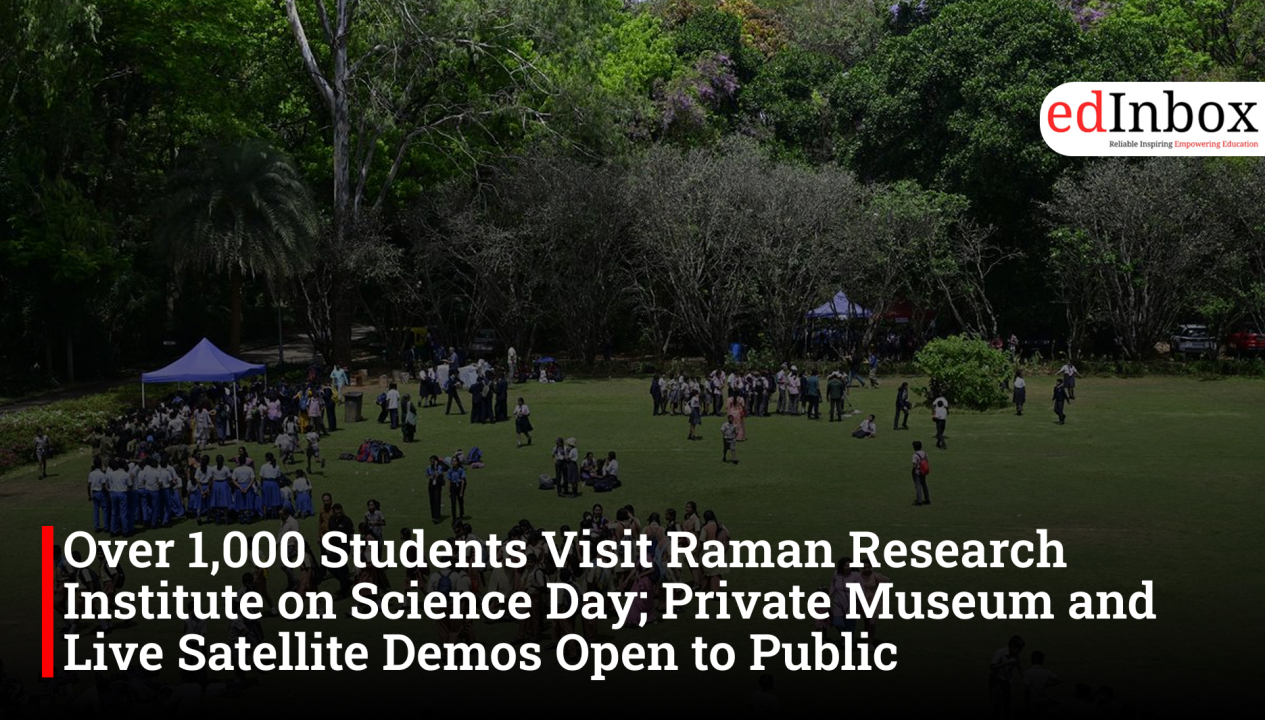
Visitors filled the Raman Research Institute on Saturday, learning about the sciences through displays ranging from a live satellite feed to demonstrations of more basic concepts. Numbering well over a thousand and largely consisting of schoolchildren, they visited the institute for National Science Day, which marks the anniversary of the Raman Effect discovery.
This is the 98th anniversary of the discovery.
Several sections of the institute that are not always open to visitors were also open. One of these was the Raman Museum that mainly exhibits the items of Sir C V Raman's personal collection. The collection consists of a large number of minerals and fossils, musical instruments, and even a fragment of rock from the Hiroshima atomic bombing. The other one, the Archival Gallery, shows the detailed chronology of C V Raman's life and his discovery along with that of the Raman Institute, also a brief presentation of curiosities such as the different international awards Raman received and the species of trees planted in the institute.
Besides this, there were also some fun activities like a treasure hunt and a quiz meant for the children who were visiting. The institute also held a Meet The Scientist session in which scientists from RRI in different fields participated. Dozens of stalls were also set up featuring experiments organised by different sections of RRI, alongside displays from outside parties.
One example was the RRI's Electronic Engineering Group which showed a satellite dish receiving images from orbit and decoding the data to display phenomena like weather over India and cloud temperature.
Among the student visitors were some of the other prominent attendees at the event, including Malleswaram MLA C N Ashwath Narayan. Speaking to indianexpress.com, he said, "This is a really good initiative, an excellent celebration of Science Day. I also spoke with several students today. I was very happy to see their curiosity."
Professor Tarun Souradeep, Director, RRI, said, "The response is very encouraging. We are glad it is growing, and it has to grow more."
In response to a query on the ability of such events to sensitise youngsters, he said, "To me, that is very important. India has a very large latent talent pool for science, which has not been used... Much of the talent does not get exposed enough to go forward."
He added, "Most exhibits are made here and focus on basic sciences rather than trying to wow visitors... Science ultimately reaches people when it is accessible. If it is packaged very glamorously, people may enjoy it if they see it, but never think they can also be a part of it."
Over 1,000 Students Visit Raman Research Institute on Science Day; Private Museum and Live Satellite Demos Open to Public
Typography
- Smaller Small Medium Big Bigger
- Default Helvetica Segoe Georgia Times
- Reading Mode