There is something deeply political about a missing roti.
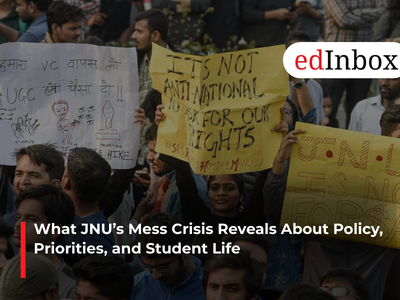
At Jawaharlal Nehru University, where debates on ideology, policy, and nationhood are routine, the current protests are not about abstract ideas—but about food. The disappearance of rotis from hostel mess menus and the shrinking of meal hours have triggered student unrest, exposing a crisis that goes far beyond campus kitchens.
At the heart of the issue lies a 20% cut in Piped Natural Gas (PNG) supply, reportedly enforced by Indraprastha Gas Limited following upstream restrictions from GAIL. On paper, it is a supply-side adjustment. On campus, it translates into empty plates.
The Politics of Infrastructure Failure
What is unfolding at JNU is not an isolated logistical hiccup—it is a case study in how infrastructural decisions ripple through everyday life. When gas supply is curtailed, messes cannot function. When messes fail, students—many of whom rely on subsidised meals—are pushed into precarity.
This is where policy meets lived reality. A Gazette notification may justify a reduction to “80% of average consumption,” but it does not account for the lived economies of students who cannot afford alternatives. The shutdown of spaces like Sabarmati Dhaba is not just about food—it is about the erosion of informal student ecosystems that sustain campus life.
From Classrooms to Crisis Lines
The irony is stark. Universities are expected to produce critical thinkers, yet students are being forced to protest for basic necessities. The demand is not ideological—it is infrastructural: ensure gas supply, restore food services, and prevent financial burden.
But beneath these demands lies a deeper question—why are students repeatedly pushed to the frontlines of systemic failures?
The reported black marketing of LPG cylinders adds another layer to the crisis. Scarcity breeds opportunism, and in the absence of robust institutional response, informal—and often exploitative—markets take over.
A Crisis of Accountability
While Indraprastha Gas Limited cites upstream constraints from GAIL, the chain of accountability becomes diffused. Who, then, is responsible for ensuring that essential services in a central university remain uninterrupted?
This diffusion is precisely the problem. In India’s layered governance structure, responsibility often evaporates between agencies, leaving institutions—and individuals—to absorb the shock.
More Than a Campus Issue
To dismiss this as a “JNU issue” would be a mistake. The crisis reflects a broader national anxiety around energy supply, affordability, and access. If a premier central university struggles to maintain basic food services, what does it say about smaller institutions, or rural hostels operating with fewer resources?
Food, after all, is not a luxury in education—it is infrastructure.
The Politics of the Plate
Student protests at JNU have often been framed through ideological lenses. But this moment demands a different reading. This is not about left or right—it is about survival within systems that are increasingly stretched.
When rotis disappear, politics becomes personal.
And perhaps that is the most telling lesson here: the future of higher education in India will not only be decided in policy documents or academic councils, but also in mess halls—where the absence of something as basic as a roti can ignite a movement.
What JNU’s Mess Crisis Reveals About Policy, Priorities, and Student Life
Typography
- Smaller Small Medium Big Bigger
- Default Helvetica Segoe Georgia Times
- Reading Mode