“I didn’t drop the course,” Yulia told me over a patchy call. “The war dropped into it.”
She is a management student from Ukraine, enrolled in a partner programme linked to Taras Shevchenko National University of Kyiv. When the conflict intensified, her classroom moved underground—literally. Lectures continued in bunkers, assignments were submitted between power cuts, and exams were taken with one ear tuned to sirens.
“Sometimes,” she said, almost laughing, “the Wi-Fi is stronger than my nerves.”
Thousands of kilometres away, in the Gaza Strip, 19-year-old Ahmed,an engineering aspirant who had hoped to join Islamic University of Gaza, never got to begin his semester. His school was destroyed. His books are buried. Now, he studies from scanned PDFs on a borrowed phone.
“You don’t plan your day,” he told me through a local volunteer. “You wait for a quiet hour—and then you try to remember what normal studying felt like.”
Between these two realities,one of interrupted continuity, the other of suspended beginnings,lies the fragile spectrum of what it means to be a student in a war zone.
The Day the Classroom Shifted
Ranya, a business student from Israel studying at Tel Aviv University, remembers the exact moment her semester changed.
“We were discussing a case study on risk management,” she said. “And then suddenly, risk was no longer theoretical.”
Her university shifted to hybrid mode within days. Some students attended classes online from safer areas; others joined from shelters. Attendance was flexible, deadlines negotiable.
“But concentration?” she paused. “That wasn’t negotiable. You either had it, or you didn’t.”
Across the border, in the West Bank, Noor, a literature student from Birzeit University, described a different kind of disruption.
“We still have classrooms,” she said. “But the mind doesn’t always arrive there.”
Her words stayed with me longer than any statistic. Because they capture a truth institutions rarely measure: presence is not the same as participation.
Russia: Continuing, But Changed
In Russia, Artyom, a computer science student at Moscow State University, described a quieter shift.
“There are no sirens where I am,” he said. “But there is a constant awareness.”
International collaborations have thinned. Exchange programmes have stalled. Conversations in classrooms are more cautious, more coded.
“You still study algorithms,” he added. “But you also learn what not to say.”
For him, education hasn’t stopped—it has narrowed.
The Myth of Seamless Learning
In policy rooms and institutional statements, the phrase “hybrid learning” appears as a solution—flexible, adaptive, resilient.
And yes, it works. To an extent.
When students from the Indian Institute of Management Ahmedabad’s Dubai cohort were relocated amid rising tensions in West Asia, classes resumed quickly. Some continued from Ahmedabad, others logged in from different countries. The system absorbed the shock.
But as one student—who preferred not to be named—told me, “Just because the class continues doesn’t mean your head is in it.”
She had returned home temporarily, attending lectures at odd hours.
“You’re present on screen,” she said. “But part of you is elsewhere—tracking news, checking on people, wondering what happens next.”
Hybrid learning preserves structure. It does not guarantee absorption.
The Unequal Geography of Education
What struck me most across these conversations was not just the disruption—but how unevenly it is distributed.
Yulia still submits assignments.
Ranya still attends classes.
Artyom still writes code.
Ahmed is still waiting to begin.
Global education prides itself on being borderless. But conflict redraws those borders sharply, dividing students not just by geography, but by possibility.
Some adapt.
Some pause.
Some are left behind entirely.
What Students Carry Forward
When I asked Yulia what she had learned from the past year, she didn’t mention her coursework.
“I’ve learned to focus on chaos,” she said. “I don’t know if that’s a skill or a survival instinct.”
Noor spoke about memory.
“I write things down more now,” she said. “Because I don’t trust the day to stay stable.”
And Ranya reflected on ambition.
“You stop planning too far ahead,” she admitted. “You think in weeks, not years.”
These are not lessons listed in any syllabus. But they shape how students will move forward—into careers, into decisions, into a world that increasingly mirrors the instability they studied through.
As our conversations ended—calls dropping, messages delayed, time zones colliding—one thought stayed constant:
Education, in conflict, does not simply stop. It transforms.
Sometimes into resilience.
Sometimes into compromise.
Sometimes into absence.
And somewhere, in between a bunker lecture in Kyiv, a disrupted campus in Tel Aviv, a quiet room in Moscow, and a phone-lit study session in Gaza, students are still trying to hold on to the same idea:
That learning, somehow, must continue. Even when everything else does not.
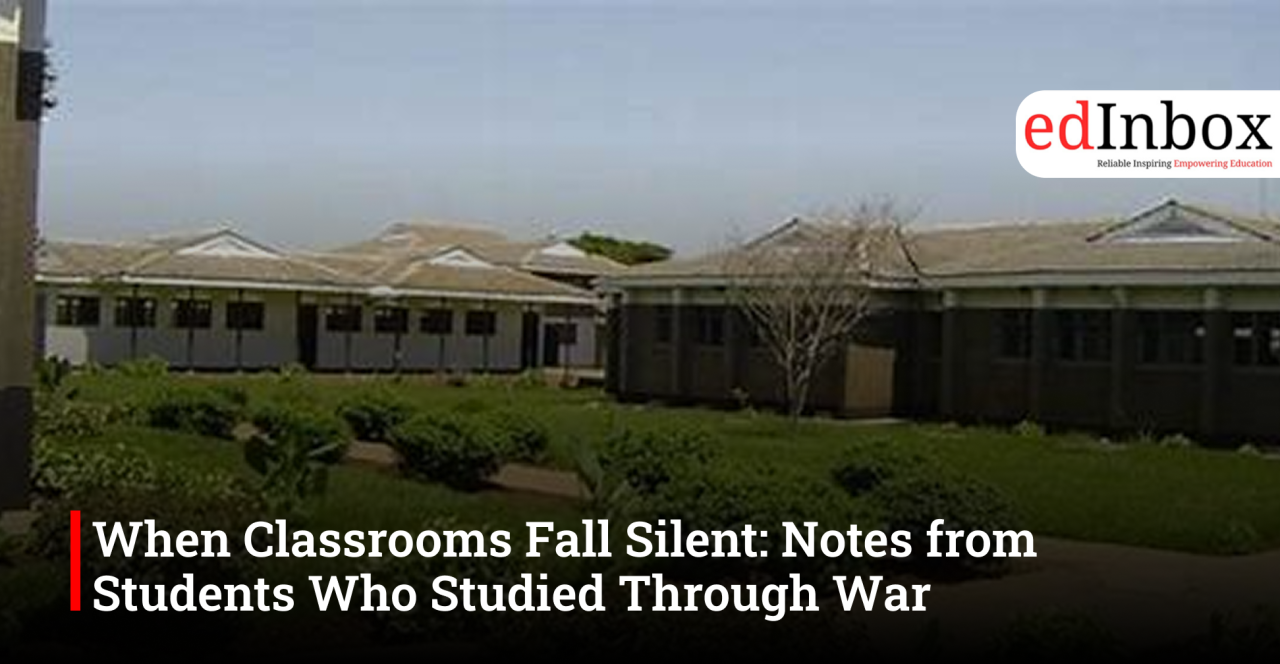
When Classrooms Fall Silent: Notes from Students Who Studied Through War
Typography
- Smaller Small Medium Big Bigger
- Default Helvetica Segoe Georgia Times
- Reading Mode