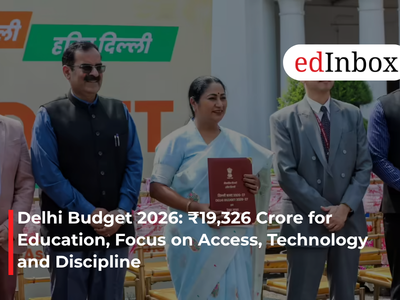
The Delhi government has set aside 19,326 crore for the education sector in the financial year 2026-27, making it the largest share of the state budget again. The Chief Minister, Rekha Gupta, while presenting the Budget, unveiled a trio of welfare, infrastructure, and technology-based reforms that are intended to increase access and enhance learning outcomes.
One of the main features is the offer of free cycles to about 1.3 lakh girl students of Class IX, backed by a fund of 90 crore. The step, besides solving the problem of last mile connectivity, is likely to discourage the dropout of adolescent girls.
For the first time in the capital, the administration has suggested the establishment of a Sainik School, indicating a desire for discipline-oriented education and leadership development. Besides this, Gupta has appealed to the Centre for permission for 10 Kendriya Vidyalayas in Delhi to satisfy the escalating enrolment demand.
Policy Reforms and Digital Push
The Budget introduces a Private Play Schools Policy to regulate early childhood education under a structured framework. Alongside, a common and digital library system is planned to ensure equitable access to learning resources.
Technology integration remains a priority, with ₹10 crore allocated for artificial intelligence in assessments and examinations, and ₹150 crore earmarked for expanding smart classrooms. The government aims to scale up from 7,000 smart classrooms to 8,777 this year, with a long-term target of 21,000.
Infrastructure and Student Support
Of the total outlay, ₹19,148 crore is dedicated to core education spending, including ₹200 crore for new school buildings and ₹275 crore for expansion of existing infrastructure. Additional measures include:
₹5 crore for medical rooms in government schools
₹2 crore for crèche facilities in offices
₹10 crore for laptops for meritorious Class 10 students
₹5 crore for student exposure visits
Sports and holistic development also find space, with ₹50 crore allocated for sports hostels and facilities, and ₹18.5 crore for global exposure initiatives.
Technical education is one of the most important areas that the government has provided funding for. Infrastructure upgradation at the ITIs level, new buildings for GB Pant Engineering College and polytechnics are included in this plan.
Besides that, initiatives are being taken to launch Centres of Excellence and make an Educity in Narela, besides the expansion of Ambedkar University of Delhi and the construction of a permanent campus for the Sports University.
The continued focus on areas such as educational accessibility, digital learning, and vocational/skills training is evident in Delhi's education budget which portrays a plan to make the education system of the capital more inclusive, ready for the future and at par with global standards.
Delhi Budget 2026: ₹19,326 Crore for Education, Focus on Access, Technology and Discipline
Typography
- Smaller Small Medium Big Bigger
- Default Helvetica Segoe Georgia Times
- Reading Mode