AI is unlikely to “replace” forensic scientists in India, but it will strongly change what their day‑to‑day work looks like and what skills they must add to stay relevant.
If you are a student in India searching for “forensic science career scope”, “future of forensic science in India”, or “AI in forensic investigation”, you are really asking one thing: “If I invest the next 5–7 years in this field, will there still be jobs for me?” That fear is understandable. The news about AI winning over humans in terms of image recognition, language tasks, medical diagnostics appears every couple of weeks. One would naturally question whether algorithms will also overtake the careful, scientific work of crime scene analysis, DNA, fingerprints or cyber forensics.
The truth is more balanced. AI is finding its way into forensic labs, police departments and digital forensics companies, but primarily as a speed-up, rather than a substitute. In order to discern this, you must distinguish between the instruments and the trade.
What AI is Really Doing in the Field of Forensic Science?
When we refer to AI in forensics, we are not referring to a robot entering a crime scene and resolving the case. AI tends to manifest in three forms in actual Indian laboratories and research departments.
Boring Repetitions Ends:
It accelerates repetitive and data-intensive work. Suppose it is lakhs of WhatsApp messages, hours of CCTV video, months of call details records, or vast piles of confiscated laptops and phones. Previously, human examiners were required to filter and tag this material and even had to skim all of this manually. Today, AI-based technologies can rapidly identify suspicious behaviour, such as specific keywords, faces, cars, time-related patterns, suspicious transactions, etc., allowing human experts to prioritise the most valuable aspects over being overwhelmed by raw data.
AI Assists in Pattern Recognition:
Finding such a pattern can be time consuming manually. Fingerprint identification, face identification, voice identification, handwriting analysis, and even bullet and cartridge-case identification: all require the identification of patterns and similarities. Trained algorithms on large data may be able to suggest probable matches more rapidly and reliably. The most important thing here is to propose, and a human forensic specialist must still analyse, verify and justify the outcome.AI Helps With Reconstruction and Visualisation:
In complicated situations, such as road accidents, violent crimes, explosions, specialised software can make 3D models of the scene, model bloodstain patterns, or offer theorisation of the way a series of events may have happened. Here too, AI is a helper. It provides investigators with new methods to prove or disprove hypotheses, but it does not determine which variant of events is legally sound.As you can see, in each of these cases, AI resides within forensic tools. Neither is it an independent AI detective who has replaced human scientists. It operates silently in the background and thus existing methods are quicker and when properly utilised are more effective.
Where AI Runs into Limits
Forensic science does not simply consist of finding a match. It is at the crossroads of science, law, ethics and human behaviour. This is the point where AI reaches its limits.
Let’s understand this with an example, if there is a crime scene which is congested, dirty, exposed to the elements or is in a poor infrastructure area, somebody will have to make a call about what to gather initially, how to avoid contamination, how to label and seal each sample, and what samples will be sent to which lab. There is no AI system that stands there, making such decisions. A qualified forensic specialist does. And no, replacing it with AI would mean leaving the death decision on something that has no life of its own. Basically immoral.
Why Are Forensic Experts in Demand?
Will the existence of one fingerprint confirm that somebody has committed the crime, or that he/she has touched the surface somewhere by mistake? Does the DNA result have sufficient strength, or is it possible it is secondary transfer? Is there a possibility that the CCTV video is false due to angle, light, or AI? These are issues of judgement, experience and legal knowledge.
The brutal fact is, in India, things are not self-evident; it is cross-examined by lawyers, it is interrogated by judges, and defence teams look for weaknesses. An algorithm cannot step into the court, swear an oath and answer questions such as:
- What was the method of collecting this evidence?
- What was the process or protocol that you used?
- How likely is it that this test provided an incorrect match?
- Was the software validated? Has it ever produced errors?
This can only be done by a human forensic expert. Even in the event that AI was employed in all the steps, the answer as to why and why the outcome was the way it was lies with an individual with a name, a degree and professional responsibility. That is a fundamental need that is not disappearing.
Will AI Replace Forensic Jobs?
It is better to state that AI will change the jobs of forensics in India instead of erasing them. Some functions formerly consuming enormous human time such as manual sorting of files, simple pattern matching in thousands of pictures, standard screening, etc will be progressively handled by software. It implies that the number of people whose work is entirely mechanical will be reduced in the laboratories and agencies, but the number of individuals able to work smart with these tools will be increased.
That is, the profession will shift towards less a personal look at each and every file, more towards a systematic process in which AI assists me in working with large amounts of data. The price will not be hard work but a knowledgeable management.
This directly creates new, blended roles for Indian students. An example of these is cyber and digital forensics, which are already adjacent to computer science and information technology. With the increase in the use of AI, laboratories and businesses will require individuals who have knowledge of evidence, chain of custody and legal admissibility, but are also familiar with software, basic coding and data analysis. A generic AI engineer cannot do without forensic training, and a traditional forensic graduate cannot do without upskilling.
How Indian Students Should Plan their Careers
Assuming you are in Class 11-12 and you are worrying about this question, the practical solution to this is not to run away, but to make forensic science supplemented with a realistic perception of AI.
It is the development of a solid base in your main subjects, biology, chemistry, physics, toxicology, fingerprints, documents, basic criminal law, and then consciously overlaying technological layers upon it. Knowing a programming language such as Python, learning what data and algorithms are, completing small projects that analyse images or texts, attending workshops on digital or cyber forensics: all these measures will help to become the type of forensic worker who will be able to survive and develop in an AI-rich world.
Assuming you envision the future in Indian forensic labs, police departments, law firms and legal-tech startups, it will consist of two general categories of individuals. There will be a group that will not embrace technology and continue doing things as they used to. The other faction will be aware of the science of evidence as well as the language of the contemporary tools. As the second category will have an apparent advantage when it comes to promotions, leadership roles and specialised positions are advertised.
Is It Worth Pursuing Forensic Science in the Age of AI?
The question: Will AI replace forensic scientists? is frightening, however, there is a more empowering truth behind it. The AI will substitute a part of the outdated approaches, a part of the tedious processes, and some menial jobs. It will not substitute the necessity of qualified forensic professionals, who are honest and capable of gathering, analysing, interpreting, and justifying scientific data in the Indian justice system.
If you are willing to treat AI as a tool you must learn, just like a new instrument in the lab or a new software in digital forensics, then AI becomes your ally, not your competitor. The forensic scientists who will be most successful in India in the next decade will not be the ones attempting to outperform AI, but those who have been entrusted with the responsibility of handling investigations using AI.
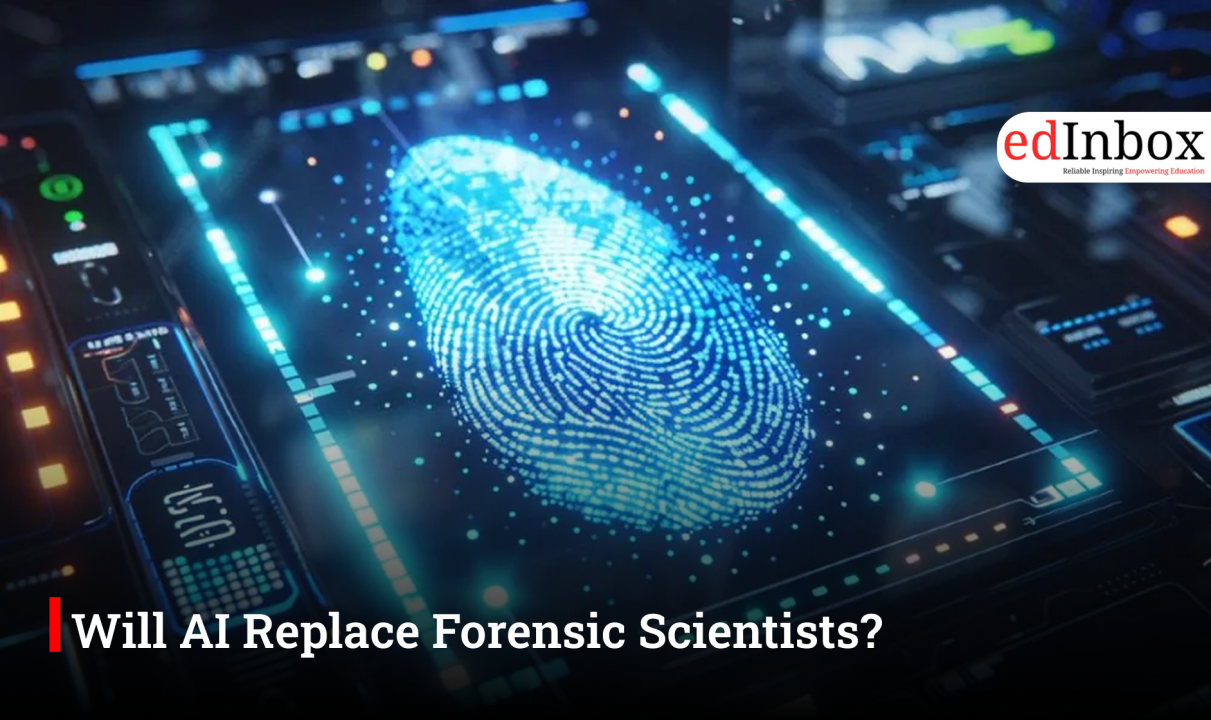
Will AI Replace Forensic Scientists?
Typography
- Smaller Small Medium Big Bigger
- Default Helvetica Segoe Georgia Times
- Reading Mode