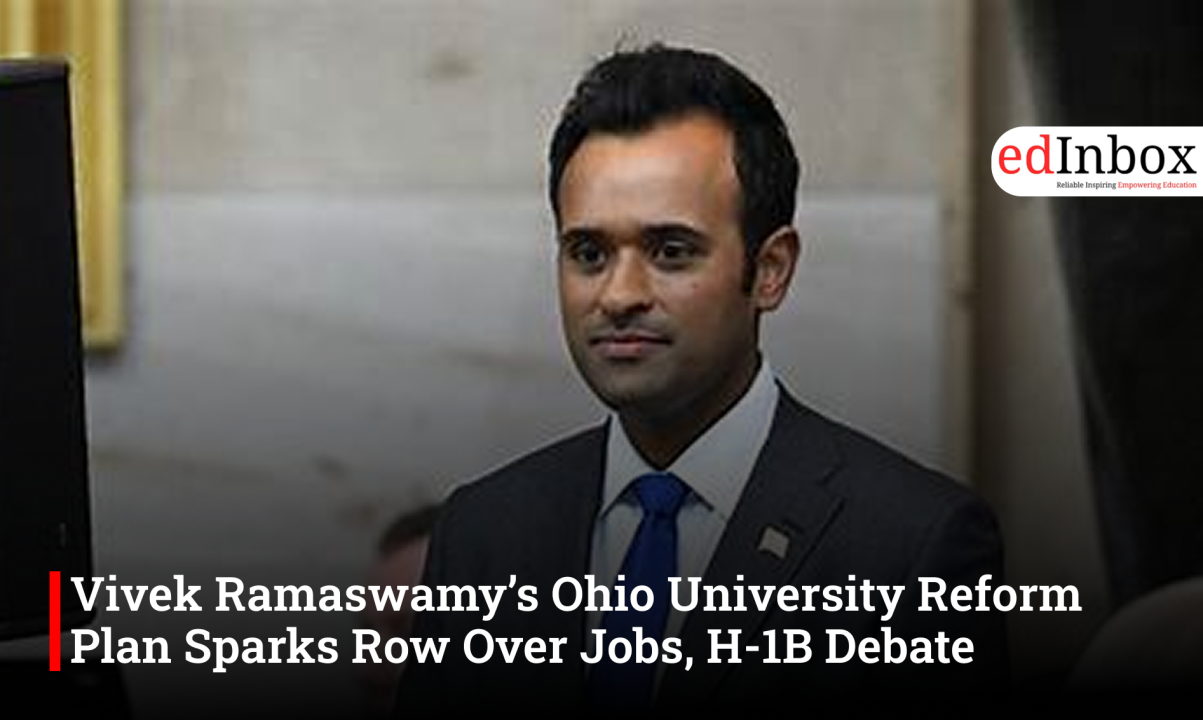
A political storm has erupted in Ohio after Vivek Ramaswamy proposed a sweeping overhaul of the state’s higher education system, with critics alleging that the plan could hurt local institutions and indirectly benefit foreign talent, including Indian professionals on H-1B visas.
The controversy began after social media posts accused Ramaswamy of wanting to “shut down” key public universities such as University of Akron, Kent State University, and Central State University. These claims suggested that restructuring could weaken Ohio’s domestic talent pipeline, reducing competition and opening doors for international workers. However, Ramaswamy’s original proposal does not explicitly call for closures.
In a column for The Columbus Dispatch, Ramaswamy contended that Ohio's public university system is too dispersed and financially in trouble. Besides 14 public universities, 24 regional campuses, and 22 community colleges, he argues that the resources are too thinly spread. Rather than closing schools, he suggested that smaller or less-enrolled campuses should be turned into specialised "centres of excellence" with a focus on their unique strengths to raise quality and efficiency.
Ohio's college enrollment has dropped from 59% in 2015 to 47.6% in 2021. The cost of public university tuition has risen nearly 50% over the past fifteen years, this trend is pushing students and the state toward financial strain. Ramaswamy warned that without change, the system could become unmanageable.
Conservative groups backing 'America First' policies have pushed back hard. They argue that shifting funding could hurt regional schools, leading to layoffs and fewer options for small-town students. The discussion has also been mixed with the larger issue of immigration, and some have associated the plan with fears of H-1B visas and competition in the global workforce.
The backlash is, in fact, a reflection of a deeper discord over US higher education policy - to what extent should efficiency and consolidation be prioritized at the expense of equity and access. On the one hand, specialisation may increase institutional competitiveness; on the other, it may isolate campuses that serve local populations.
The problem has taken on a new political dimension as Ramaswamy is running for the governor of Ohio, where education reform remains a major issue. The narrative has been further complicated by his Indian-American heritage, which critics have also used to mobilize the debate.
In the end, the dispute in higher education reforms - especially those regarding funding, demographics, and workforce development - is a good example of how quickly identity politics and global labor issues can get mixed in with such reforms.
Vivek Ramaswamy’s Ohio University Reform Plan Sparks Row Over Jobs, H-1B Debate
Typography
- Smaller Small Medium Big Bigger
- Default Helvetica Segoe Georgia Times
- Reading Mode