In an era when the media is undergoing a radical transformation with the entry of artificial intelligence and rapid digitization, Haribhau Bagde has drawn attention to the strengthening of journalism and mass communication education in India. He has also stressed that the media ethics, trust, and imprint should be the major distinguishing factors. While addressing the third convocation of Haridev Joshi University of Journalism and Mass Communication in Jaipur on 25th March 2026, the Governor laid down the point that media education should not only keep pace with the time but should retain its old values as well.
Pointing out the splendid and puissant legacy of journalism in India, Bagde spoke highly of the role of media in achieving independence and urged the educational institutions to include ethical training based on the freedom movement. For instance, the great and illustrious freedom fighter Ganesh Shankar Vidyarthi was a journalist who used the medium as a tool against the colonial power and so, his legacy is worth mentioning too. Besides imparting digital skills to the students, the syllabus must also inculcate a sense of commitment to truth and public service which were the defining principles of journalism during India's independence struggle, Bagde explained.
Journalism, according to Devnani, was akin to a "mission", rather than a mere profession. He has corroborated Bagde's stance on the necessity for a code of ethics for journalists as being their "mission". Devnani has compared the journalism to a "mission" rather than as a profession. Besides this, he had a serious word of caution for the journalists about the ever-increasing spread of misinformation in the times of AI. Therefore, he urged the young journalists to put a premium on accuracy even if it means compromising on speed. Besides this, Devnani pointed out the significance of highlighting regional languages to make sure that there is a multicultural and inclusive-type of storytelling involving India's different languages well represented in the media landscape.
He announced that viral but fake content should not be given free rein and that fair, responsible journalism that builds a nation is the way forward. This convocation was a very important academic moment as 271 students of the 2024-25 batch were conferred their degrees - undergraduates, postgraduates, and doctoral candidates. Twelve gold medals and 35 merit certificates were awarded to the top performers. V-C Nand Kishore Pandey spoke about the university's initiative to gear students with industry-standard, hands-on media skills. He talked about the blend of hands-on learning with the demands of the new-age technologies like mobile journalism and AI tools without diluting journalistic principles.
The Education Policy 2020, a national document, is being reflected in the Governor's comments as it stresses vocational training, digital skills, and the exposure to the latest trends. As media houses are increasingly going digital, journalism colleges will have to change. However, it is not their ethics that should be compromised as it is a point of no return. The urge for fresher tools is there on an increasing scale, and so is the urge for untainted, honest reporting.
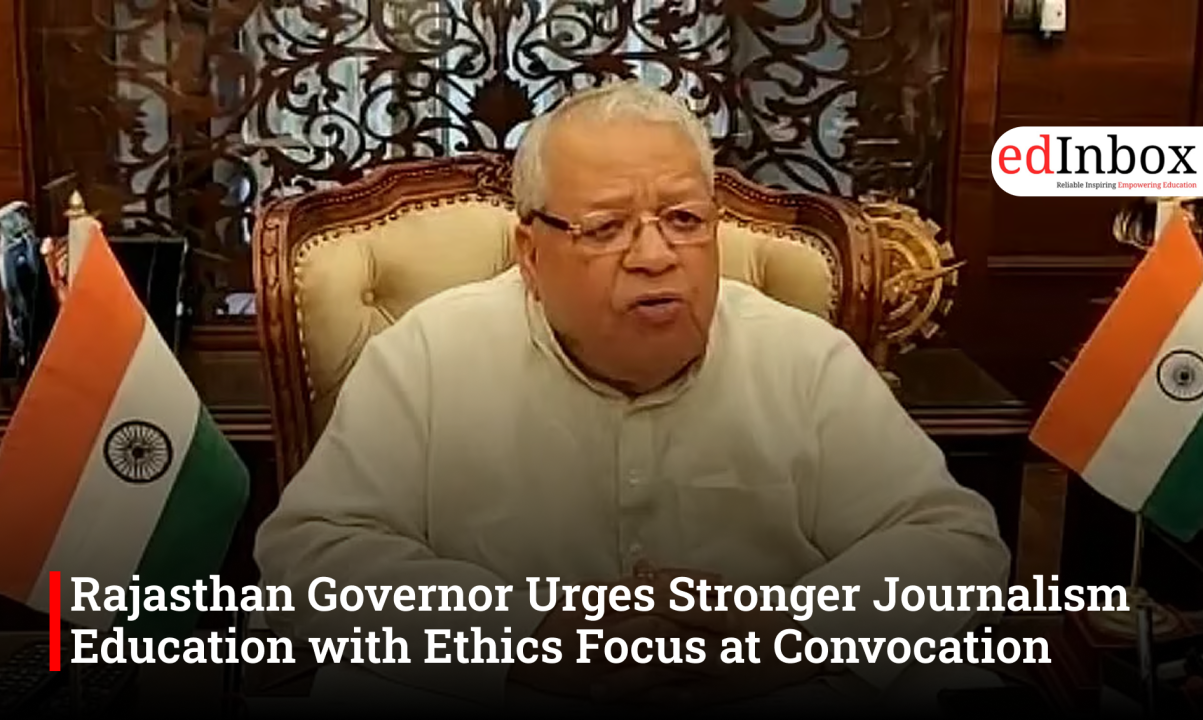
Rajasthan Governor Urges Stronger Journalism Education with Ethics Focus at Convocation
Typography
- Smaller Small Medium Big Bigger
- Default Helvetica Segoe Georgia Times
- Reading Mode