Humans have a stubborn, persistent habit of turning simple ideas into elaborate labyrinths, and nowhere is this more costly than inside a classroom.
There is a certain kind of teacher who is brilliant, well-meaning, thoroughly educated, who will spend forty-five minutes explaining a concept that could have landed in four. They draw diagrams. They reference literature. They introduce sub-frameworks to clarify the framework they just introduced. By the end of it, the students are more lost than when they walked in, and the teacher walks out feeling they've done excellent work. This is not a failure of intelligence, no, it is a failure of a deeply human instinct: the compulsive need to make things complicated.
We do it everywhere, in boardrooms, legal contracts, government forms, software interfaces, medical instructions. But education is where this habit does its most lasting damage. Because when a child leaves a classroom more confused than they entered, they don't blame the complexity. They blame themselves. They quietly decide that they are simply not the kind of person who understands. That conclusion, silent, personal, often permanent, is the real cost of our obsession with complexity.
Complexity Doesn't Mean Intelligence. It Never Did.
There's a status game hiding inside educational complexity, and it has been there for a long time. Academic writing is celebrated for its density. Lectures are praised for their depth, which often just means their inaccessibility. Teachers who simplify are sometimes accused of dumbing down. Teachers who are obscure are quietly assumed to be serious.
But complexity in teaching is not a virtue. It is more often a disguise, for incomplete understanding, for unwillingness to do the harder work of clarity, or for a social system that rewards credential-holders for keeping knowledge difficult to reach. Think about how mathematics gets taught in most secondary schools. The syllabus begins with rules, exceptions, formulas, and notation. Before a student is ever shown what a problem looks like in the real world, they've been buried under layers of abstraction.
Why do Literature Lovers Hate Maths?
Mathematics has become a ritual of memorisation rather than a language for thinking. Yes, maths was always a language of the universe that we made into a mugged up showpiece in our cognitive system (brain)! The students who thrive are the ones who can tolerate ambiguity long enough to eventually find elegance. The rest quietly conclude that mathematics simply isn't for them. This is not inevitable. It is a design choice, and a poor one.
Ever thought why literature loving people hate maths even when literature is much more complex than a universal formula? This is because they were told to learn it by heart and not actually taught. These people are nowhere less capable, they are just under explained.
The Jargon Trap
Every academic discipline has one. A vocabulary so specialised that it functions less as a tool for precision and more as a bouncer at the door. Jargon, when used correctly, is efficient, a surgeon and a nurse communicating in clinical shorthand makes sense because they share context. But in a classroom, where the entire point is to bring someone from not-knowing to knowing, jargon is usually a barrier dressed up as rigour.
Watch what happens when you explain photosynthesis to a seven-year-old using scientific language versus when you say: "plants eat sunlight the way we eat food." One produces understanding. The other produces a vocabulary word that disappears by Thursday.
The strange part is that we know this. Cognitive load theory, developed by educational psychologist John Sweller in the late 1980s and extensively validated since, has been telling us for decades that working memory is limited, and that overloading it with unfamiliar terms and excessive abstraction actively prevents learning. A 2023 review in Educational Psychology Review confirmed what we've known for years that the simpler you keep a new concept, the better students learn it. This isn't hidden knowledge. It's part of teacher training worldwide. And yet, the moment those same teachers get their own classrooms, they bury students in exactly the kind of complexity the research told them not to.
Why We Do It Anyway
Humans are weird creatures, we make things complicated because simple things are harder to respect. We live in a culture that confuses length with depth, complexity with intelligence, opacity with authority. A one-page explanation feels slight. A forty-page report feels substantial. Never mind that the forty-page version could almost certainly be eighteen pages without losing anything except the filler that made its author feel thorough.
The best example here is of Indian literature. Let’s specifically take Charaka Samhita, this is the book of internal medicine, it has all the info about what herb to take, how to take, when to take, in just a few lines each! Yes, no deep explanation to make it lengthy, instead it was the gurus who explained it in detail. What was once the ideal way of learning, soon became the worst because of the influence of invaders.
In education today, there is the added weight of institutional tradition. The lecture format has barely changed in five hundred years. Examinations still, in many systems, reward the performance of memorised complexity over demonstrated understanding. A student who can regurgitate a twelve-step economic model word-for-word will outscore a student who genuinely understands supply and demand but expresses it plainly. Remember that ‘zip scene’ from 3 Idiots? That’s exactly what we are pointing at.
There is also something almost psychological at play. When a person has spent years mastering something difficult, simplifying it feels like a betrayal of that effort. If it was hard to learn, surely it should be hard to teach. This is what psychologists call the "curse of knowledge", a term coined by Colin Camerer, George Loewenstein, and Martin Weber in a 1989 paper in the Journal of Political Economy, and later popularised by Chip and Dan Heath in “Made to Stick.’ Once you understand something deeply, you genuinely forget what it felt like not to know. Teachers who haven't revisited foundational material in years are often the least equipped to explain it to beginners, because they have forgotten the fog.
What Simplicity Actually Demands
Simplicity is not easy. A poet can tell the whole story in a few stanzas while a writer writes volumes to express that one feeling. Here it's not about comparing the two talents, it’s just an example of how difficult it is to simplify things but how easy it is to neglect simple things. That deserves its own sentence, because it is the most persistently misunderstood thing about good teaching.
Making something genuinely, usefully simple without stripping out what matters, is a sophisticated intellectual act. It requires understanding the material so thoroughly that you know which parts are load-bearing and which are decoration. It demands that you care more about the learner's understanding than about boasting your own depth.
Great teachers who changed how you thought about something,almost certainly made it feel possible. They met you where you were. That gift turns out to be mostly just effort and humility wearing the same coat.Those teachers weren’t great because they had the knowledge, but because they understood you to make you understand.
Why Understanding this Becomes Essential
It’s undoubtedly tempting to be the most educated and knowledgeable person in the room, which makes any human choose the complex path.
A population systematically taught to feel that knowledge is inaccessible, that only certain minds can grasp certain ideas, is a population with a reduced capacity for curiosity, critical thinking, and civic participation. When people believe economics is "too complicated" for them, they disengage from economic policy. When they believe science belongs to scientists, they disengage from science. That disengagement has consequences that compound over decades.
The gatekeeping of knowledge through complexity has never been neutral. It has always benefited some groups and disadvantaged others. Students with the most cultural capital, the most books at home, the most access to additional explanation outside school, they survive the fog and emerge on the other side. Everyone else concludes, very sensibly from their experience, that certain kinds of knowledge are not for them. Research from the Education Endowment Foundation consistently finds that disadvantaged pupils are disproportionately harmed by poor instructional clarity, gaps in attainment that widen precisely where explanations fail.
A Different Kind of Ambition
There is a version of educational ambition that says: I will teach you everything I know in all its complexity, and your job is to keep up. The most common method of teaching has existed since ages. The system excludes most individuals from its educational pathways.
A different ambition asks: what does this person actually need to understand, and what is the clearest path there? It asks the teacher to do more work so the learner can do less unnecessary work. It measures success by depth of understanding retained, not quantity of content delivered. It is more demanding, and more honest.
Some schools are already doing this. Curriculum redesigns need to start from essential questions instead of using content lists as their foundation. Assessment systems should provide greater value to students who demonstrate their understanding through detailed explanations than to students who present memorized material. Teachers need to acquire skills in both instructional design and subject matter expertise. These actions should not be seen as radical experiments. The solutions exist because they directly address evidence which has been established throughout multiple generations.
The Brutal Picture of Romanticizing Complexity
Humans complicate things for many reasons. A teacher presents too much information because his enthusiasm for the subject matter reaches such high levels that he cannot stop teaching. A person uses complex explanations to protect himself from unwanted questions about his beliefs. A student who learned from me now believes that I must teach him according to my own teaching methods. We should recognize that people who judge other people based on knowledge tests establish barriers which protect their exclusive understanding.
Education is the field where all human behavior patterns meet their most critical outcomes. The children in those rooms remain open to reaching the conclusion that their lack of understanding shows their personal shortcomings. Students still do not understand that their problems arise from three areas: teachers, textbooks, and educational systems. Students believe that their confusion represents personal deficiencies. Students who experience personal failure throughout their lives will develop an identity based on their lost opportunities.
We owe them better. We owe them teachers who have done the hard work of simplification. The curriculum needs to be designed to achieve understanding through learning activities instead of focusing on content delivery. The educational system should create incentives that both serve as rewards for clear communication and which prevent romanticizing complexity. People should acknowledge that confusion arises because students struggle to understand. It’s not the student, it’s the explanation at fault.
Not convinced? Come on, you have given exams by studying from youtube because you didn’t understand anything in class. That’s the simplest summary of this article.
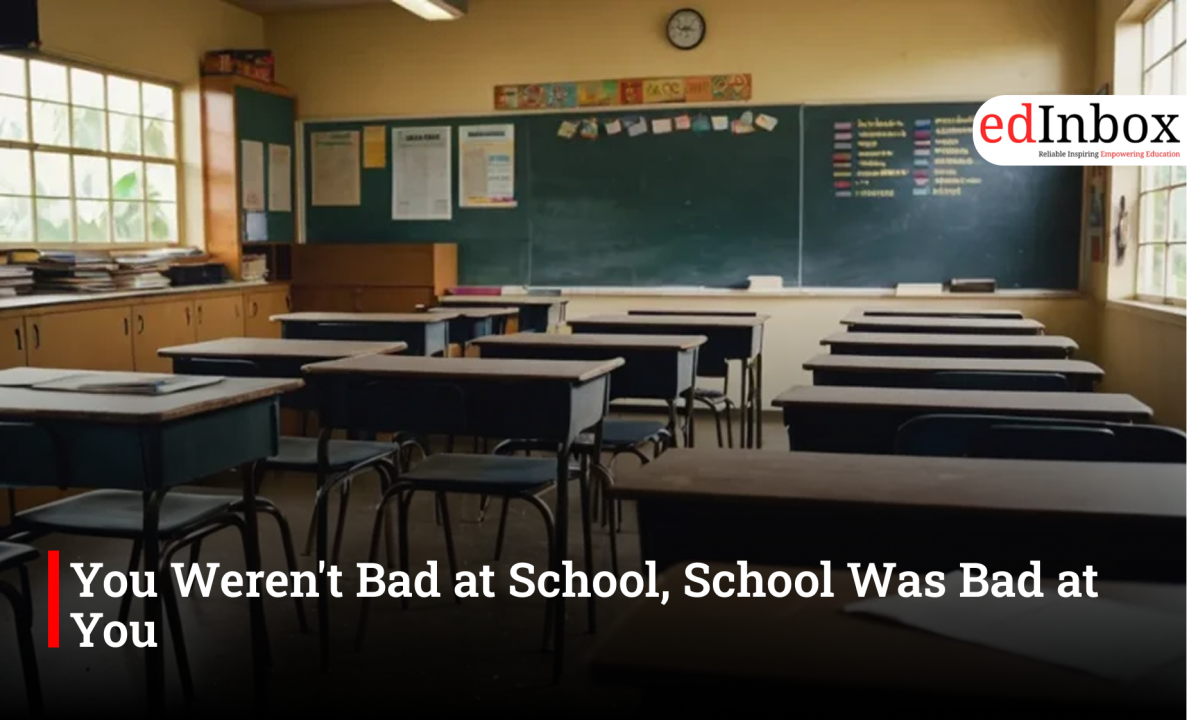
You Weren't Bad at School, School Was Bad at You
Typography
- Smaller Small Medium Big Bigger
- Default Helvetica Segoe Georgia Times
- Reading Mode